JAP | ENG
Shanghai, Suzhou #1/6
1985
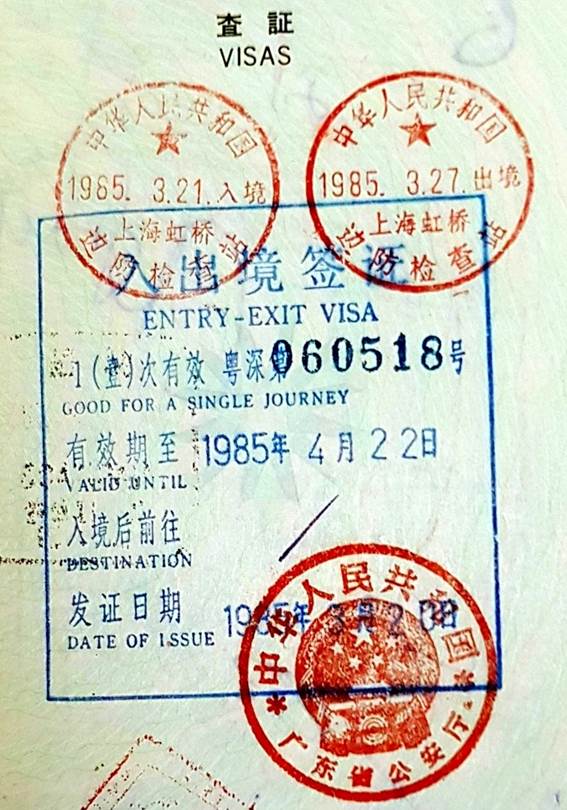
Shanghai, China for the first visit
I was invited to visit Shanghai by a wealthy overseas Chinese who had previously gave me the opportunity to design luxury condominiums in Singapore.
This was my first visit to Shanghai since I had gazed at the forbidden China from afar, before its liberation, across the strait from Macau in 1978.
This was seven years after the Treaty of Peace and Friendship between Japan and the People’s Republic of China was signed.
Entry visa in Hong Kong
In 1985, Suharto’s government in Indonesia severely restricted travel to China for the own citizen by political reasons. In Singapore, due to the reluctance to visit China by neighbouring Indonesia, Singapore’s citizens also need permission to leave the country to travel to China.
It was a time when restrictions were in place. At that time, China’s GDP was less than one-third of Japan’s, and it still remained poor, and in any case, there were not many travelers to China.
Naturally, there are no direct flights from Southeast Asia to Shanghai. The Hong Kong transit was the only route.
After spending a few nights in Hong Kong, I was issued a one-month visa by the Guangdong Provincial Public Security Bureau, which is a Chinese agency, and arrived in Shanghai on March 21 and returned to Narita on March 27, 1985.
Shanghai Airport
I arrived at Shanghai Airport (now Hongqiao Airport).
The sign only says “Shanghai”. The airport was deserted for international flights.
Only one Japan Airlines TriStar plane was lying on the air bridge.
This three-engine jetliner developed by Lockheed in the United States was the star of the time, and was often flown between Tokyo, Hong Kong, and Singapore. In 1999, Shanghai Pudong International Airport opened, which is now Shanghai Hongqiao International Airport.
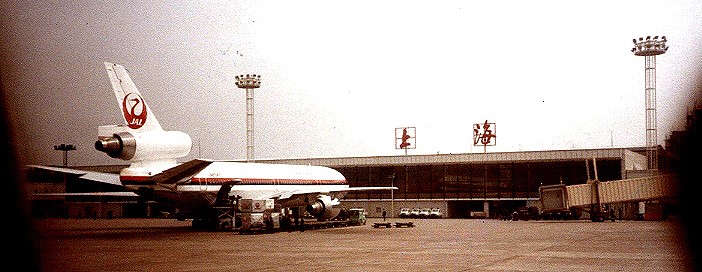
Photo by author, 1985
Immigration
As for the immigration process in Shanghai, it reminded me of Bangkok under martial law and South Korea under military rule.
I had expected to see People’s Liberation Army soldiers swarming about, like the tense Khabarovsk airport in the same communist country I experienced in 1968, but it was surprisingly peaceful and not intimidating.
Entering and leaving China was surprisingly smooth, perhaps due to the small number of visitors.
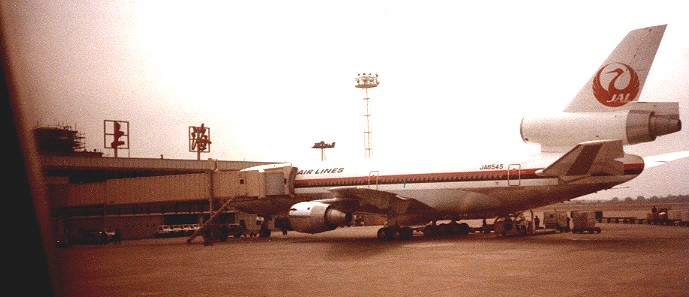
There is only one JAL aircraft on the tarmac!
Photo by author, 1985
Fossil-like remains of Shanghai’s former concession
It is said that the former concession of Shanghai before the war was full of all kinds of modern things, and anyone could directly enjoy American culture such as Hollywood movies and jazz, and French culture such as cafes on the terrace.
According to sources, in June 1928, the capital of the Republic of China was moved from Beijing to Nanjing, and the city of Shanghai reached the height of its prosperity with the new capital just around the corner.
With the end of the Chinese Civil War and the establishment of the People’s Republic of China on October 1, 1949, the history of the concession city of Shanghai came to an end, and hundreds of thousands of capitalists, members of secret societies, cultural figures, engineers, and skilled workers moved to Hong Kong.
After that, the former concession city of Shanghai was forced to pay its profits to the central government and was unable to make new investments until the end of the 1980s. The townscape has become a slum due to the pressure of population growth.
I think it is fortunate that we can observe the cityscape that was the height of Shanghai in the 1930s, even in 1985, as it is 50 years later.
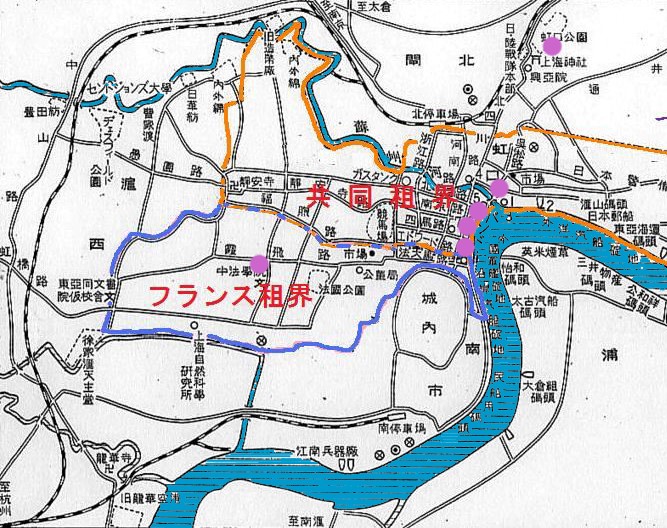
Pre-war Shanghai Concession Map
Stay at the fossil-like Jinjiang Hotel
The main building of the historic “Old Jinjiang Hotel” is the Cathay Mansion, built in 1929 in the British Gothic style.
The other building is the Grosvenor Mansion, built in 1934 with a beautiful Art Deco lobby. Both buildings exude the scent of the good old days of the concession era.
Both buildings were built by the Jewish Sassoon family.
On the large site next door, the Okura Garden Hotel, a Japan-owned Hanazono Hanten (Okura Garden Hotel), is under construction by a major Japan construction company.
It is Shanghai’s first foreign-funded hotel project.
It will be the catalyst for a new Shanghai.
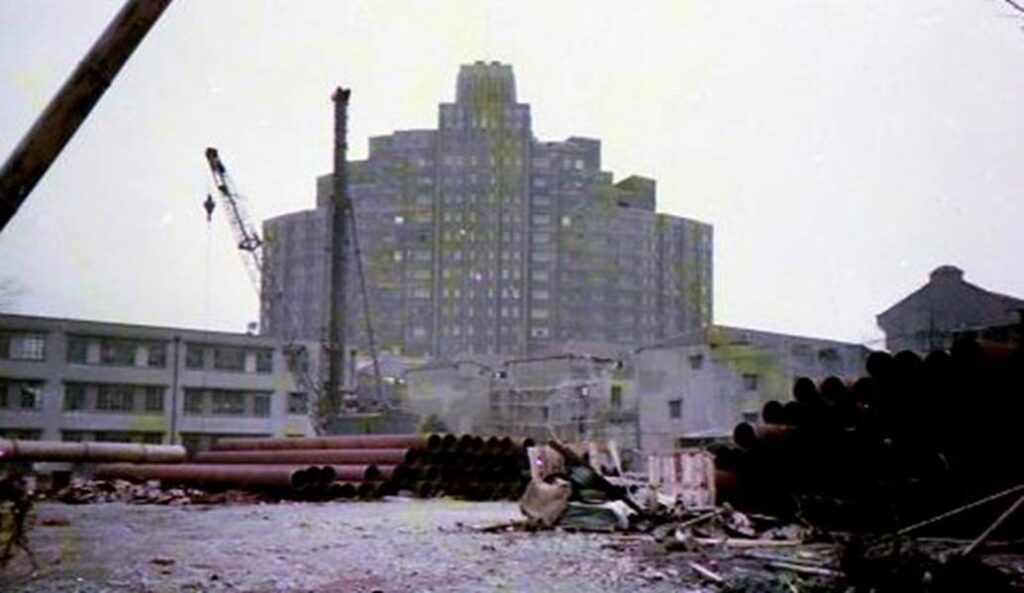
Construction site of Kinko Hotel and Okura Garden Hotel
Photo by author, 1985
Grosvenor Mansion (Jinjiang hotel VIP building)
The building has a solid façade covered in decorative bricks, with no ornamentation. It exudes a sense of history and dignity, and exudes a very sophisticated and calm appearance.
As I later learned, British Prime Minister Margaret Thatcher, U.S. President Reagan and Cuba’s Fidelo Castro also stayed at the palace.
Prime Minister Kakuei Tanaka, who visited China in 1972 to restore diplomatic relations between Japan and China, also stayed at the guest house.
I had no idea that such a super VIP was staying there, and I shared a room with a friend in this VIP building with a huge bathroom for four nights.
However, the only hot water we got was lukewarm water during the few days we stayed there. On top of that, the heating was an old steam heater, so the room didn’t get warm enough, and it was hard on my body during the cold Shanghai nights in March。
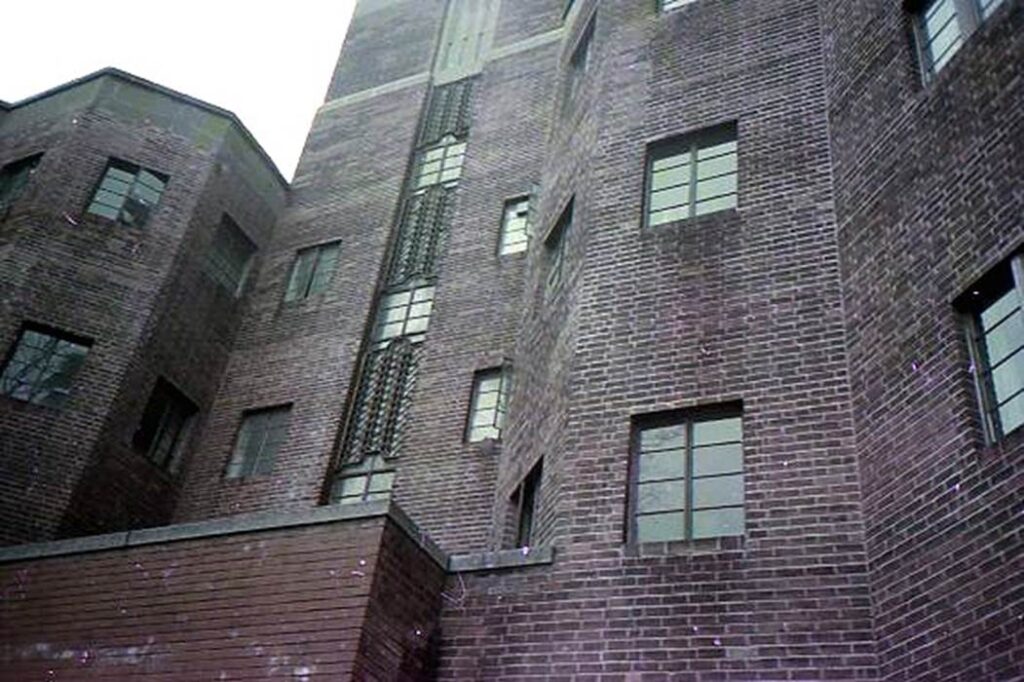
Photo by author, 1985
Jinjiang Hotel
Entrance on the first floor of the guest house.
Distinctive Art Deco doors.
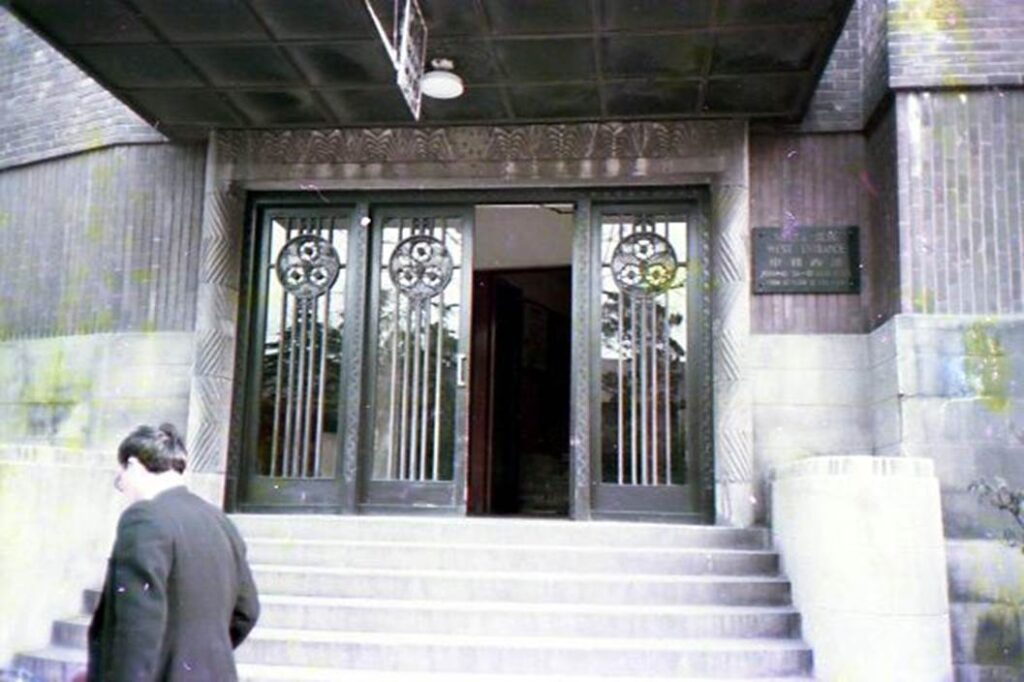
Photo by author, 1985
Cathey Mansions
Jinjiang North Tower. 13-storey former Cathay Mansion.
It was completed in 1929 by the Sassoon group.
It is an English Gothic style with an emphasis on vertical lines, and it can be seen that it must have been a very conspicuous building in Shanghai at that time.
Both were requisitioned by the Communist government after 1949。
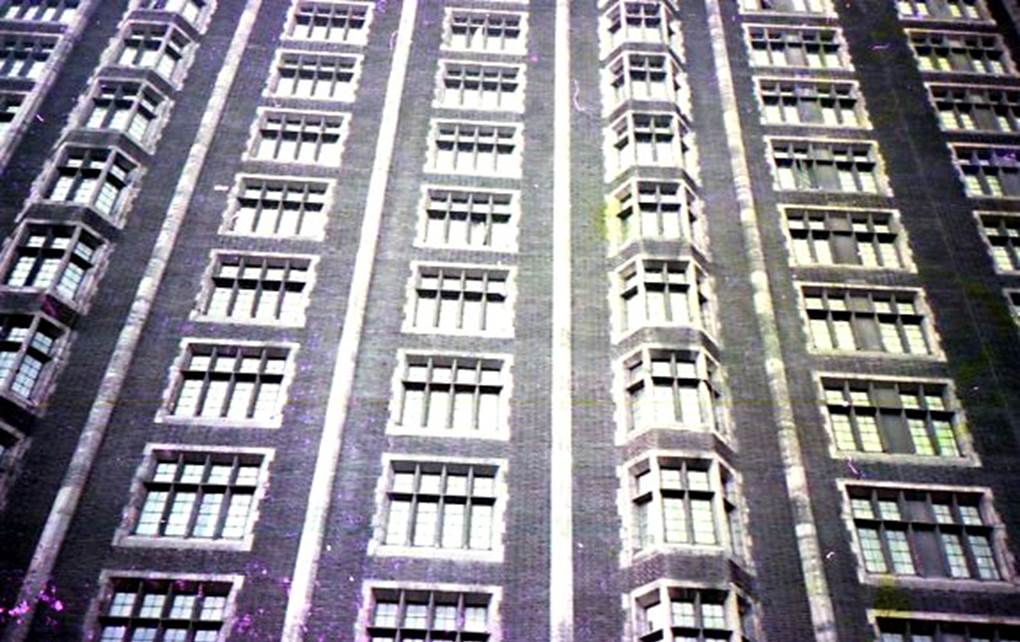
Photo by author, 1985
The only woman I found here wearing a cheongsam.
Most of the women you see on the street are dressed in the same pants as men, and you won’t see them wearing skirts, let alone cheongsam.
When I entered the Chinese restaurant on the top floor of Jinjiang Hanten, the captain who guided me was wearing a cheongsam.
At that time, this outfit, which was considered old-fashioned, was allowed only in the restaurant of this hotel as an exception.
Wearing cheongsam requires special permission.
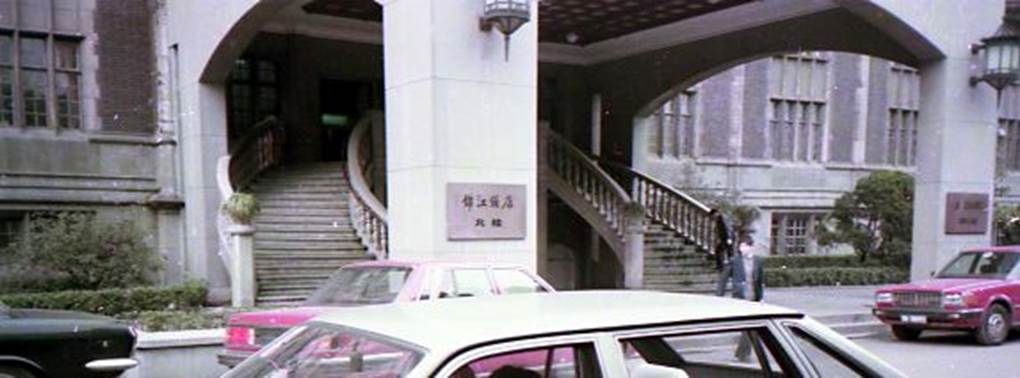
Jinjiang Hanten North Building 1st floor entrance.
Photo by author, 1985
The Bund of Shanghai
Beginning in 1845, after the end of the Opium Wars, the Western powers established a foreign settlement called the Concession in Shanghai, which was closer to the center of the mainland than Hong Kong, and which was not attracting much attention at the time.
The chaotic and liberal atmosphere of the concession later attracted not only businessmen and investors, but also criminals, refugees, and associations from all over China. Opium, gambling, and various other factors overlapped to create Shanghai, which was called the Demon City.
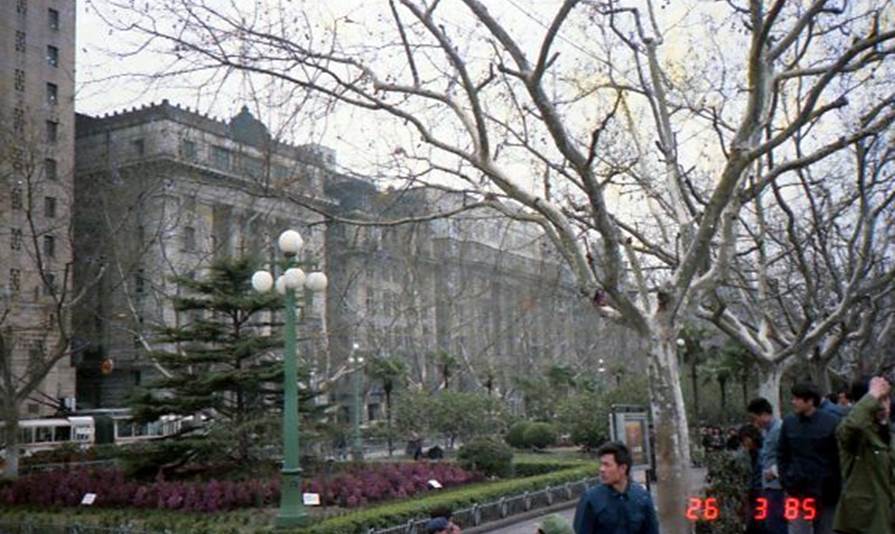
Photo by author, 1985
Morning on Zhongshan East Road
Facing the street are massive, imposing buildings built in the 1920s and 1930s, lined up tightly together like fossils, unchanged since their original construction, making for a spectacular street.
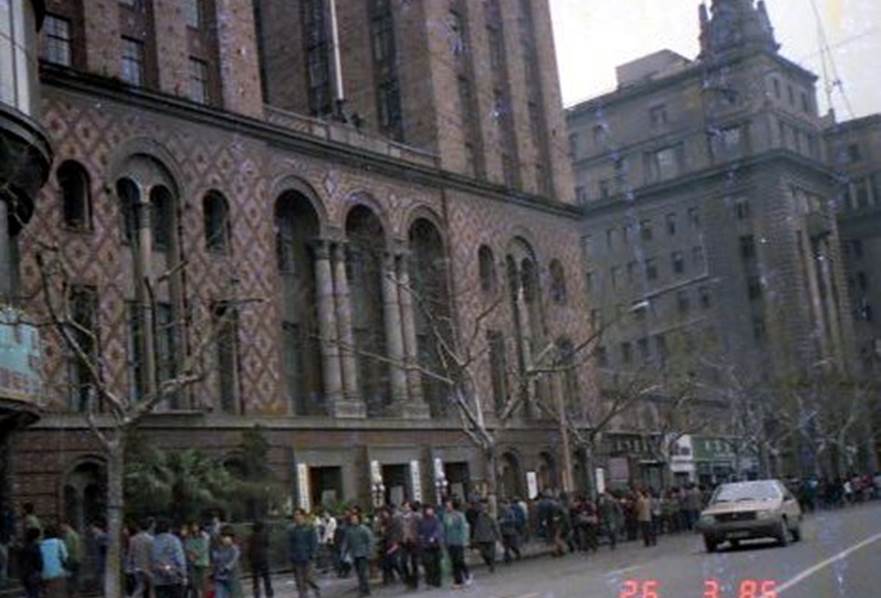
Photo by author, 1985
Balancing heavy loads on pole
On the main road, which is the main entrance to Shanghai, I met a group of people carrying balancing heavy baskets on long poles.
Behind the building, Shanghai’s first Hong Kong-funded office building is under construction.
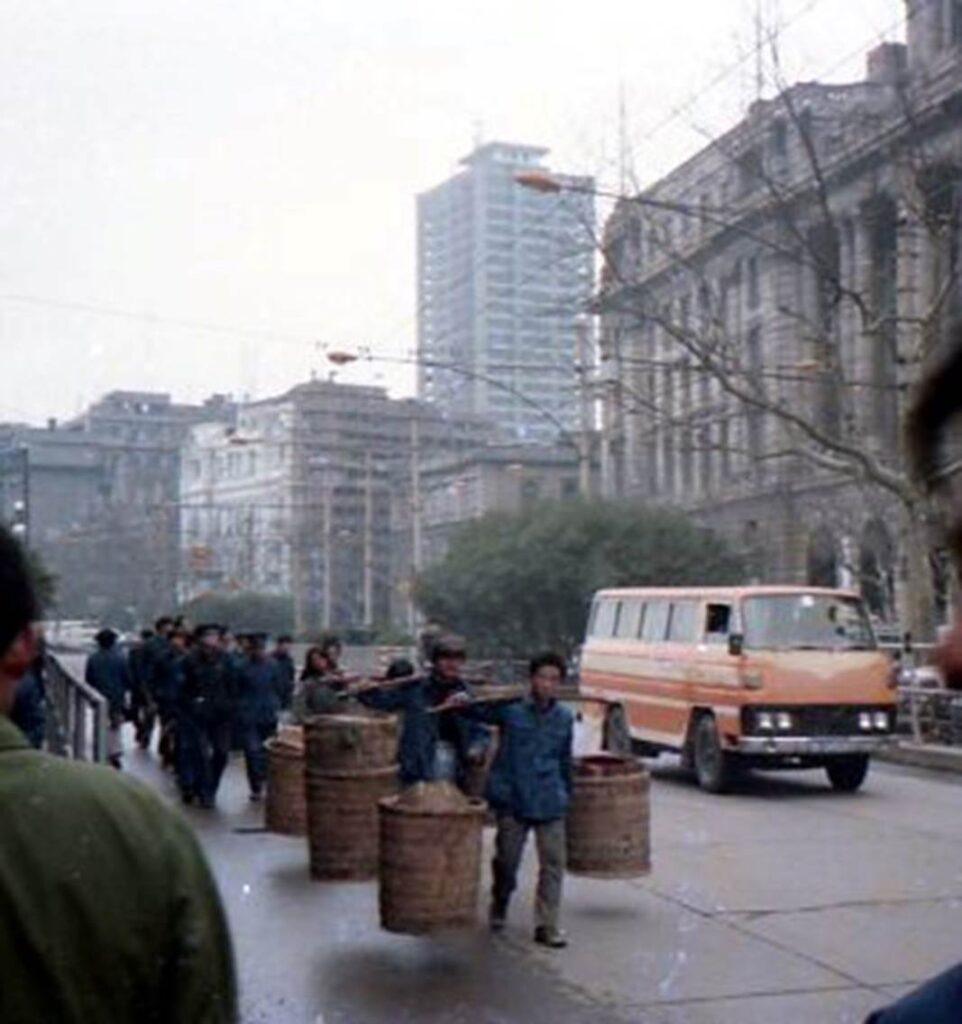
Photo by author, 1985
The neoclassical style Hongkong and Shanghai Banking Corporation head office was completed in 1923 at 12 The Bund, Shanghai, it became the Yokohama Specie Bank during the Japanese occupation, and in 1955 became the Shanghai Municipal People’s Government building.
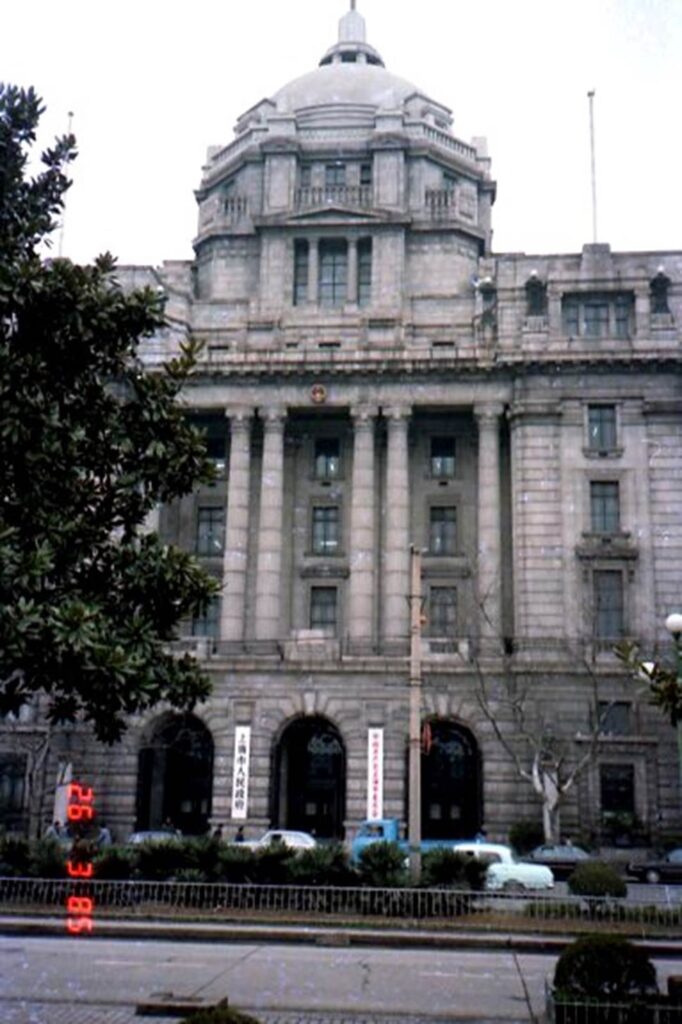
Former Yokohama Specie Bank
Photo by the author, 1985
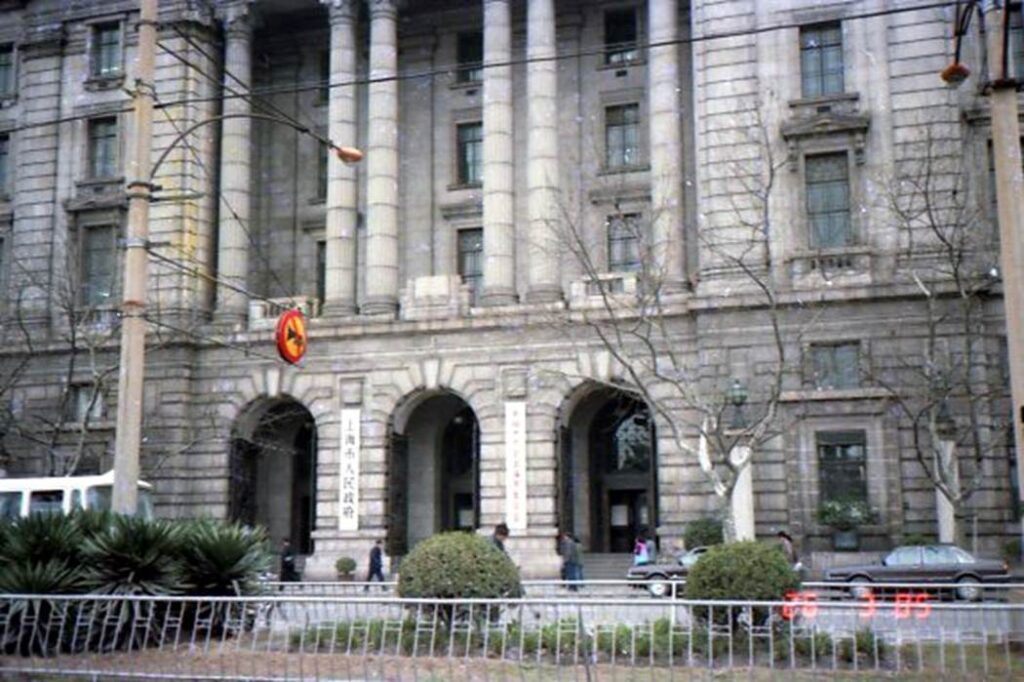
Former Yokohama Specie Bank
Photo by the author, 1985
1929 Golden Gate Hotel 1958 Overseas Chinese Hotel
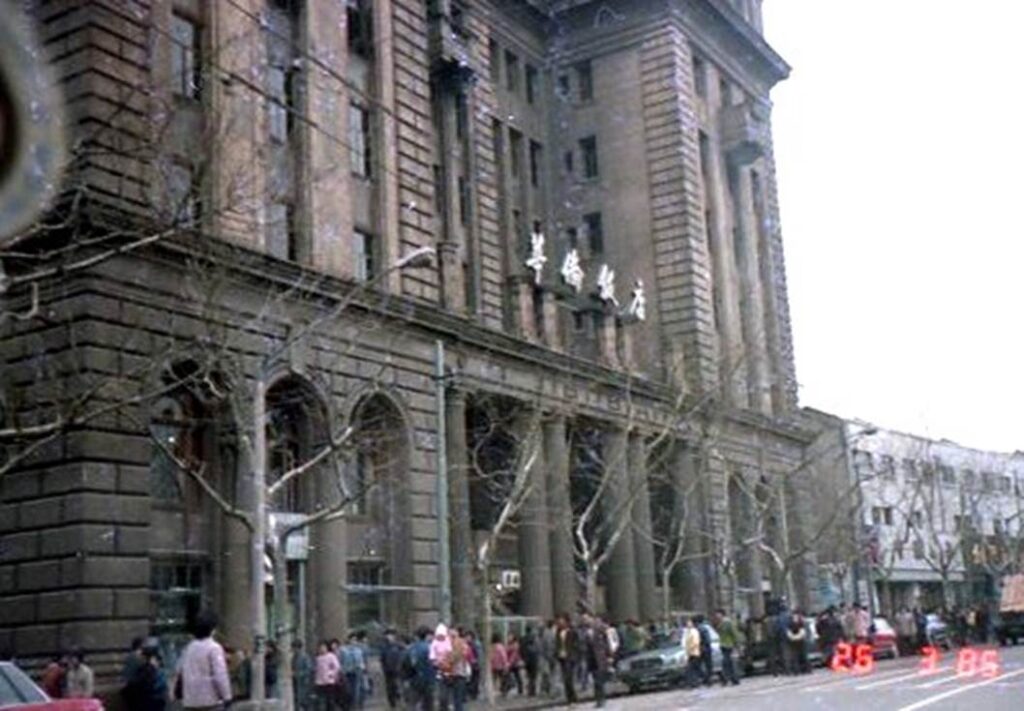
Photo by author, 1985
Nissin Grand Building, Zhongshan East 1st Road, 5 Former Nissin Kisen Building
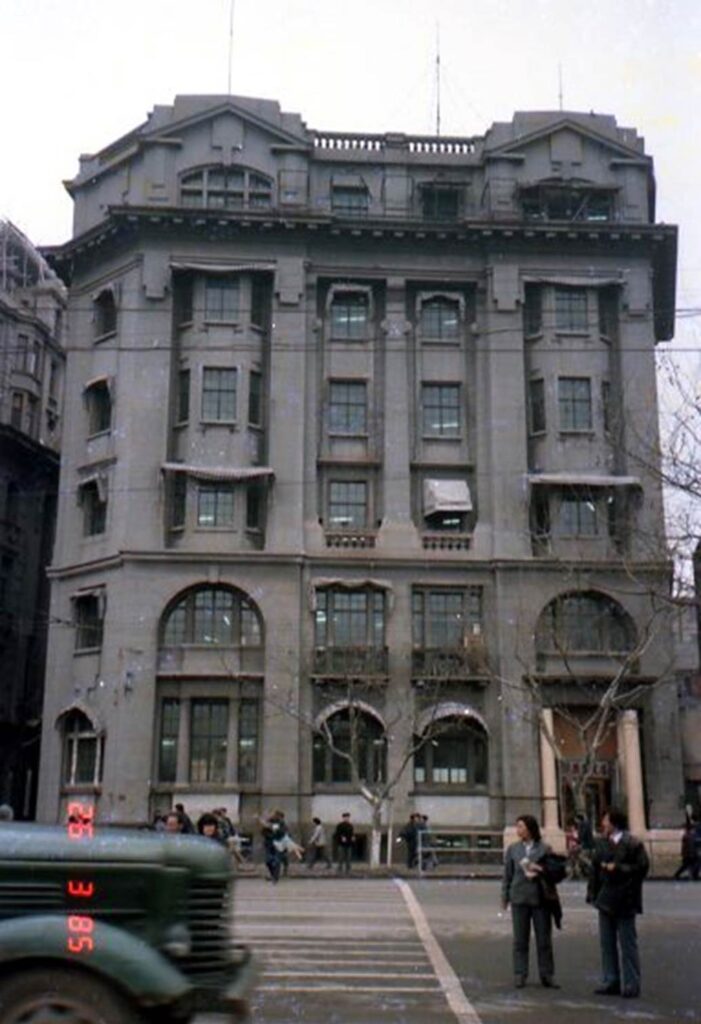
Photo by author, 1985
The Shanghai Customs
(Building was completed in 1927)
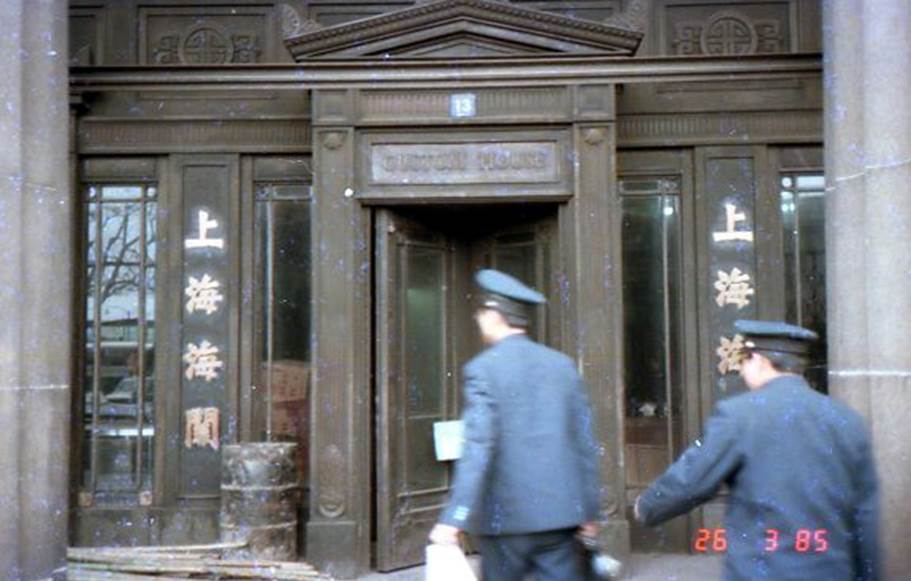
Photo by author, 1985
Urn on the promenade
The main entrance to Shanghai, the Bund (Zhongshan East 1st Road).
A wide 1.5 km amazing promenade along the Huangpu River.
It’s a leisurely walk. I noticed that there were pots placed at intervals of about 30m on the wonderful promenade.
Looking inside, I saw an incredible number of cigarette butts floating in the water. Most of the men were smokers, and with the yellow sand, many of them seemed to have sore throats….
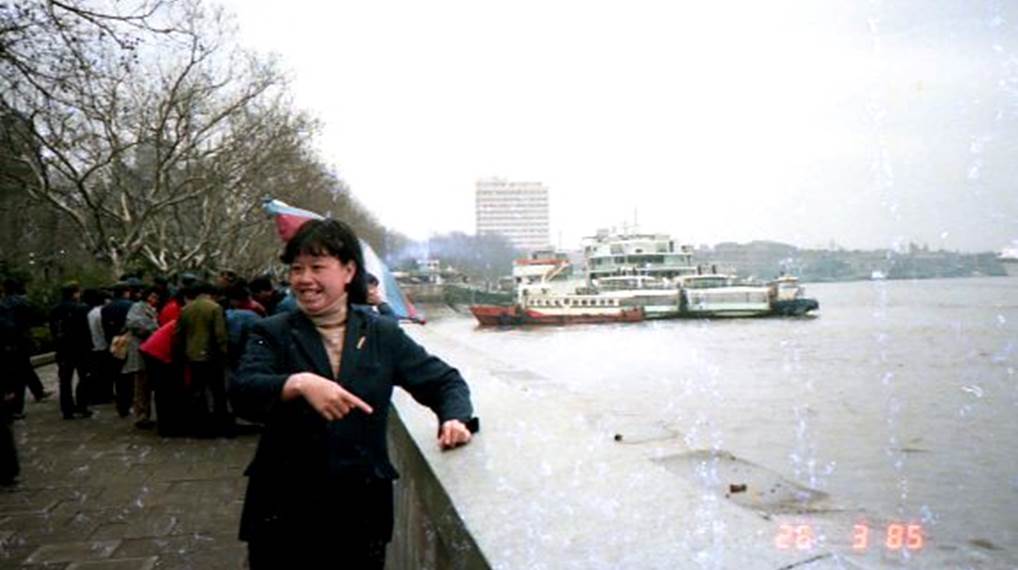
Photo by author, 1985
Heping Hotel (Peace hotel)
Along with Jinjiang Hotel, Heping Hotel is one of the two major hotels representing Shanghai.
It is located at the intersection of Zhongshan East Road, which is a financial district, and Nanjing East Road, which is a commercial and downtown area.
On the right, Heping Hanten North Tower, Old Sassoon House, Bund No. 20.
On the left, Heping Hotel South Tower, Old Palace Hotel Bund No. 19
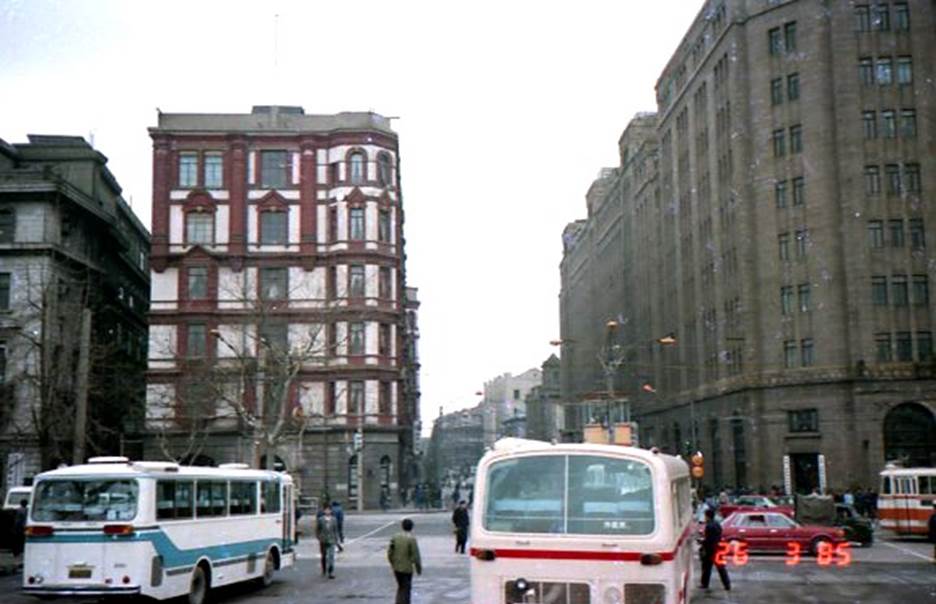
Left, South Building, Peace Hotel, Right, Peace Hotel, Nanjing East Road
Between the North Building of Heping Hotel and the South Building of Heping Hotel is Nanjing East Road, which forms the largest shopping street in Shanghai. Retro traffic police manual signal tower at a T-junction.
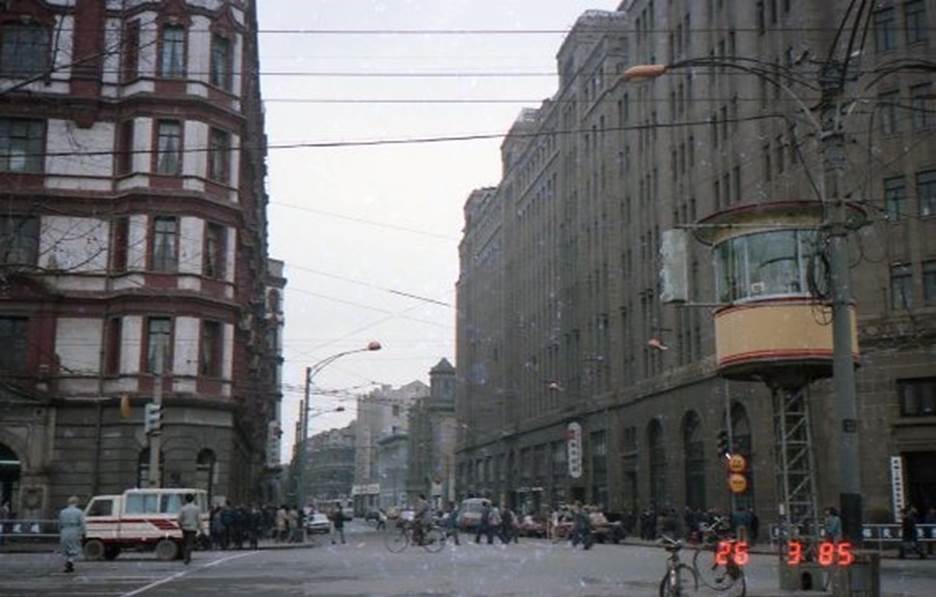
Photo by author, 1985
Left/HePing Hotel, Middle/Bank of China,
Right/former Yokohama Specie Bank
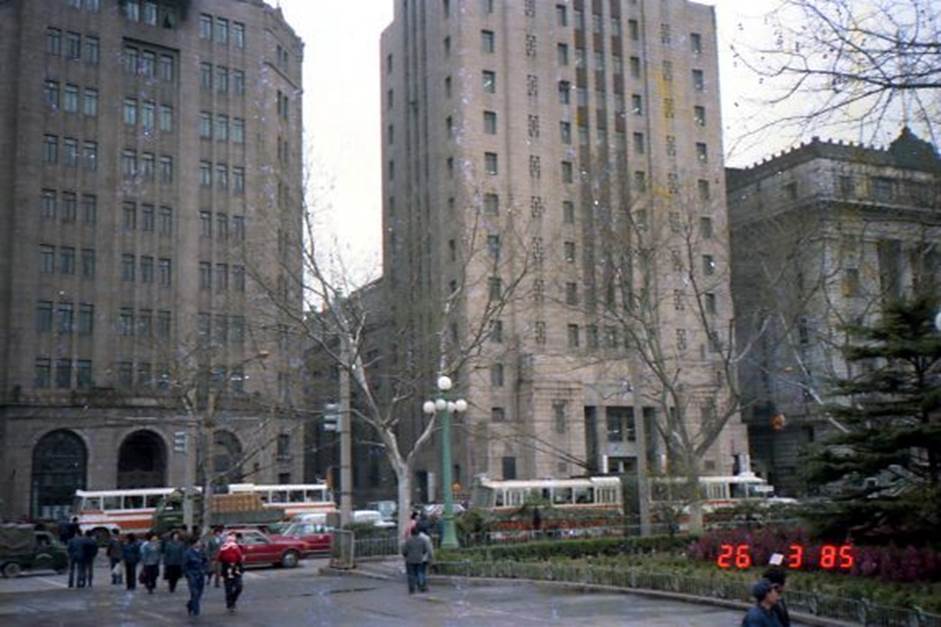
Photo by author, 1985
Heping Hotel South Tower facing Nanjing East Road
I learned that the jazz bar in this hotel is famous. As the name “OLD JAZZ BAR” suggests, they are all mature performers from before the 2nd world war.
The average age is 80 years old. Some of the members had been playing jazz since the 1940s, before the war.
After a turbulent history such as the war and the Cultural Revolution, the fact that they have continued to play jazz shows the spirit of passing on the culture of the Shanghainese people.
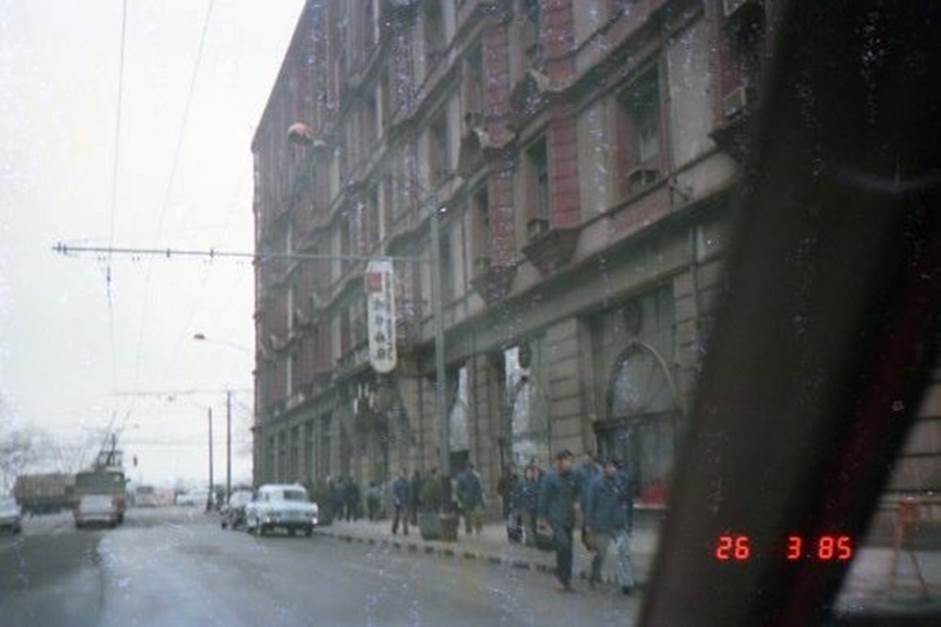
Photo by author, 1985
The main entrance of Heping Hotel South Building facing Nanjing East Road
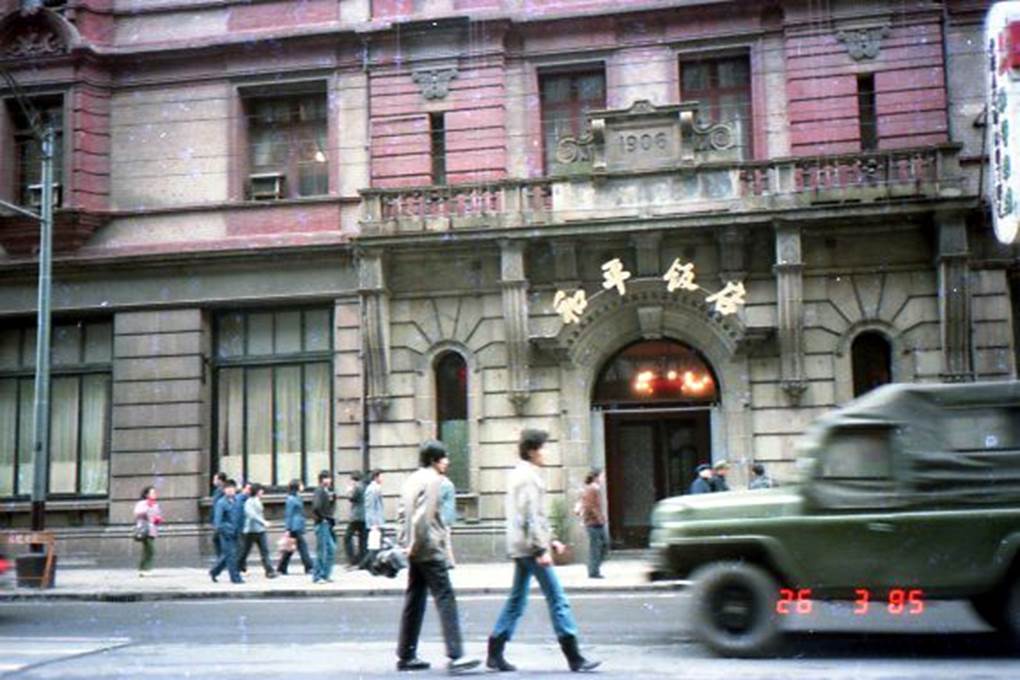
Photo by author, 1985
The window sill of the south tower of Heping Hanten.
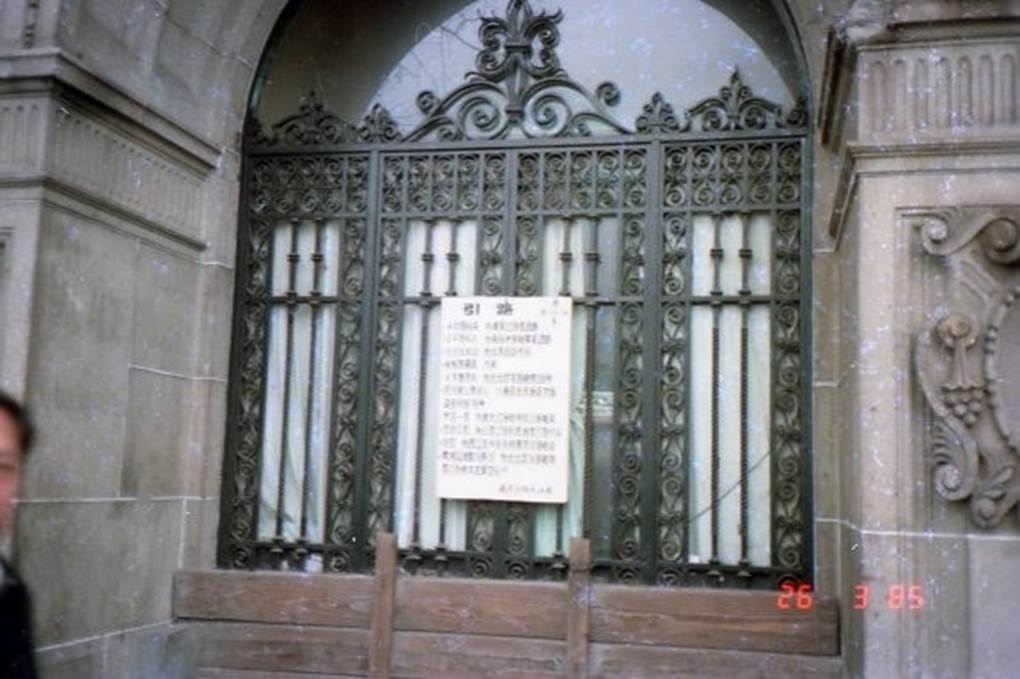
Photo by author, 1985
The façade of the South Tower of HePing Hotel
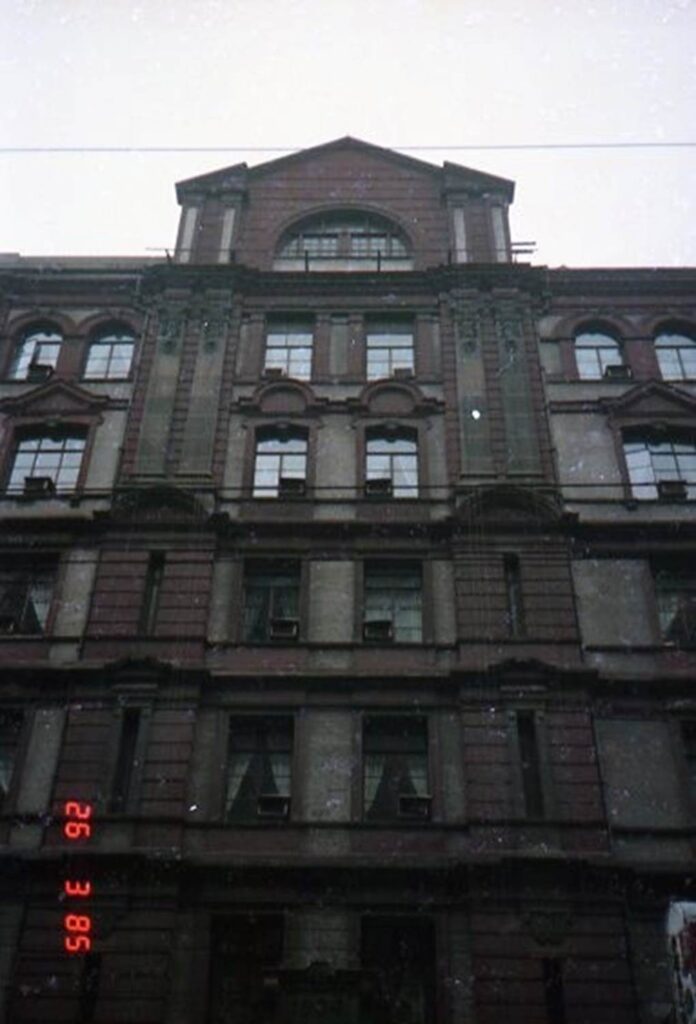
Photo by author, 1985
Internal View Reception
I didn’t stay at the South Tower of this Heping Hotel, but I was allowed to see the inside of the building.
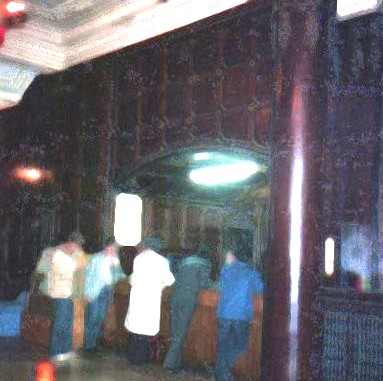
Photo by author, 1985
This elevator would have once been a manual bellows sliding door. The stainless steel in this part is shiny and makes you feel uncomfortable here
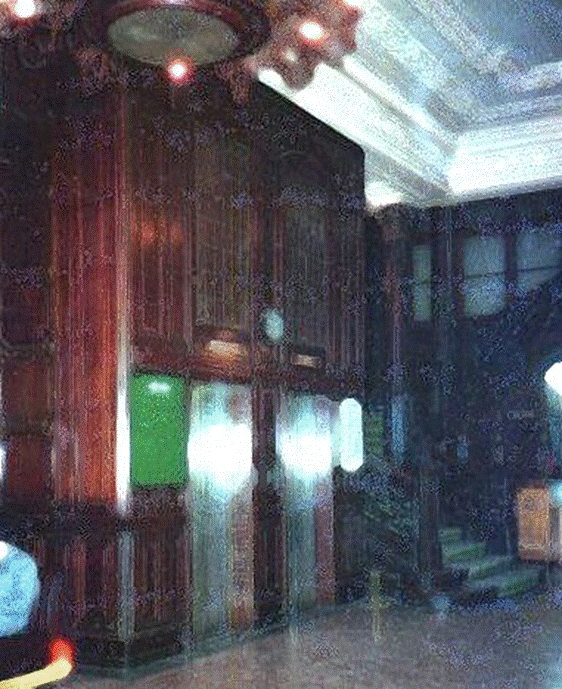
Lift Lobby, Photo by author, 1985
The stairs of the south tower of HePing Hotel.
The finest wood from 1920 is used, and the craftsmanship of Shanghai’s good times can be seen in the details.
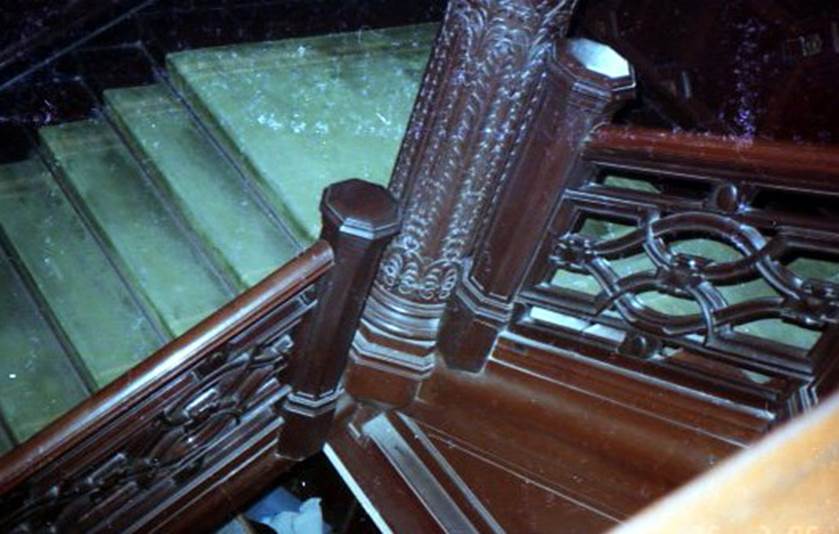
Photo by author, 1985
The hotel’s central corridors and the door frames of the guest rooms have been painted with multiple coats of varnish, giving them a lustrous black finish that gives a sense of age.
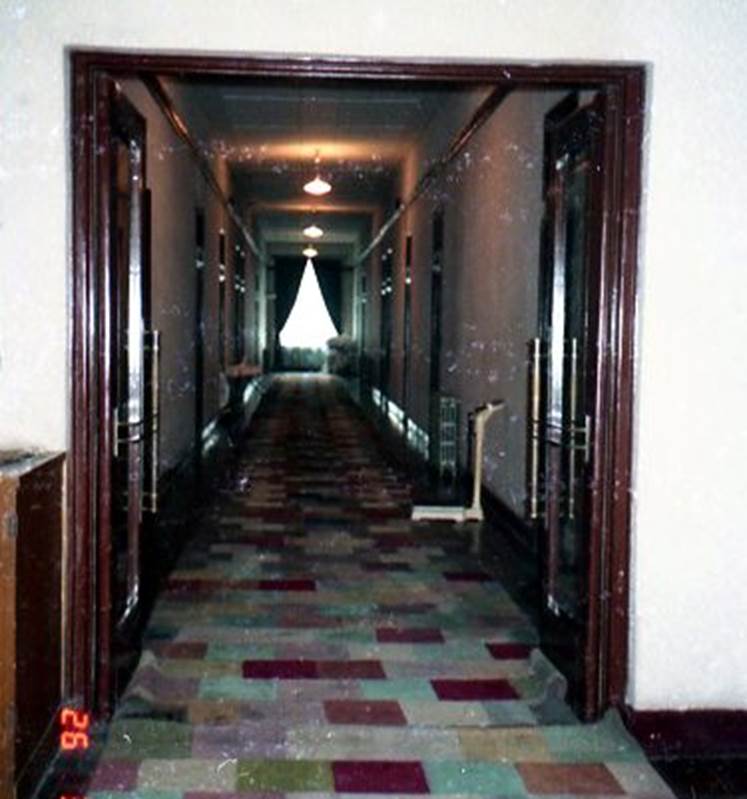
Photo by author, 1985
You can see the Huangpu River, which was once connected to the world, from the guest room of the Heping Hotel South Building. In contrast, the empty Pudong district on the opposite bank. Today’s Pudong district is home to a concentration of Shanghai’s skyscrapers.
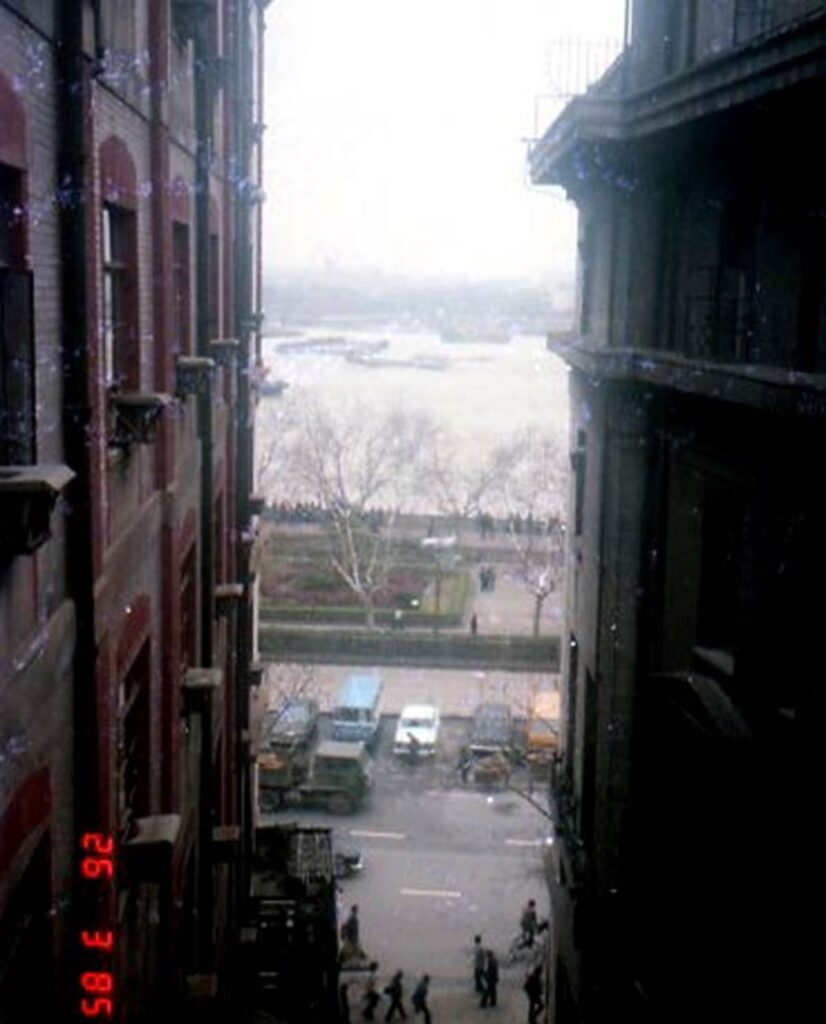
Photo by author, 1985
East Nanjing Road
Shanghai’s busiest commercial district. Photographed from Nanjing East Road, which is a downtown area, in the direction of Zhongshan East Road. At the end, you can see the north tower of the Heping Hotel and the bronze pointed hat roof of the former Sassoon House. (below)
This is a picture of Nanjing East Road, Shanghai’s busiest shopping district in 1985, when private cars were not seen. Bicycles and trolleybuses were the legs of the common people. Most of the restaurants and department stores facing the road were state-owned or public-owned, and there were no private services, and the cash registers threw change back to customers.
This photo was taken long before 1990, when Subway Line 2 (East-West Line) opened under this boulevard, connecting Hongqiao Airport with the new Pudong Airport, and the infrastructure was finally in place. (below)
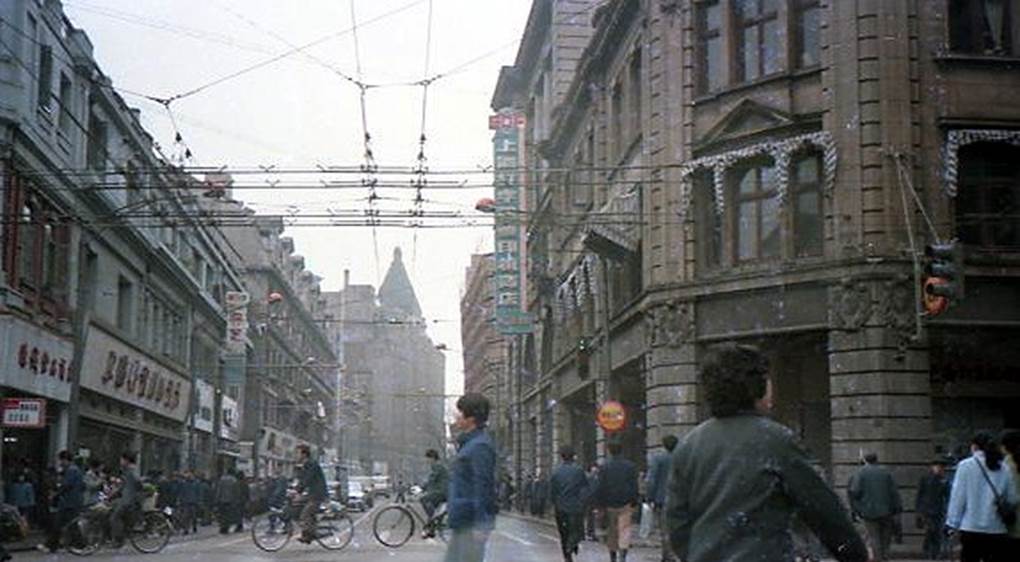
Photo by author, 26 Mar 1985
Photo by author, 26 March 1985
A crowd of people in Mao suits
People walking along Nanjing East Road, Shanghai’s main street.
Most of them are wearing Mao suits. No cars in sight.
In the distance, a trolley bus, the everyday life of the common people.
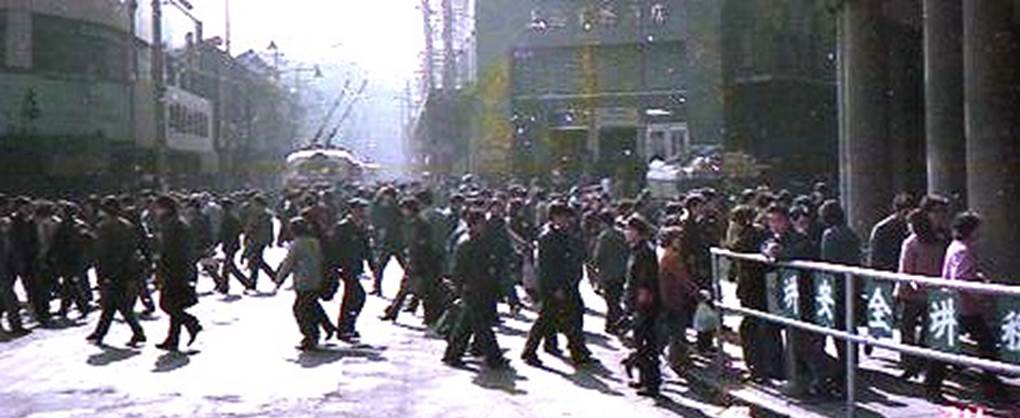
Photo by author, 1985