JAP | ENG
Barcelona, Spain
October 2013
#3/3
Placa de Catalunya
It is located almost in the centre of Barcelona, on the border between the old and new towns. It is crossed by major roads such as Passeig de Gràcia and La Rambla. The area is about 5 ha. Plaça de Catalunya was completed in 1927.
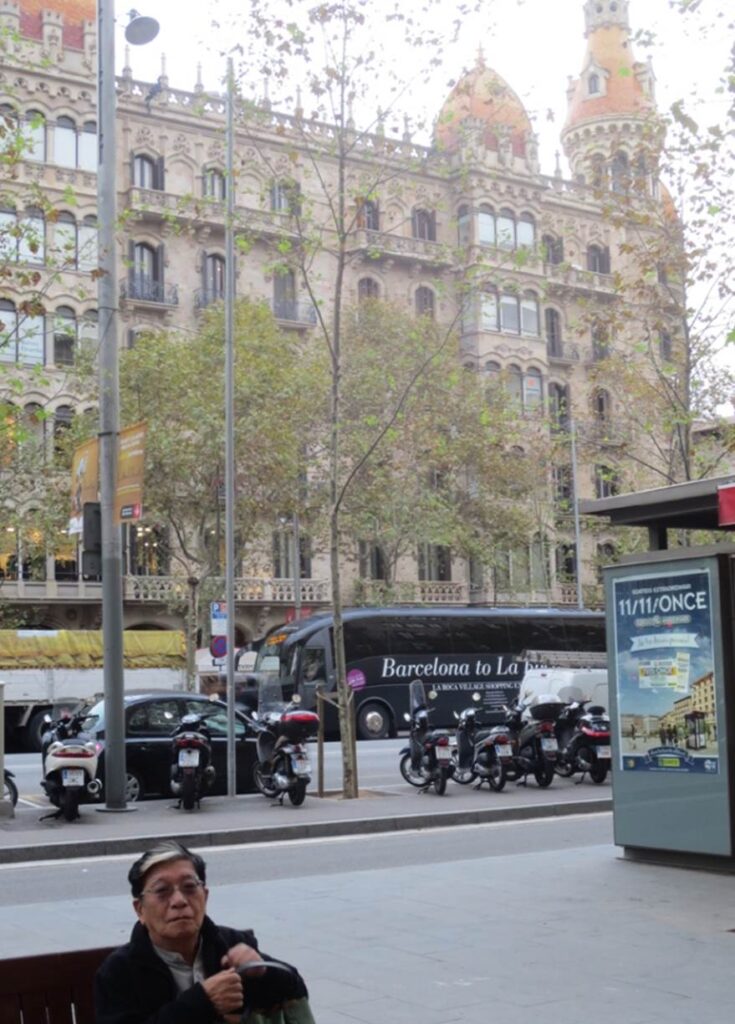
Photo of author, 2013
From Plaça de Catalunya on the map below, go south on La Rambla (blue line) to Palau Güell. If you go north from the square, you will find Casa Batlló and Casa Mila along Passeig de Gràcia (red line).
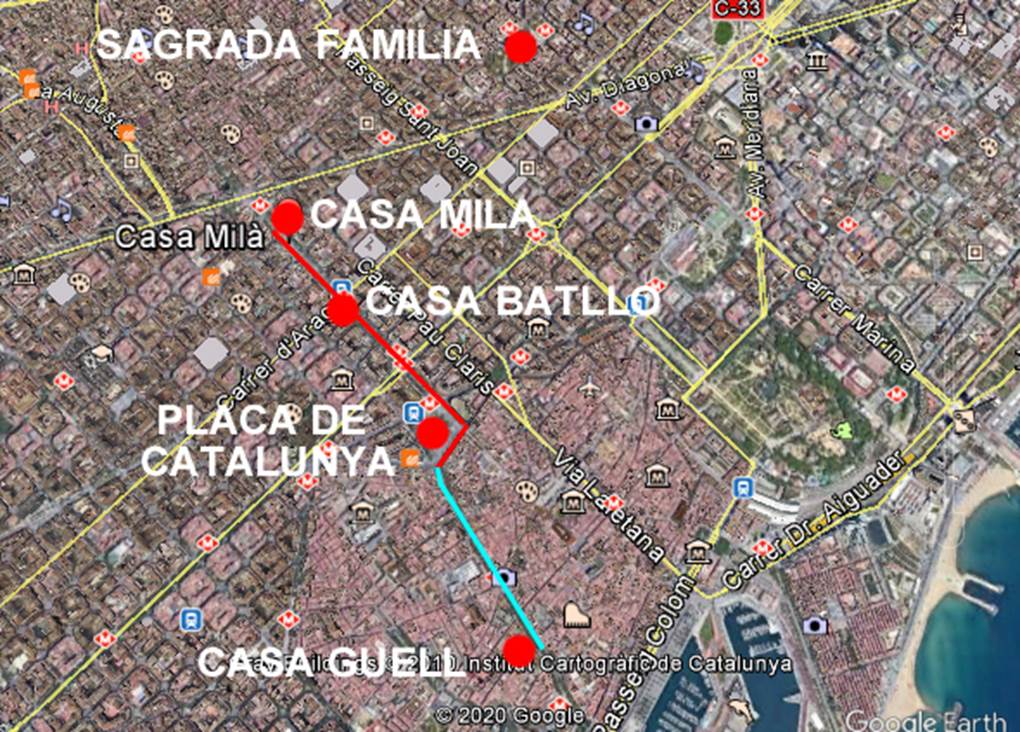
Works by Antonio Gaudí
Below is a chronological list of four of the seven works designed by the maestro Antonio Gaudí and inscribed on the UNESCO World Heritage List.
Palau Guell 1886ー1890 World Heritage Site
Parc Guell 1900-1914 World Heritage Site
Casa Batlló 1904ー1906 World Heritage Site
Casa Mila 1906-1910 World Heritage Site
In addition to Gaudí, other works by modern architects selected for World Cultural Heritage include Frank Lloyd in the United States (7 works) and Le Corbusier in France (18 works).
Palau Guell World Cultural Relics
The Guell House was built between 1886 and 1890 at the request of Eusebi Guell, a businessman who was Gaudi’s greatest patron. It is located near the tree-lined La Rambla in Barcelona’s old town.
Palau Güell is located in the old town of El Raval, west of La Rambla. The El Raval district has a long history of becoming a den of crime and drugs due to overcrowding and unsanitary conditions, but in recent years it has been urbanized and has become a multinational district.
In later years, Mr. Güell was a businessman who was so successful that he was awarded the title of Count even though he was a civilian. For the young Gaudí, designing a house commensurate with Mr. Güell’s status and financial resources gave him the opportunity to demonstrate all of his abilities as an architect and realize his work.
In order to meet these expectations, he devoted four years and all his energy to the completion of this mansion in 1886. After completion, Count Güell was said to be very pleased with the result.
People lining up to see the inside.
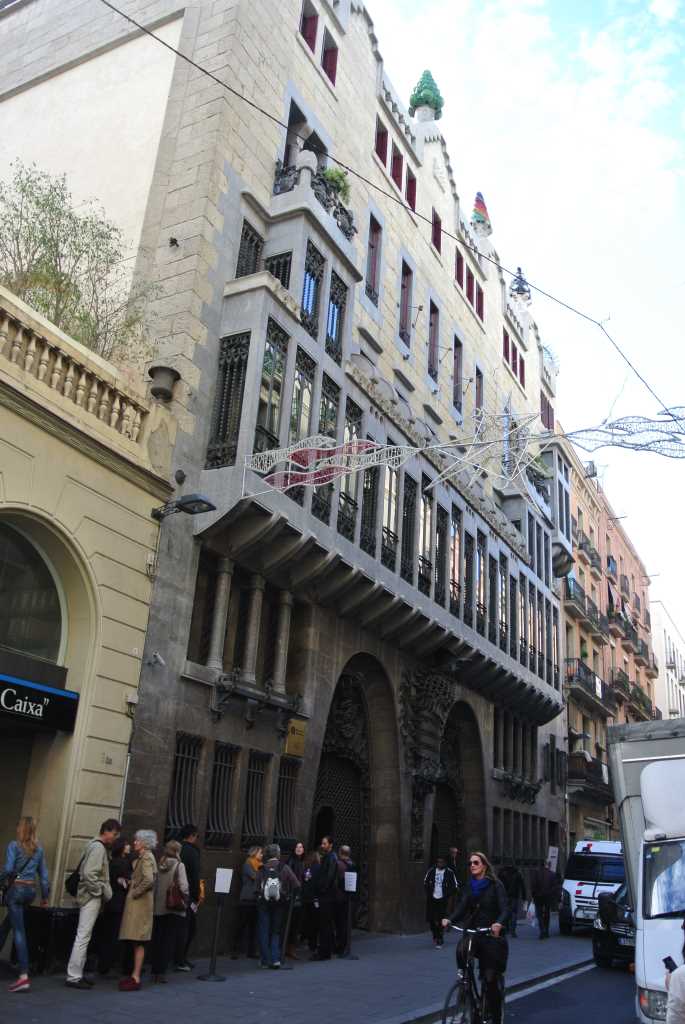
Photo by author, 2013
Unlike his later works, there is no use of curves yet, and curves are limited to metalwork, such as entrance gates, window grilles, and balcony railings.
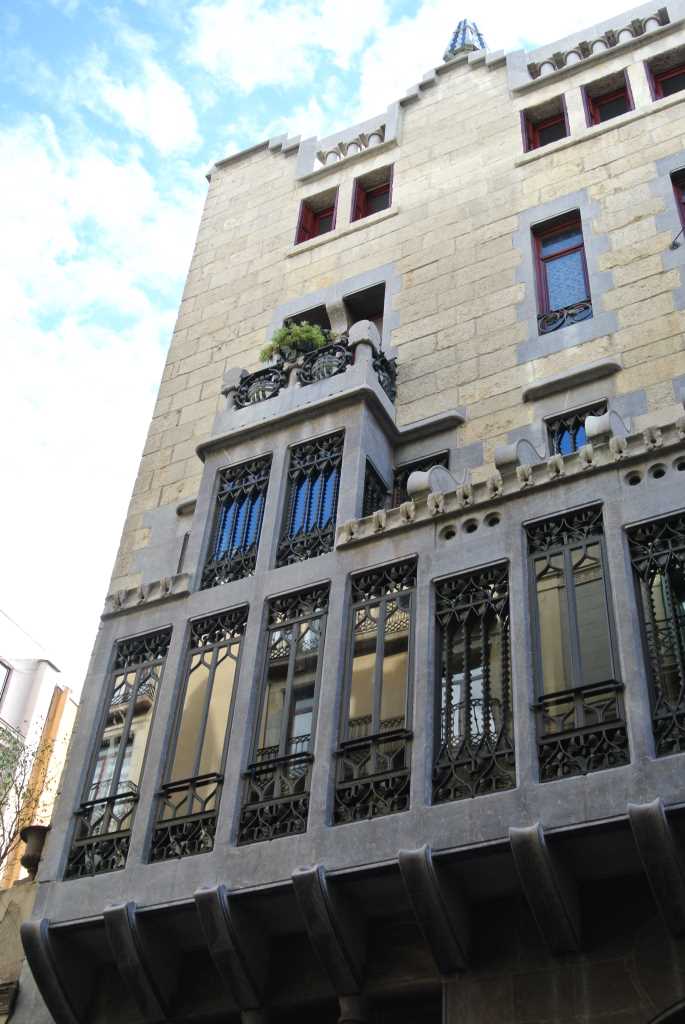
Photo by author, 2013
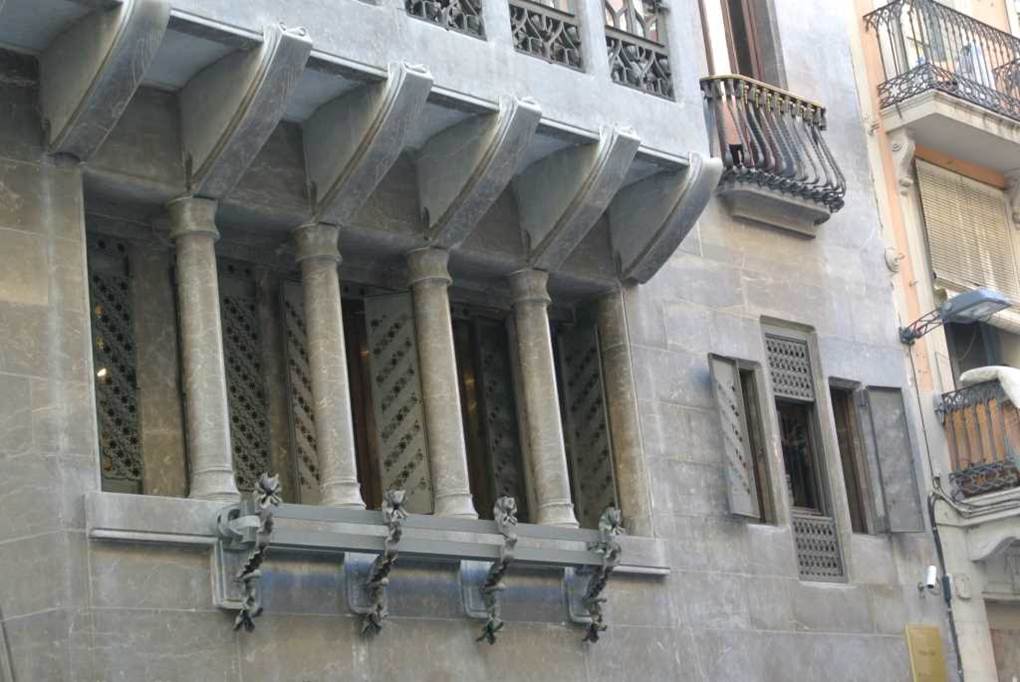
Photo by author, 2013
It was created by Gaudí when he was 34 years old.
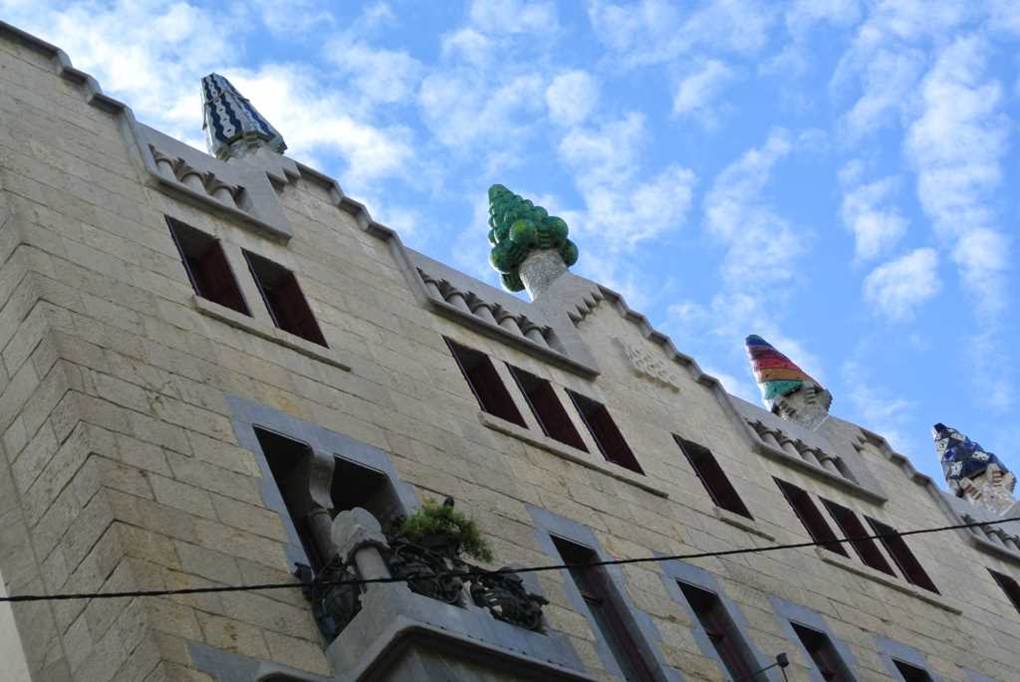
Photo by author, 2013
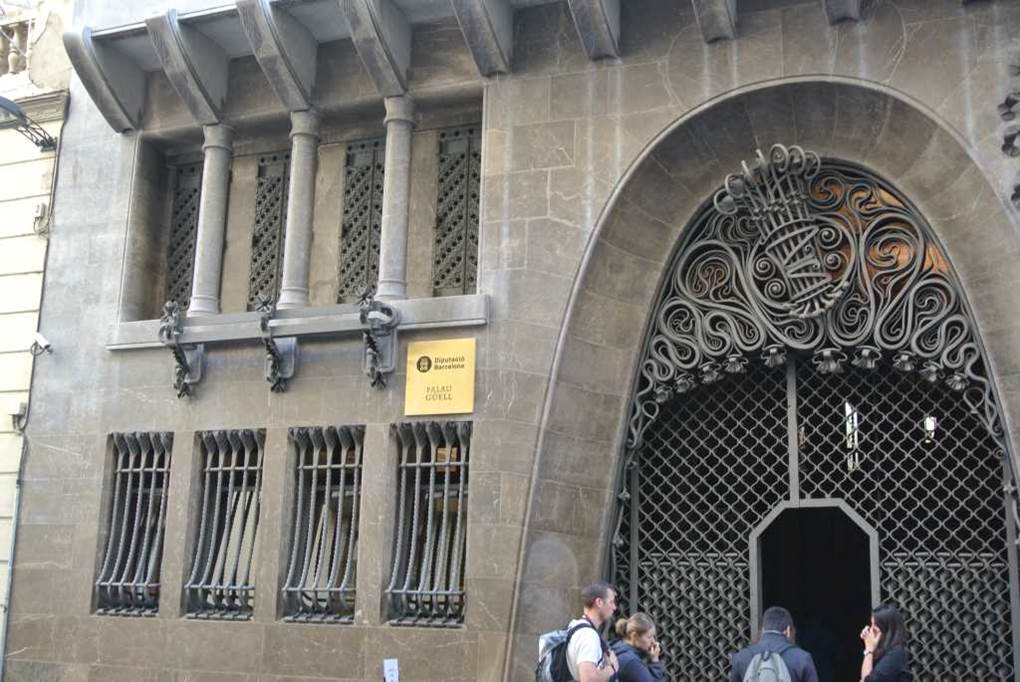
Photo by author, 2013
The decorations above the two doors at the entrance are decorated with the initials “E” and “G” of “Eusebi Güell”. It’s a very intricate metalwork.
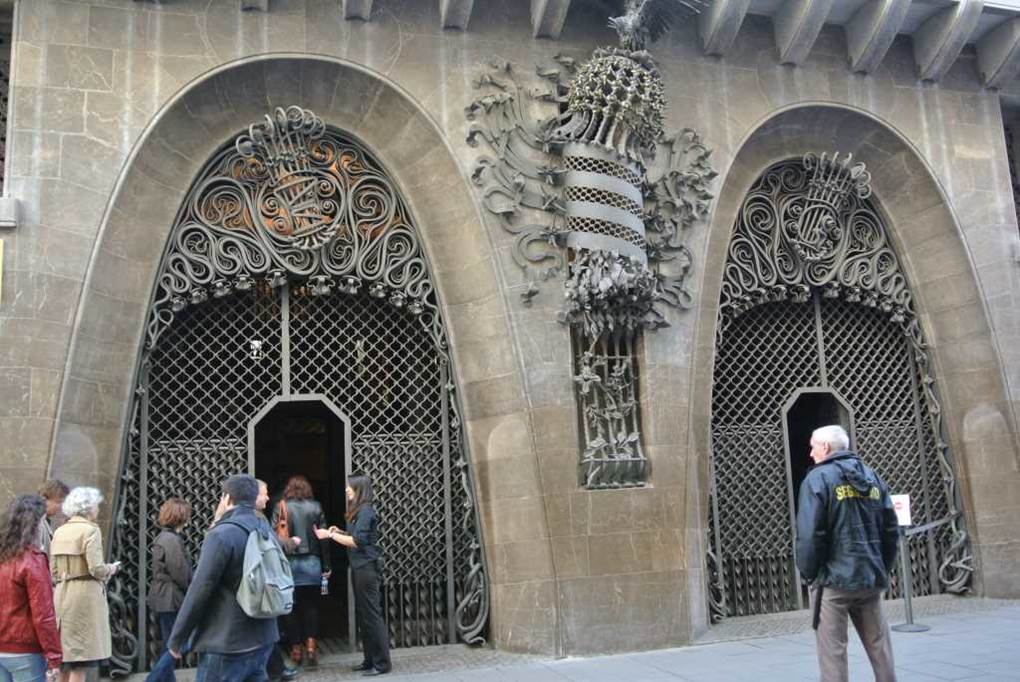
Photo by author, 2013
At the top, between the two doors, is a statue of a falcon made of wrought iron. The spiral decoration below it is the coat of arms of Catalonia. It is clear that there were very skilled professional craftsmen who could create such works.
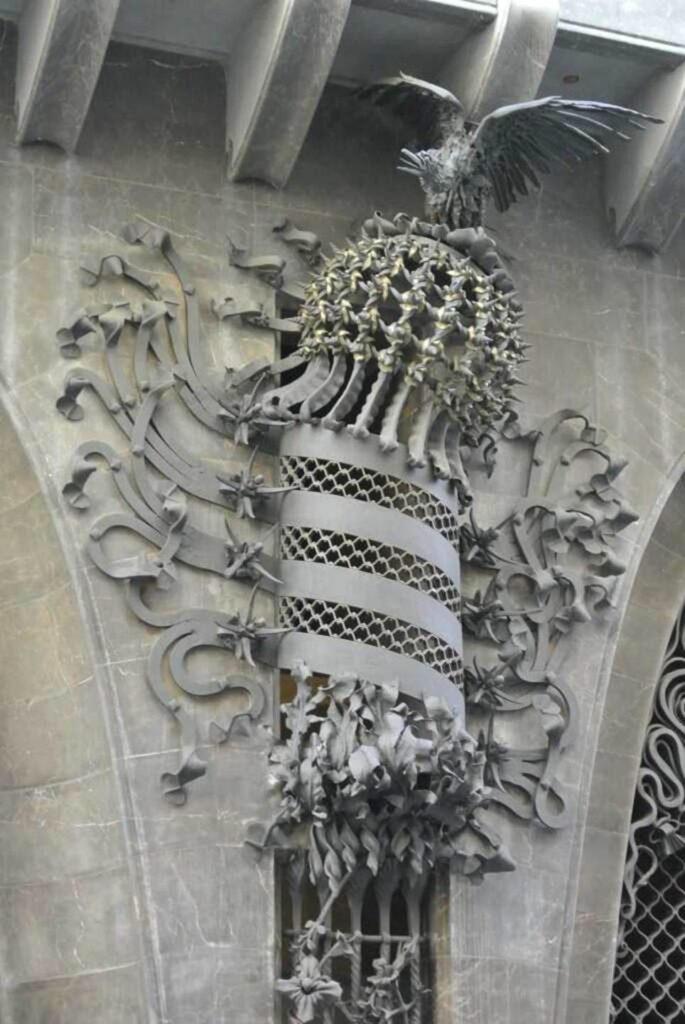
Photo by author, 2013
Next, we head to Park Güell, which is located on the side of the mountain on the north side of the new town.
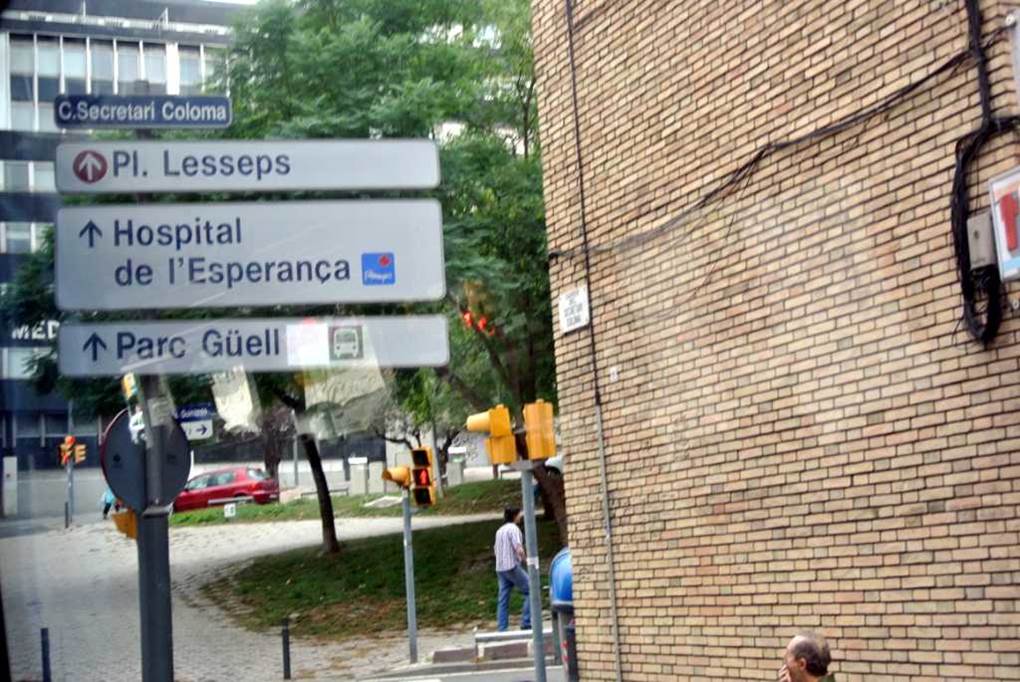
Photo by author, 2013
Parc Guell World Heritage Site
This housing development was the dream of the client, Count Güell, and Antonio Gaudi. Gaudi and Güell wanted to create a new residential area in this place where people could live surrounded by nature and art. Between 1900 and 1914 was built which was intended to make a dream new residential area for the bourgeois.
In the end, 60 houses were planned to be built with infrastructure such as plazas and roads, but no buyers were found, and in the end only two houses were sold, and the real estate development ended in failure, and the only buyers were Gaudi himself and Count Guell.
Take a stroll through Park Güell
The handrails on the slopes are made of curved iron and are full of playfulness.
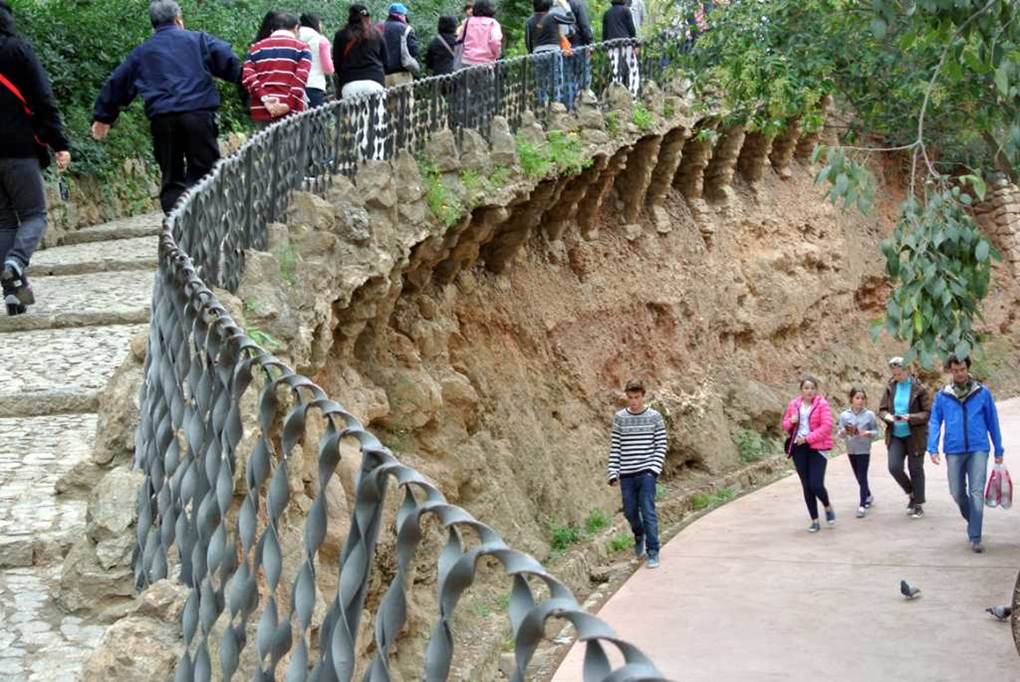
Photo by author, 2013
The shape of the lush vegetation matches perfectly with the shape of the man-made handrail.
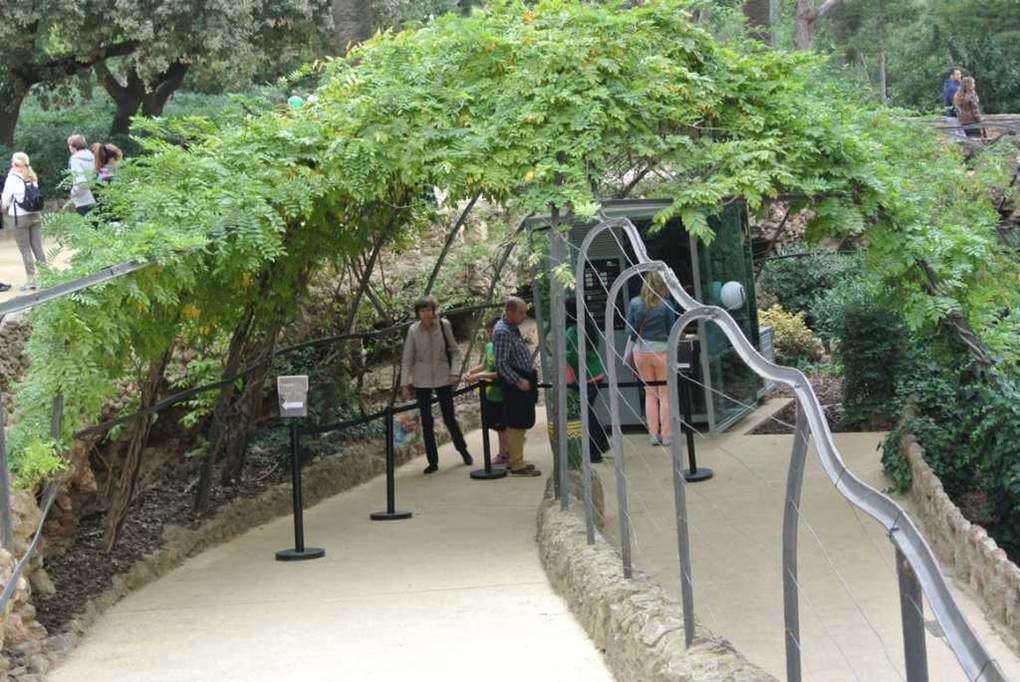
Photo by author, 2013
Washerwoman’s porch
(Portico of the Washerwoman)
This corridor is called the “Washerwoman’s Porch” and is named because one of the many pillars represents a woman in a long skirt with a laundry basket on her head.
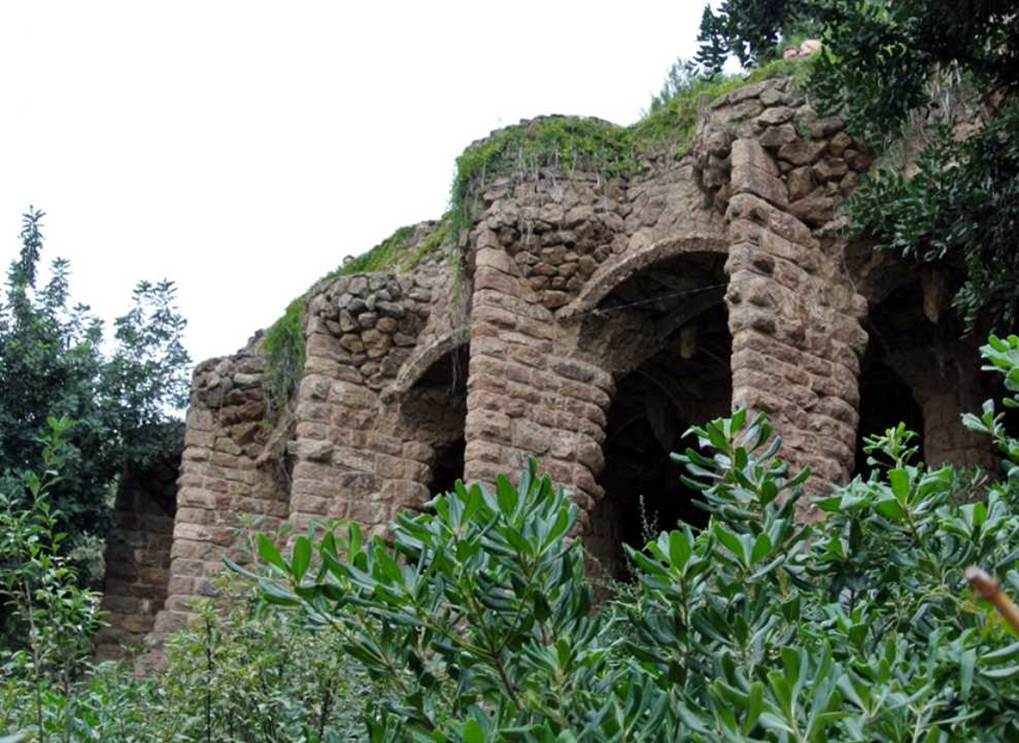
Photo by author, 2013
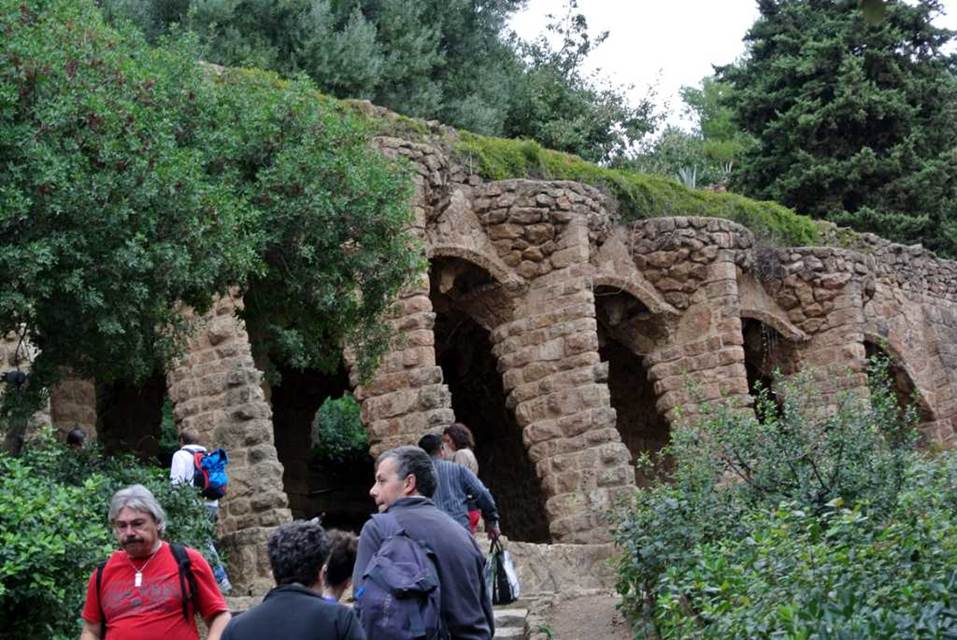
Photo by author, 2013
Gaudi did not use any numbers or formulas to design the inclination of the columns and walls, but instead spent 10 years creating models and conducting experiments to come up with this shape and then carrying it out.
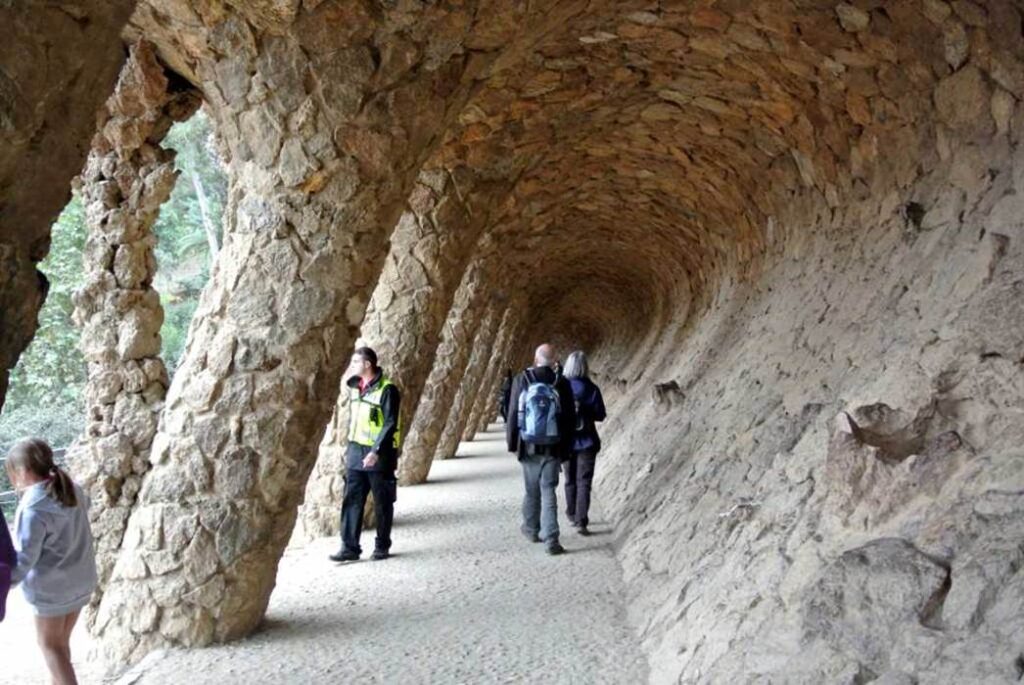
Photo by author, 2013
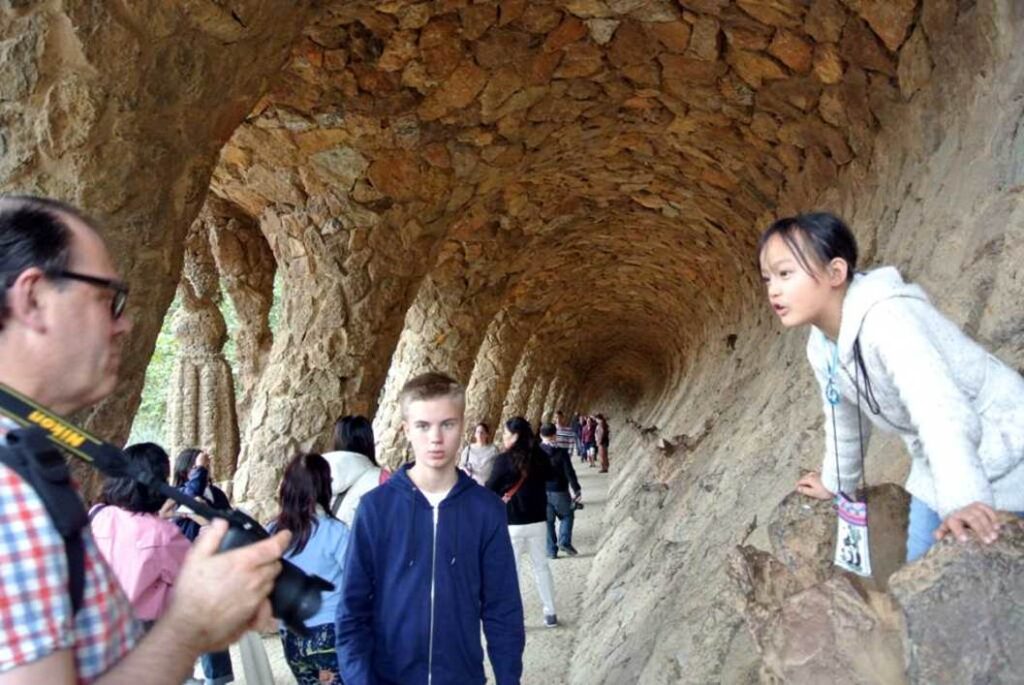
Photo by author, 2013
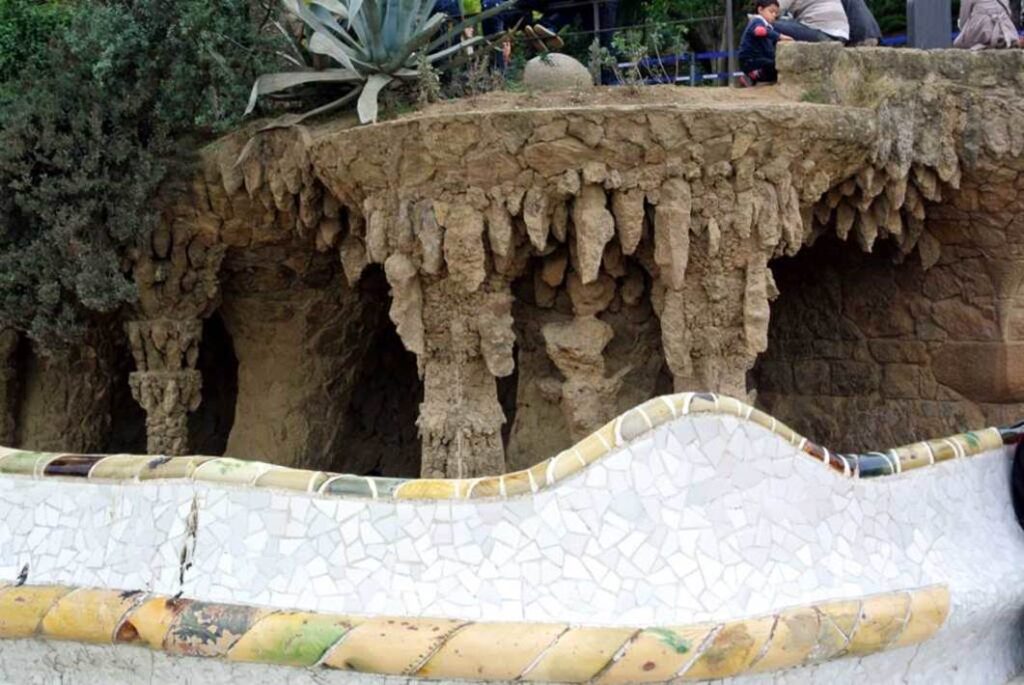
Photo by author, 2013
A popular lizard that sits on the grand staircase.
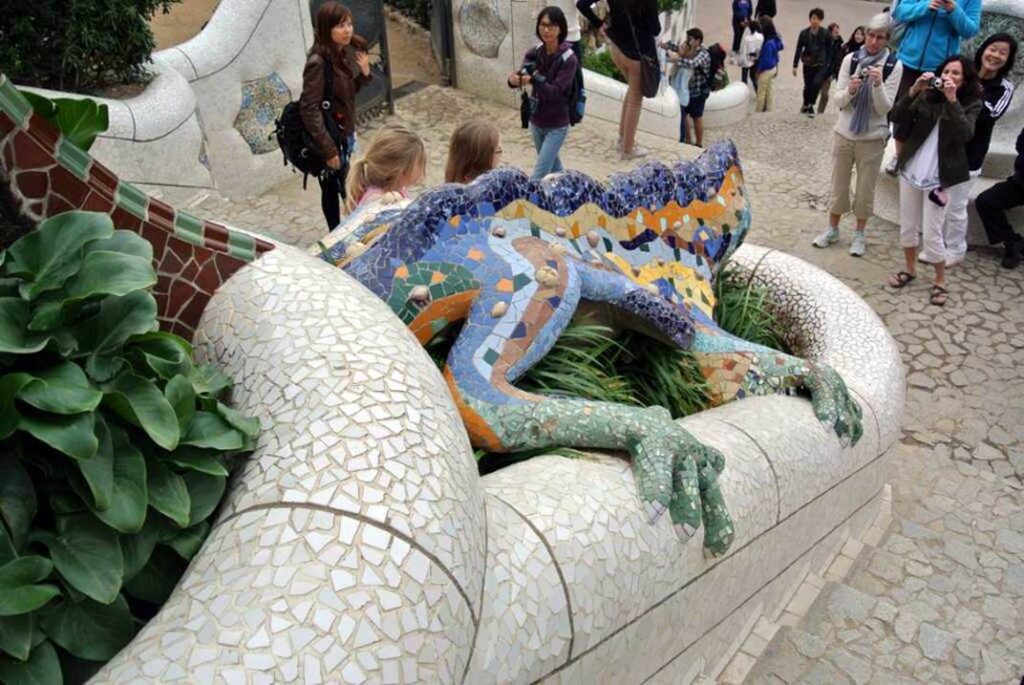
Photo by author, 2013
Fragments of various coloured tiles are affixed to a series of benches that run around the edge of the park.
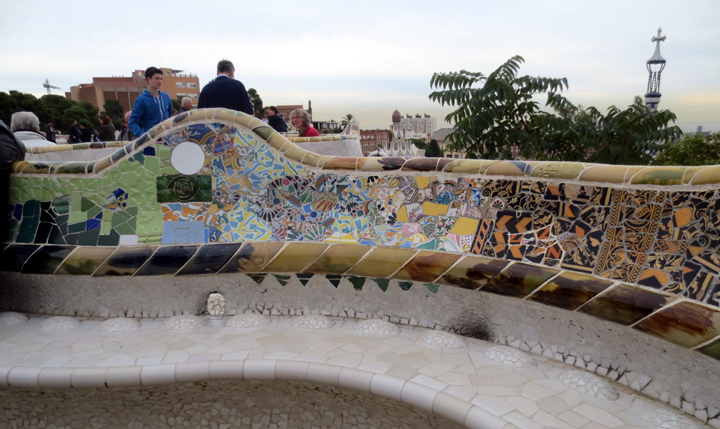
Photo by author, 2013
Continuous bench of colourful crushed tiles.
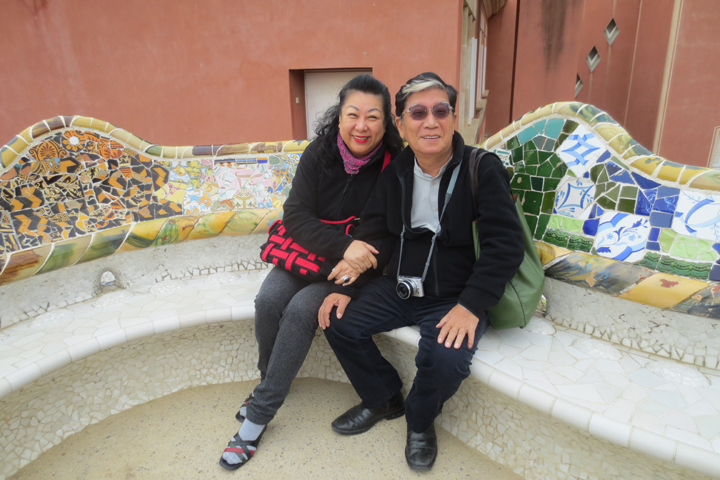
Photo of author, 2013
An outdoor rest area. We took a coffee break, savouring the lingering impression of Gaudi’s architecture.
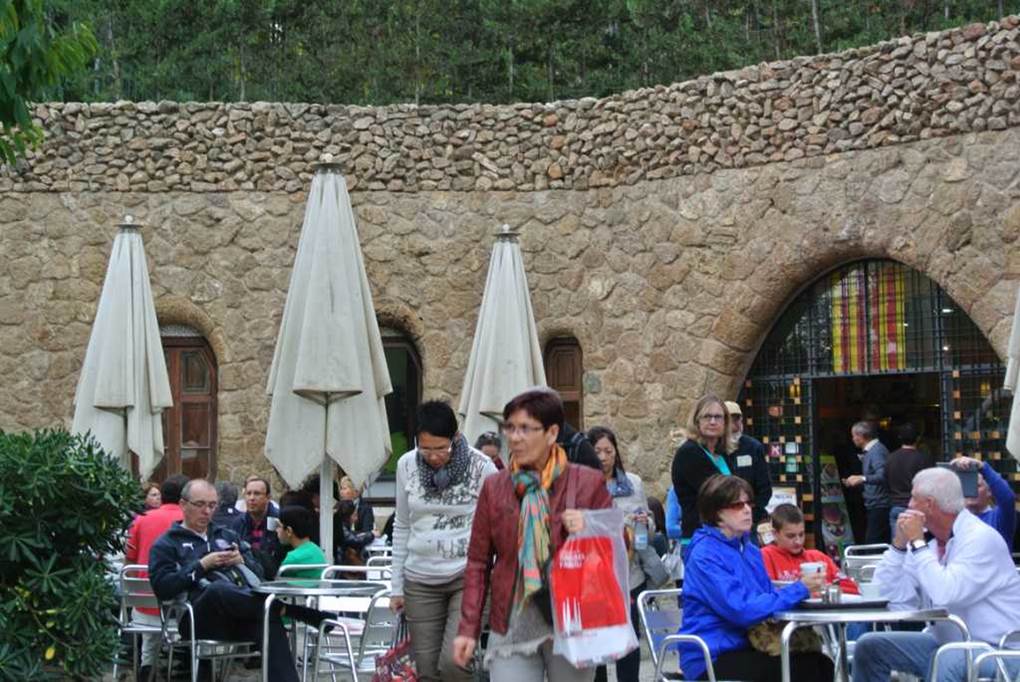
Photo by author, 2013
Guards’ hut (historical museum) and Administrative office (candy house)
The two most imaginative buildings in Park Güell are the “Guard Hut” (left of photo) and the “Administrative Office “(right of photo) located on the left and right sides of the main entrance of Park Güell.
Gaudí deliberately placed these two fairytale buildings at the main entrance to create a barrier between the outside and grounds of Park Güell, intentionally emphasizing that the inside and outside are two different worlds. It is also called the “Candy House” because Salvador Dalí said, “It looks like a tart candy sprinkled with sugar.”
Park Güell was originally conceived as an apartment complex, so the two buildings were designed to serve as buildings to receive visitors and manage the site.
Guard’s hut
The current guard’s hut (photo below) is now the Barcelona City History Museum, and is a popular tourist spot where queues form during the day.
At first glance, the guard hut and the administrative office look the same, but there are subtle differences. One was a bay window, which was meant to emphasize the residence where the guard’s family lived at that time.
Another is disc-shaped colorful crushed tile like marble chocolate pasted on a white window. The tiles are pasted around the window to protect privacy and prevent people from looking inside.
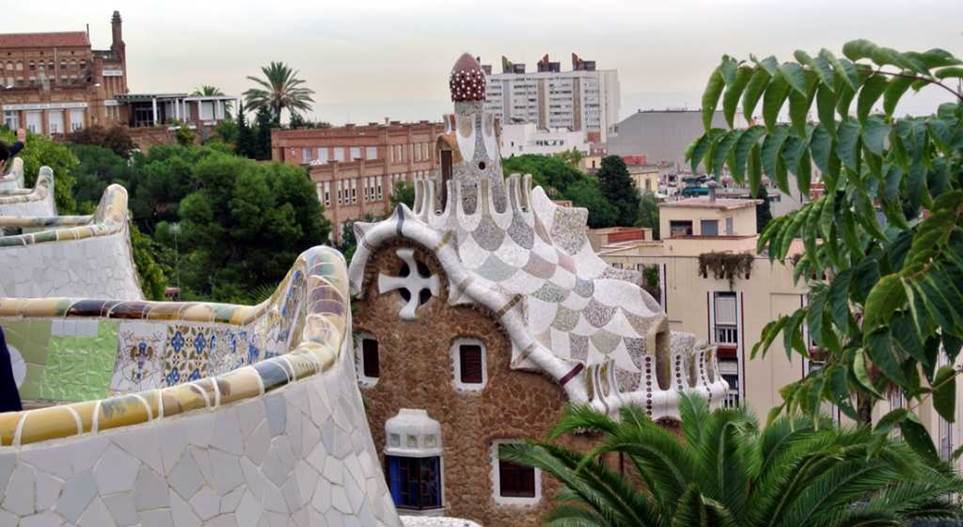
Photo by author, 2013
This sawtooth-shaped object on the roof of the building looks like just a decoration at first glance, but it is actually a handrail.
The inside cannot be seen from below, but it was made for the terraces on the left and right sides of the corners of the roof.
However, there is a risk of falling through the gaps, so its practicality is somewhat questionable. These handrails are also lined up on the roof of the management office opposite, and on the walls on both sides of the central staircase, making them one of the symbols of the park.
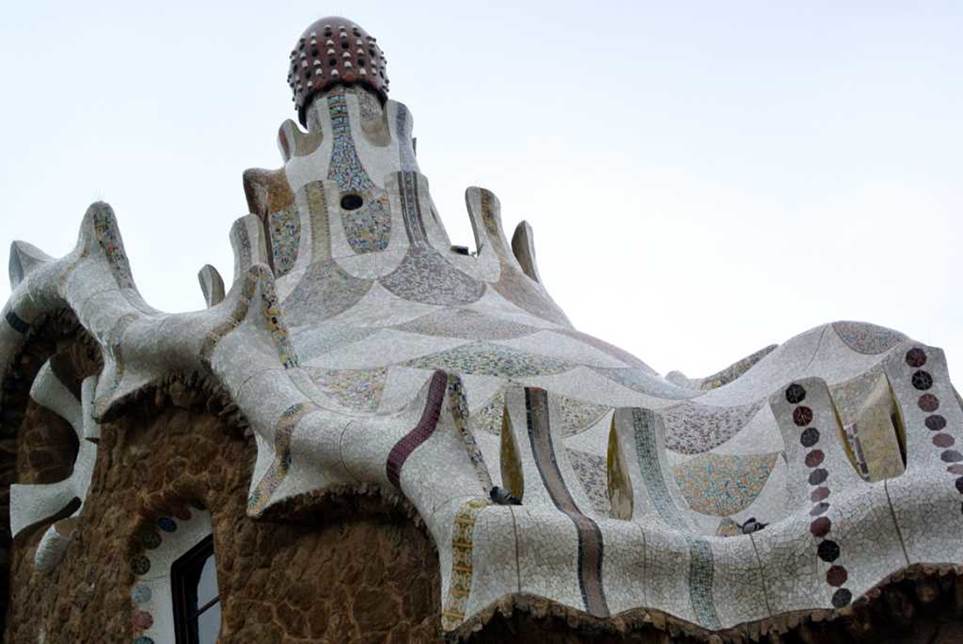
Photo by author, 2013
Candy House (Administrative Office)
Salvador Dalí, a genius born in local Catalonia, described it as “like a tart confectionery,” and it looks like a candy house itself.
Incidentally, it seems that among the artists with ties to Barcelona, Gaudi and Picasso were the ones Dali recognized as true geniuses during his lifetime.
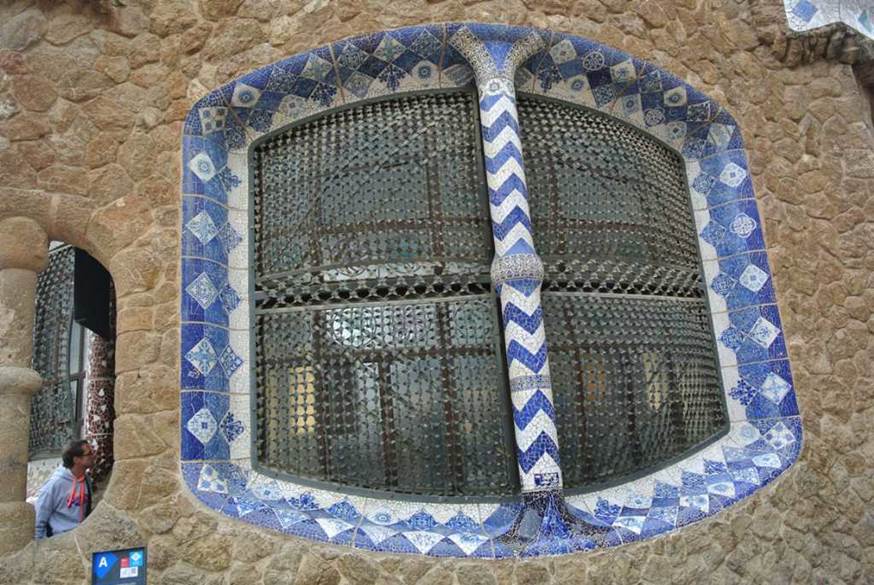
Photo by author, 2013
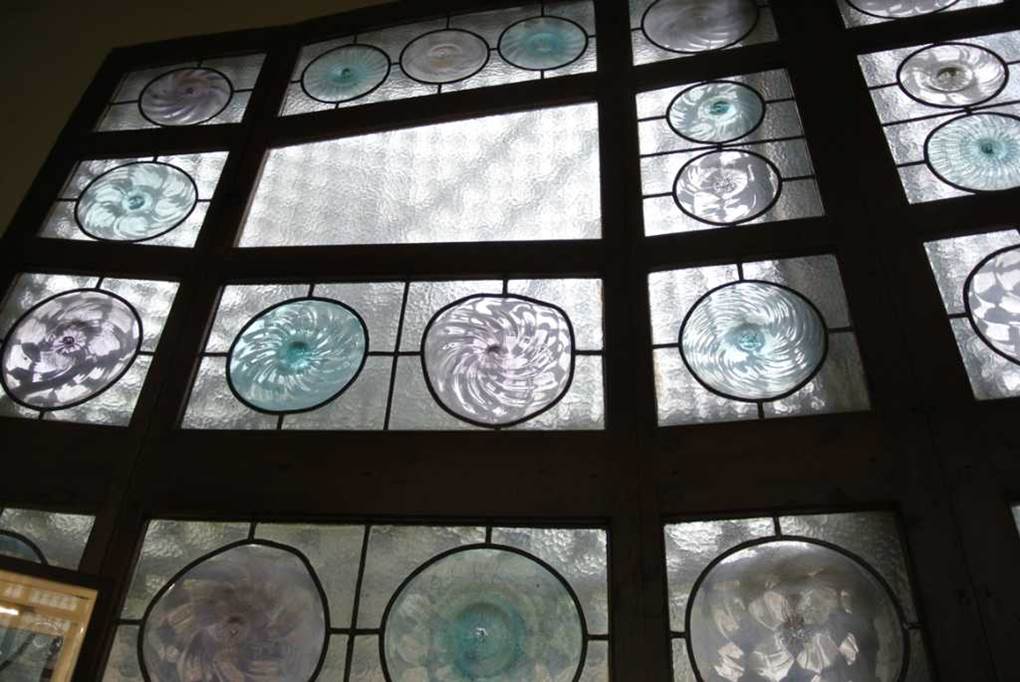
Photo by author, 2013
Gaudí’s House
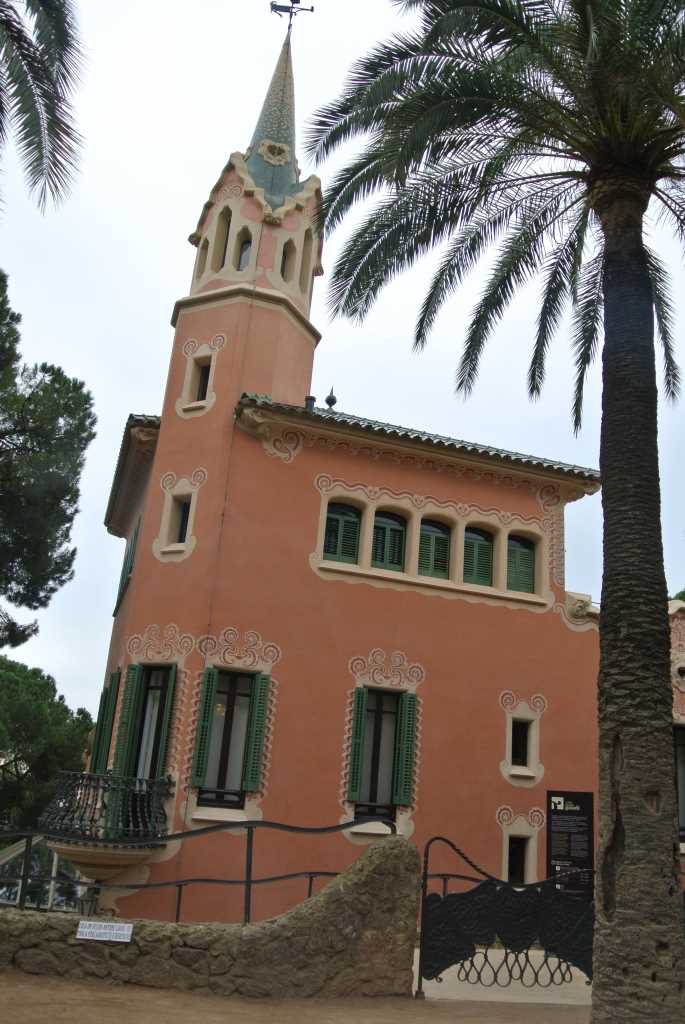
Photo by author, 2013
Passeig de Gràcia
Barcelona’s most chic shops are concentrated on Passeig de Gràcia, which stretches 1.5 kilometers from north to south.
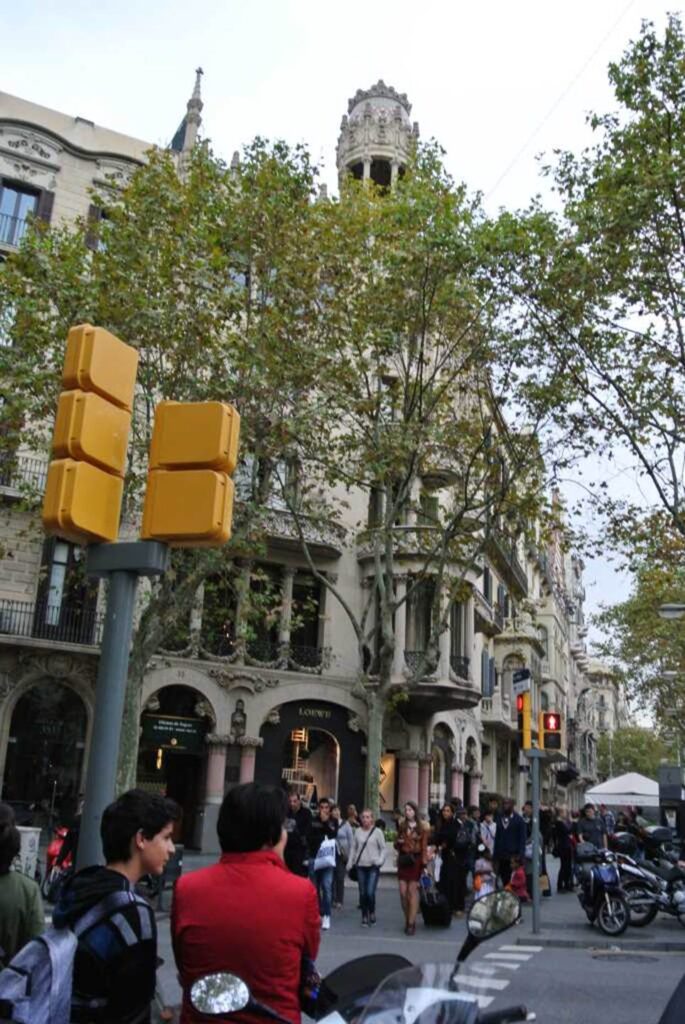
Photo by author, 2013
Casa Batlló World Heritage Site
Casa Batlló, located in the middle of Passeig de Gràcia, was commissioned by the textile giant Josep Batlló i Casanovas, and Gaudí renovated the building from 1904 until 1906.
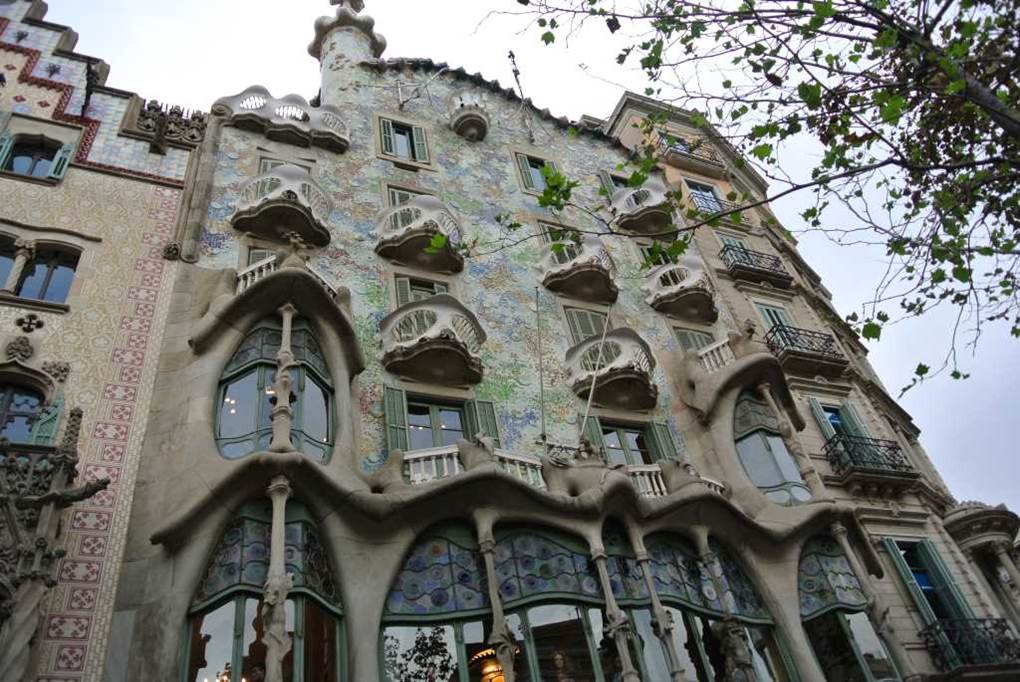
Photo by author, 2013
The walls are decorated with intricate decorations. Fragments of colored glass and mottled discs are delicately arranged in a gradation. There are 330 of these discs, and they are custom-made. A pelvis-like railing is attached to the balcony.
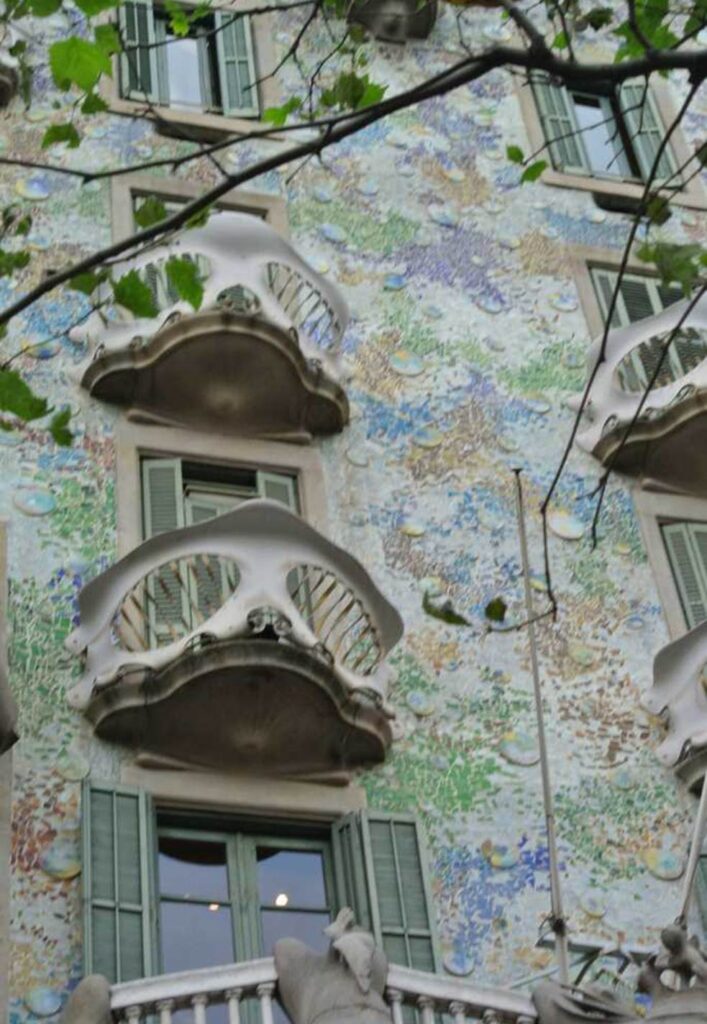
Photo by author, 2013
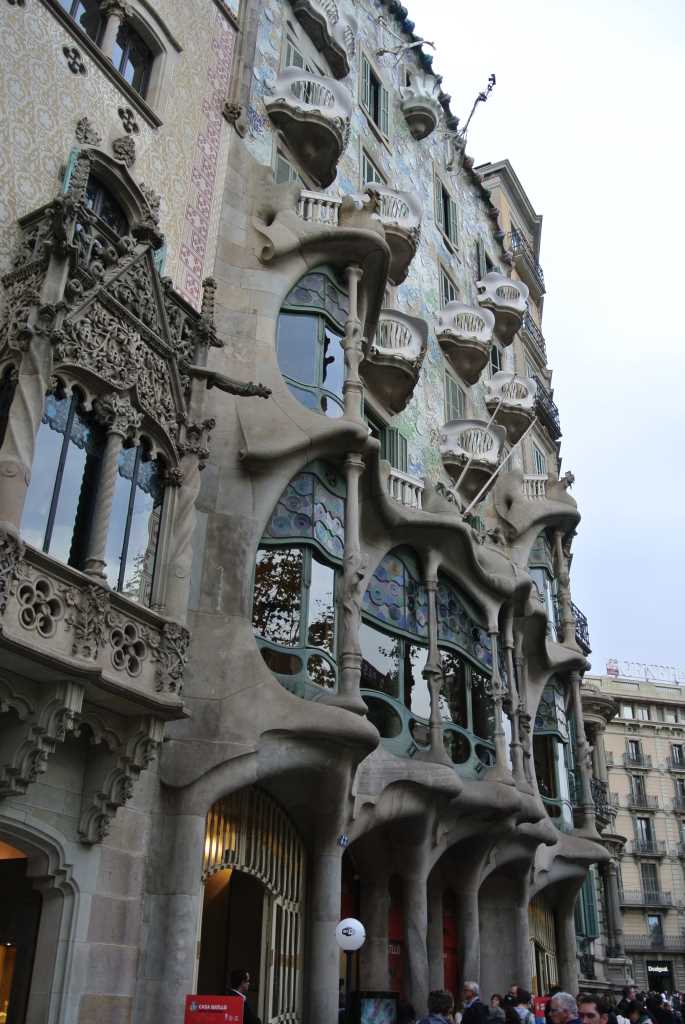
Photo by author, 2013
Tourists are queuing up to tour the interior.
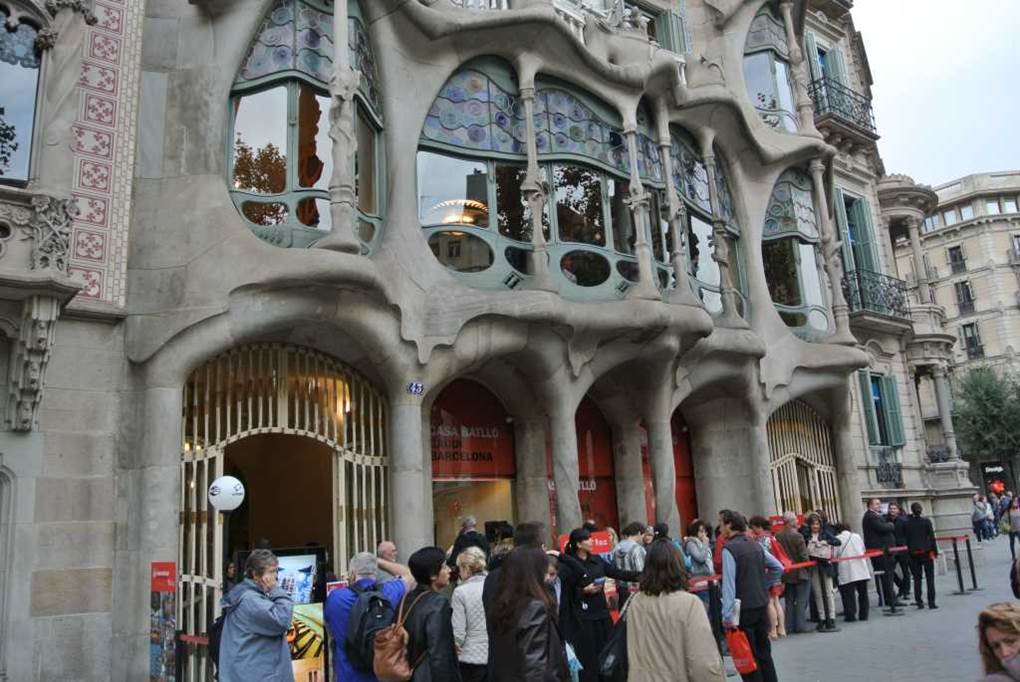
Photo by author, 2013
What Gaudí wanted to express in Casa Batlló was the beauty of the building’s surface, which was constantly changing due to sunlight.
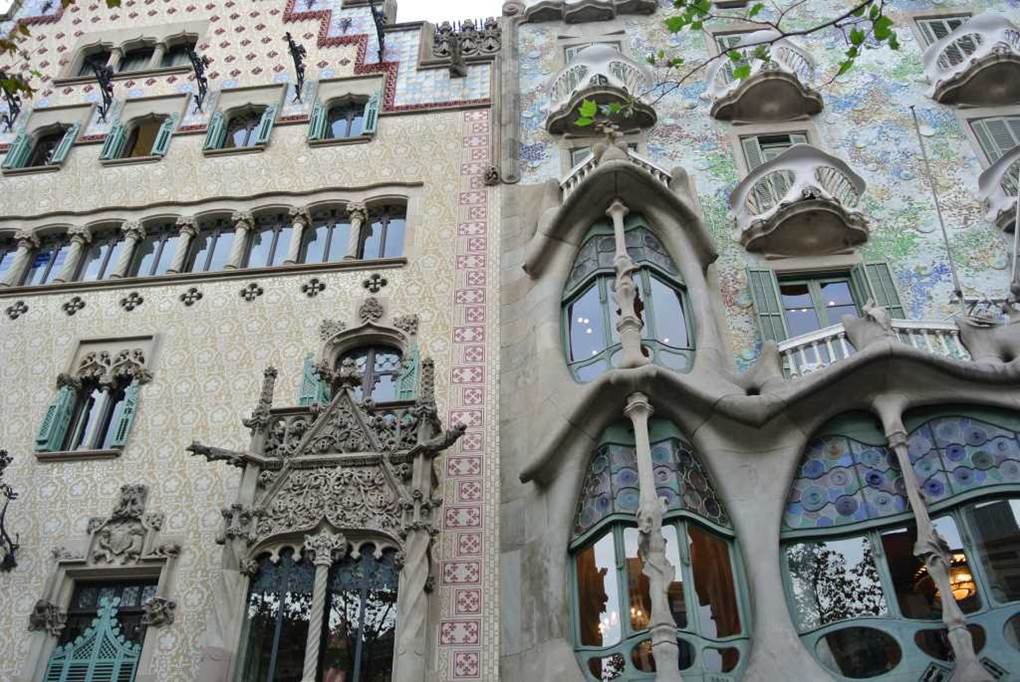
Photo by author, 2013
The building next to the left of the Casa Batlló has a strong presence too.
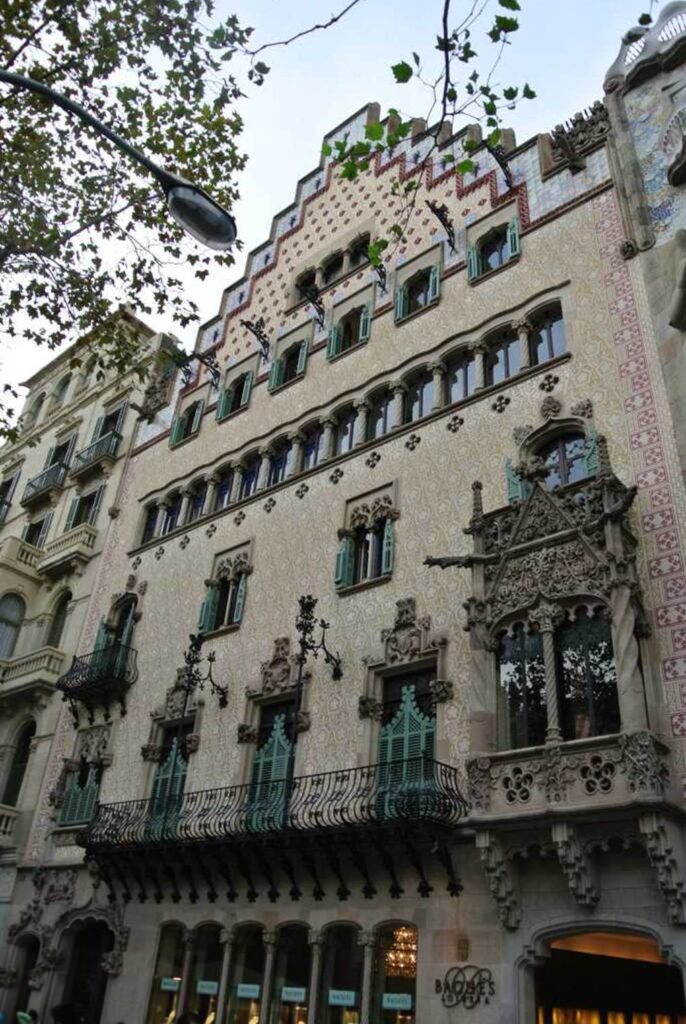
Photo by author, 2013
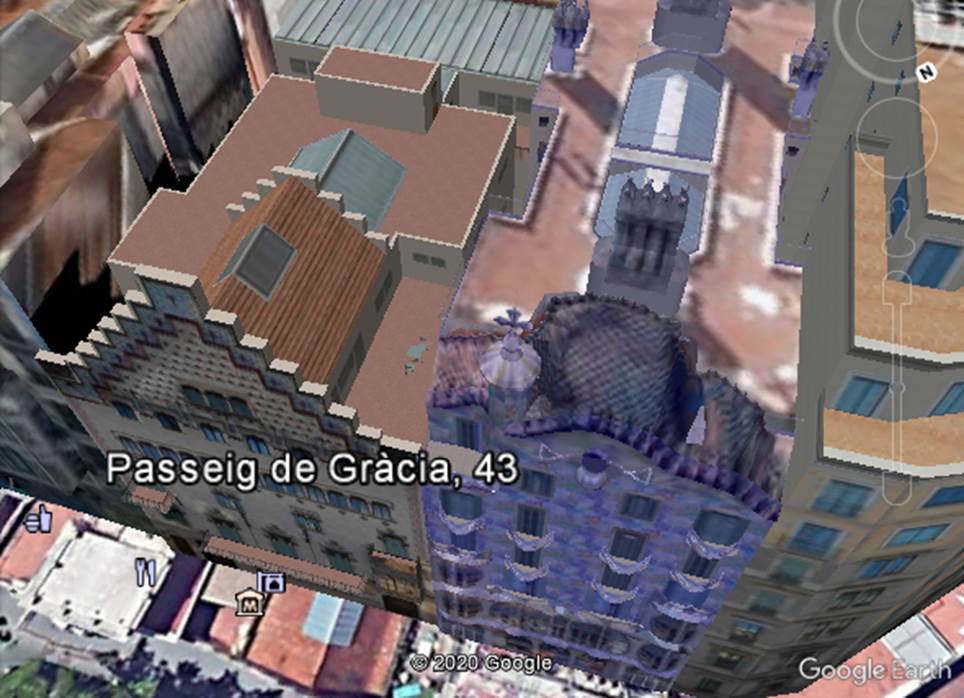
CASA MILA World Heritage Site
From 1906 to 1910 it was built on Passeig de Gràcia as the residence of businessman Pere Mila and his wife. It was designed by Gaudí when he was 54 years old. This Casa Mila is a building that is entirely made up of curved lines. The design is distinct from ordinary modern architecture.
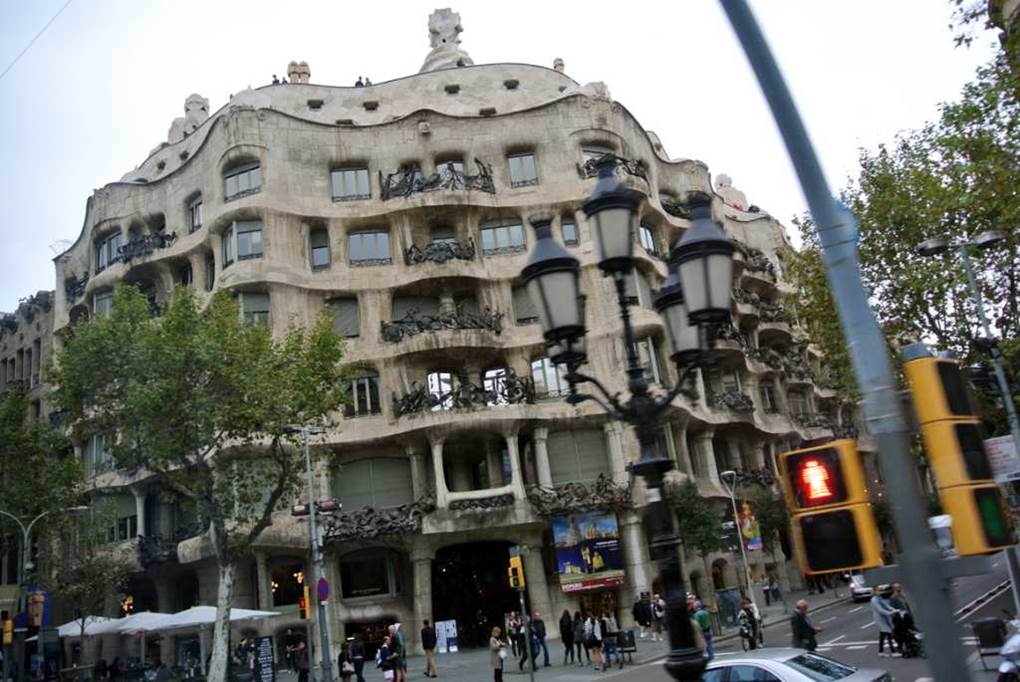
Photo by author, 2013
This Casa Milà is more like a sculpture than an architecture. At the time, the people of Barcelona saw Casa Mila as a building of impracticality, and gave it the nickname “La Pedrera” (the quarry), but today it is one of Barcelona’s most iconic architectural heritages.
The rent was about 10 times the average craftsman’s monthly salary, and the building’s poor appearance made it difficult to find tenants. Commercially, it was a failure.
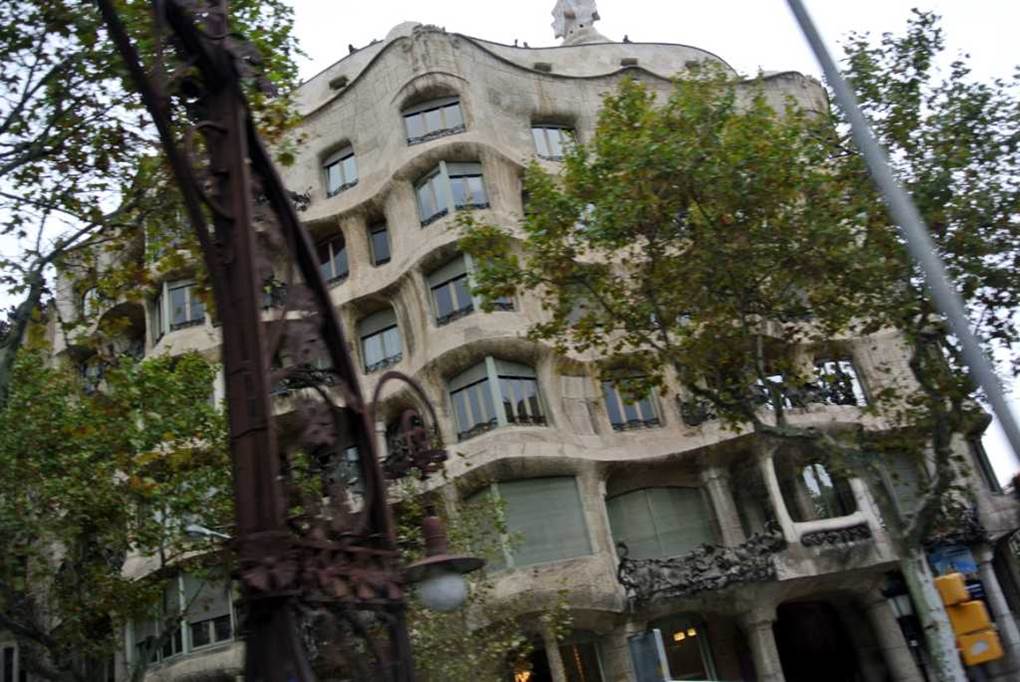
Photo by author, 2013
Gaudí installed new facilities at the time such as an elevator and running water to Casa Milà. It was also one of the first houses in Barcelona to have an underground car park. In the 26 spaces underground, residents could place cars and horse-drawn carriages.
However, Gaudí’s design is conspicuous for its emphasis on beauty, as seen in the heavy use of curved surfaces. Therefore, we have to put up with the lack of practicality. With Gaudi’s design designated a World Heritage Site, spending time in the spacious space may be an enjoyment that outweighs the inconvenience. It is about 300 m2 in size and has a total of 8 rooms, and is currently home to four families.
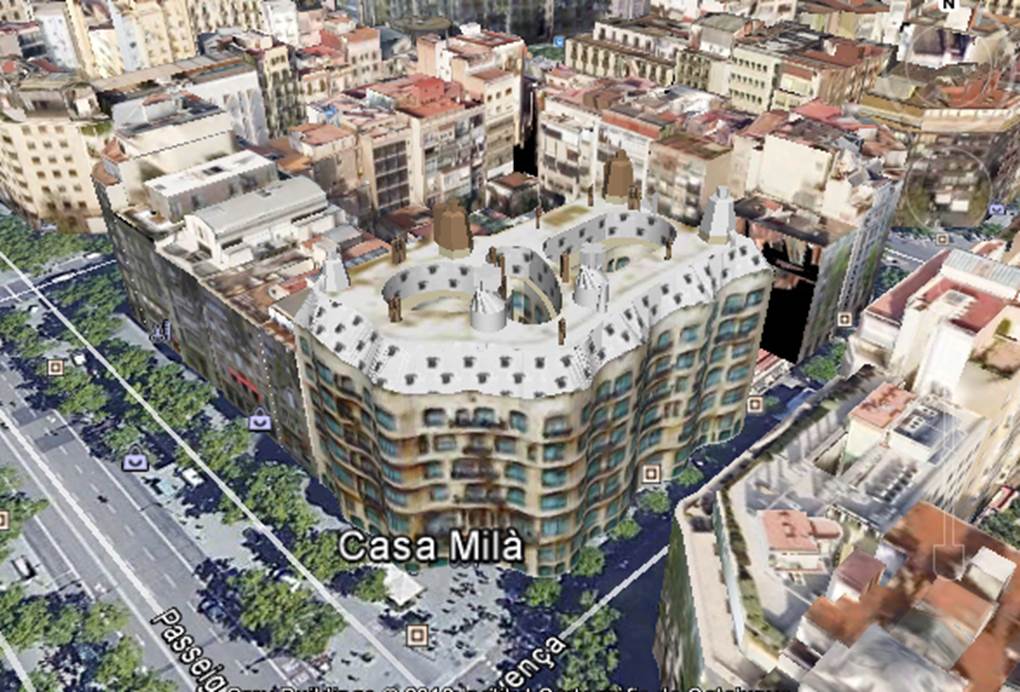
All photos by author, October 2013