JAP | ENG
India Travelogue 1989
#8/26
Fatepur Sikri
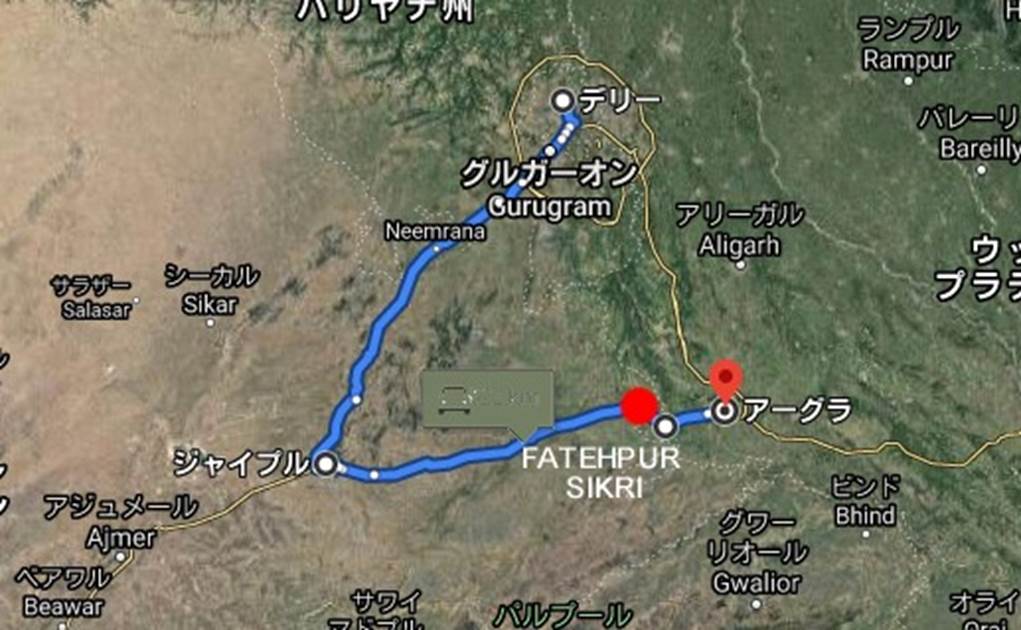
In the early morning hours of February 7, 1989, I checked out of the Maharajah’s Lumbar Palace Hotel in Jaipur, the capital of Rajasthan, and visited Fatehpur Sikri for the first time in a Hindustan Motor Ambassador car with a driver and interpreter who we had booked in advance. It takes about 205 km on Route 21 and we arrive in about three and a half hours if you don’t include breaks.
Threshing
The road has one lane on each side, and stretches eastward across the dry central Indian plains at an altitude of about 300m. On the way, I came across a strange sight. On the road in front of me, there were straw mats measuring 2m x 6m, repeatedly placed at regular intervals on the road. It looked like grains or something were being dried on the straw mats. I thought the driver would avoid them, but instead he drove right over them.
Later, when I heard from the interpreter, I found it strangely convincing that farmers were using the four wheels of passing cars as a thresher to save them the trouble of threshing.
It is now February, winter in India, and the temperature around here is 10 degrees in the morning and around 25 degrees in the afternoon, so it is very comfortable. There has been no rain for several months, so the roads and tires are completely dry. It is the perfect period for threshing.
After repeating the threshing work many times, we arrived at our destination, Fatehpur Sikri, around noon.
But what kind of distribution route does the threshed food follow after that ? What kind of hygiene precautions are taken for the grains? It would not be surprising if grains and beans threshed in this way were supplied to the restaurants of five-star hotels.
The national car of India
Hindustan Motor Company’s Ambassador car. Modelled after the British Morris cars of the 1980s, it was manufactured in India until the 2000s.
The rear seats are high, like London taxis, so you can see the front of the car for a good view.
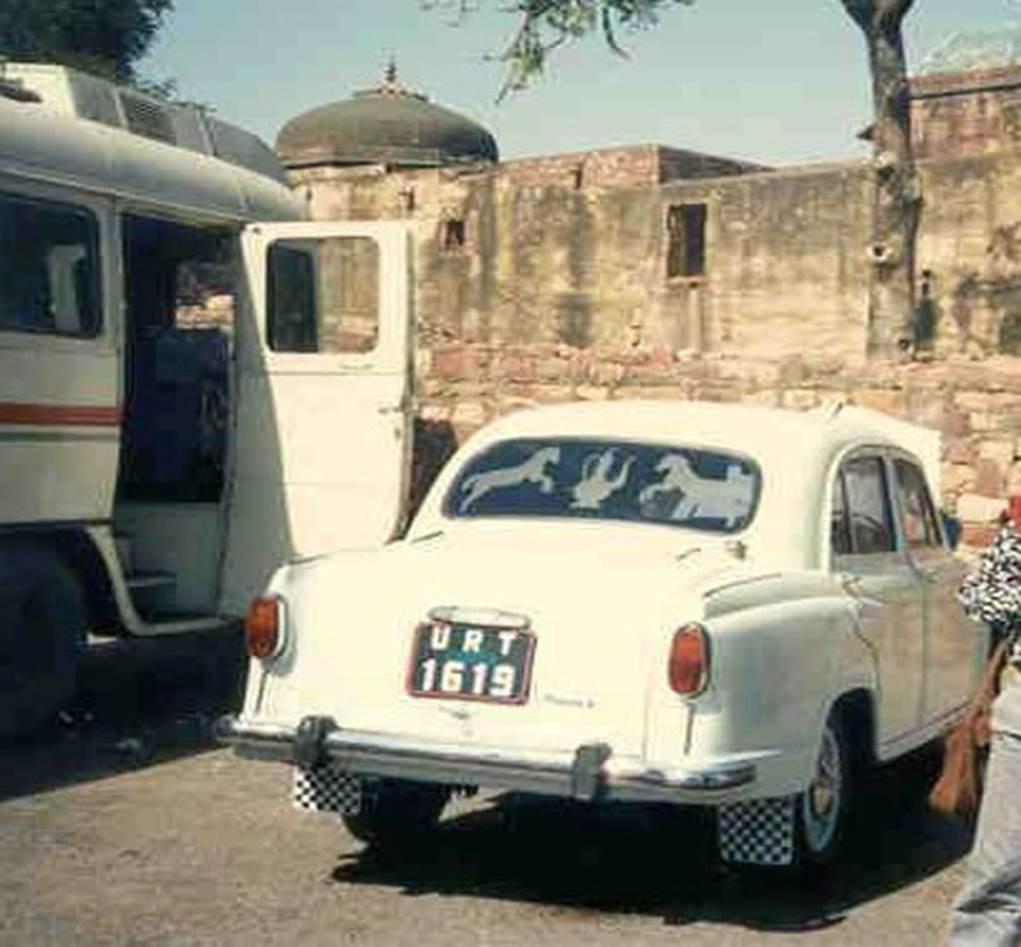
Photo by author, 1989
Palace City, FATEHPUR SIKRI
UNESCO World Heritage Site
Fatehpur Sikri is located on a plain 40 km west of Agra, on a 1 km x 3 km plateau with a difference in elevation of about 55 m.
Fateh means victory, and pur means city. It was built by Emperor Akbar in the second half of the 16th century as the capital of the Mughal Empire.
It was completed about 20 years ago when Toyotomi Hideyoshi decided to take over Fushimi Castle. After Hideyoshi’s death, the castle was abandoned by Ieyasu in 1619, and Fushimi Castle no longer exists. On the other hand, the abandoned castle of Fatehpur Sikri still exists after 630 years and is a UNESCO World Cultural Heritage Site. (below)
As shown in the figure below, the city wall surrounded a large area, but now the railway runs through the castle area, and there are also stops.
Nearby, small towns are sprawling formed.

Author’s sketch 1
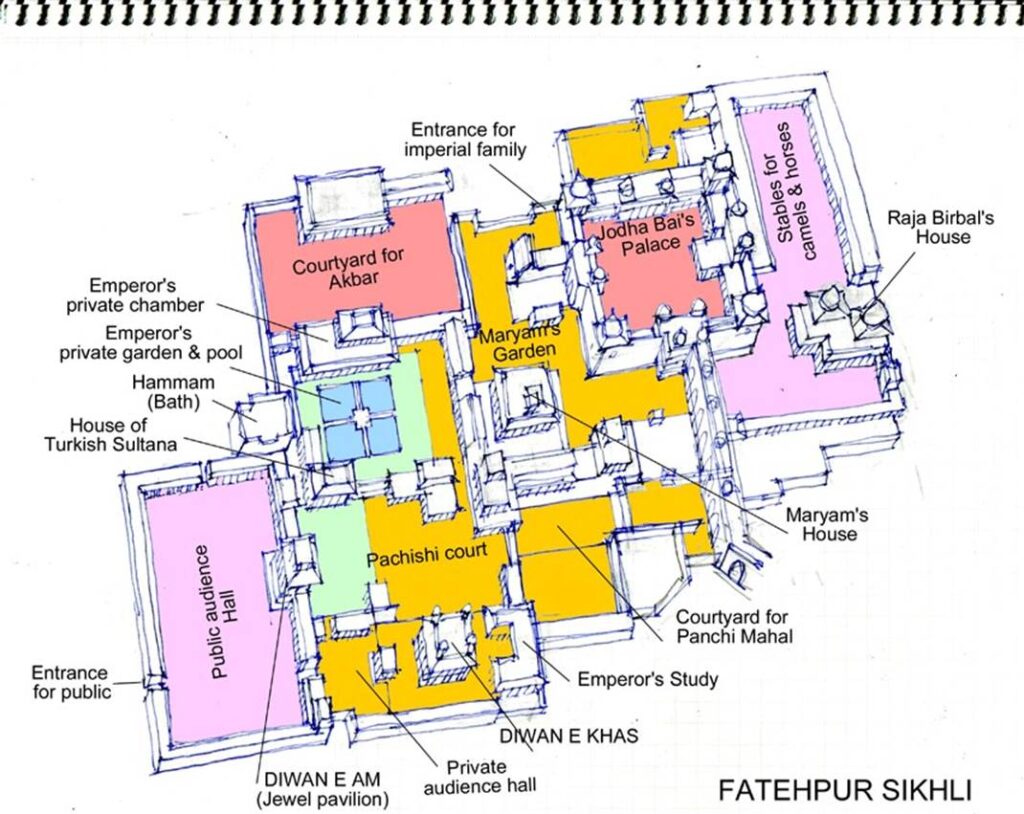
As shown on author’s sketch 2 below, it can be seen that this castle is not only a government office but also a residential facility, a religious facility, and a military facility from the perspective of architectural planning.
From an architectural design point of view, it can be said that it is a very clever and creative fusion of Hindu and Muslim cultures. (below)
Later, when the lake, which relied on natural spring water, dried up, Akbar the Great moved his capital to Lahore in the Punjab region in 1585, where he made only occasional visits.
Author’s sketch 2
Diwan-i-Aam : Hall of Public Audience
Open space for the general audience
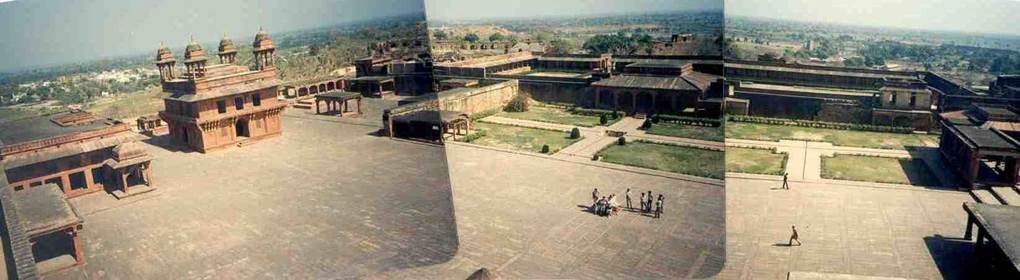
Photo by author, 1989
The gate called the Pavilion of Jewels separates the inside and outside of the palace, and connects it to the next square space.
Public audiences are held in the square inside the gate (below).
On the southwest side of the square are the residence of the Turkish Sultan and the Turkish baths.
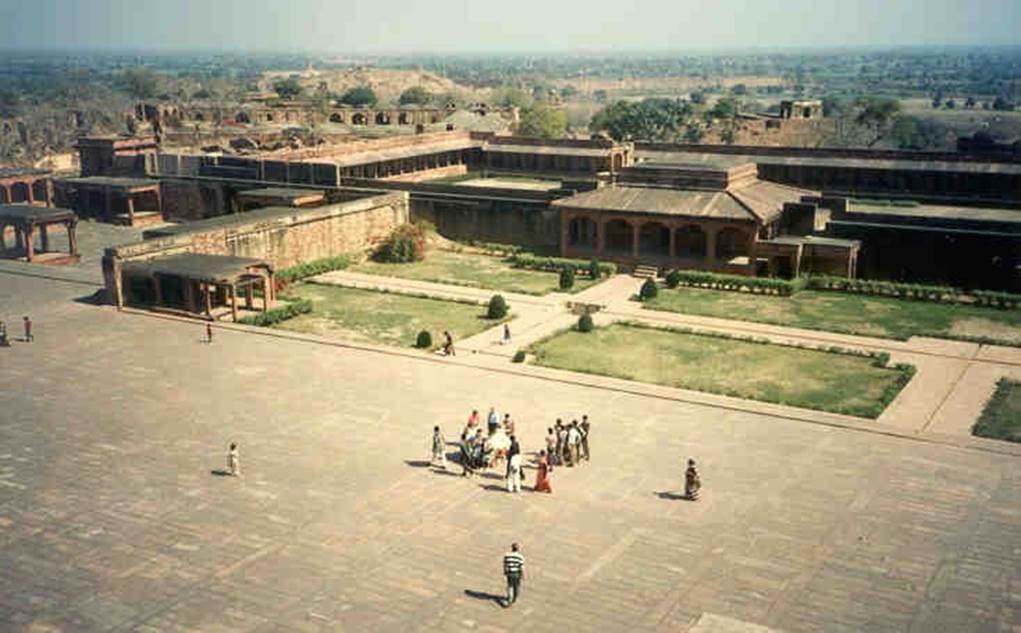
Photo by author, 1989
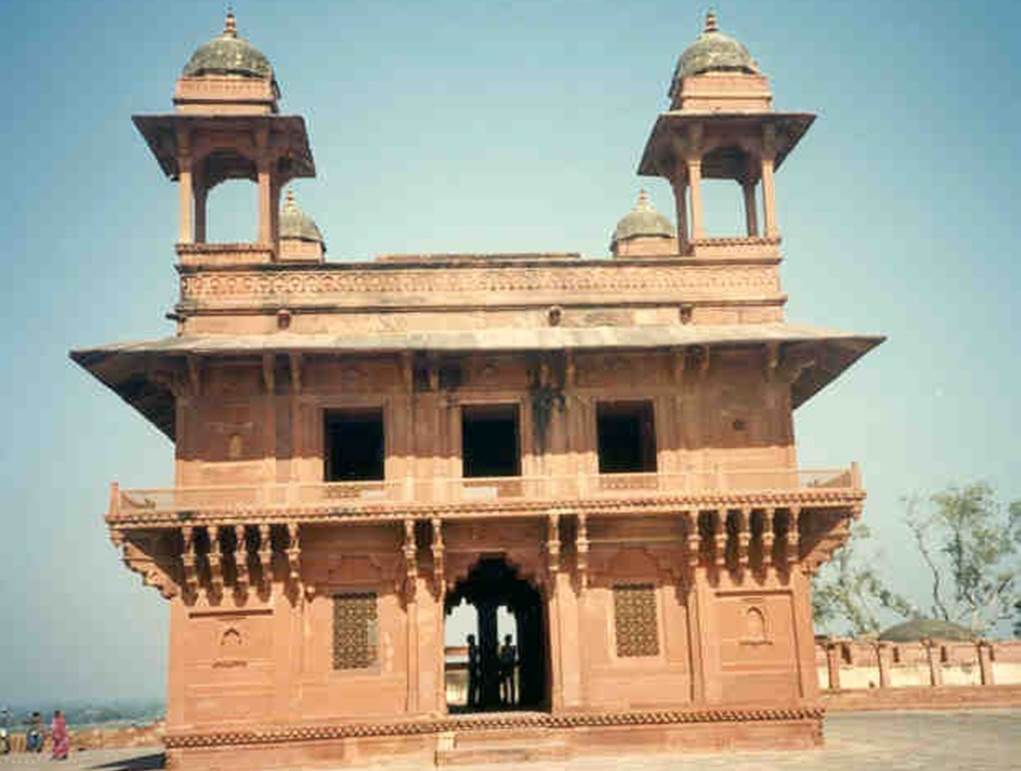
Diwan-i-Khas
This building is said to have been the place of the king’s office and at the same time a place for private audiences.
The distinctive feature of this building is the placement of small chhatris, which are gazebos for shade, at the four corners of the flat roof.
Chhatri literally means canopy or umbrella, and is a characteristic of Mughal architecture, and also serves as a monument.
They are often placed at the top of Mughal buildings.
The photo below shows part of the Kuala Lumpur Central railway Station.
This building also has a Chhatri , an influence of the spread of Mughal architecture.
Central column with huge capitals
Inside, there is a central pillar as shown in the photo.
Thirty-six snake sculpture brackets support the beams on the upper floors.
At the top, there is a diagonal beam, and in the center there is a circular pedestal supported by a column with a huge capital.
Akbar receives audiences from this pedestal, with those seated on the floor on the first floor. Those receiving an audience stand on the floor on the first floor and look up at Akbar, who is seated on this central platform.
This centripetal audience structure can be seen as embodying the will to order the world with Akbar at its center.
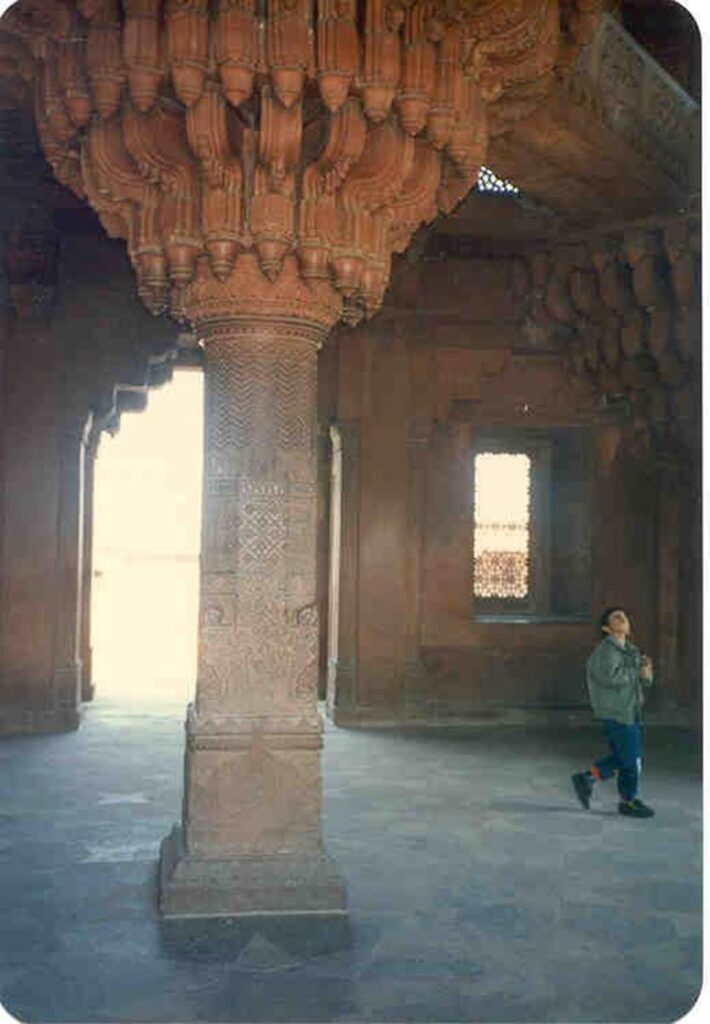
Photo by author, 1989
Anup Talao (man made pond)
Inside Akbar’s palace, there are no trees to provide shade.
This is probably because this dry plateau is not suitable for growing trees.
This man-made pond is the only garden that enriches the palace and is the focus of the palace.
There is a square island-shaped platform in the center, and I imagine that palace events such as songs and dances were held here day and night.
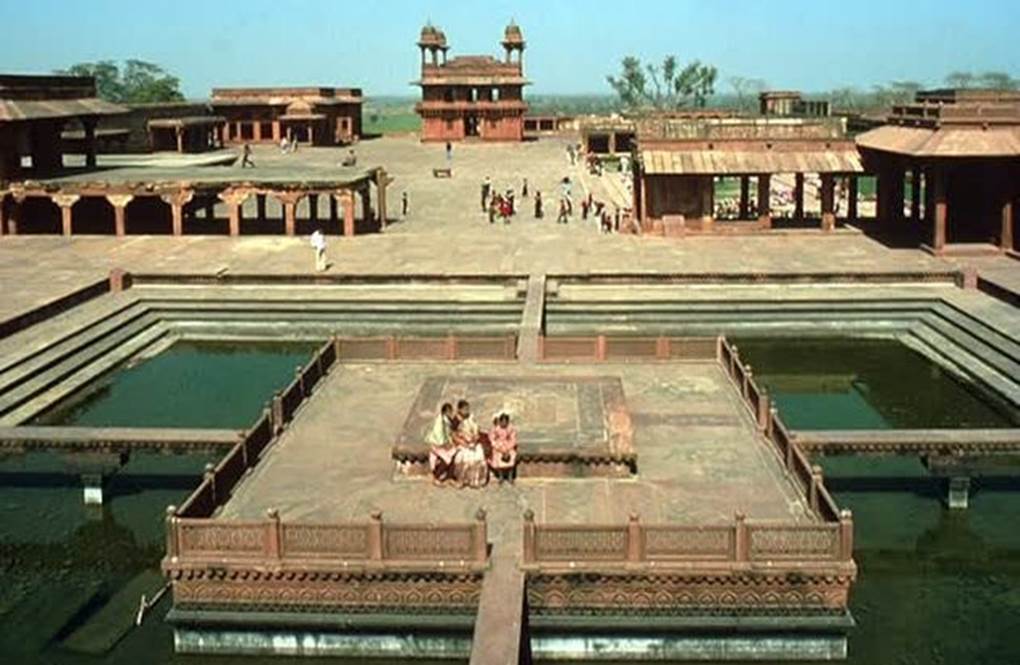
Photo by author, 1989
Khawabgah complex (Dream Palace)
On the north side of the Anup Talao pond in the photo below is the private space of Emperor Akbar.
There are rooms for various purposes, such as a closed room for meetings with the nobility, a room for official documents and books, a bedroom and a bathroom.
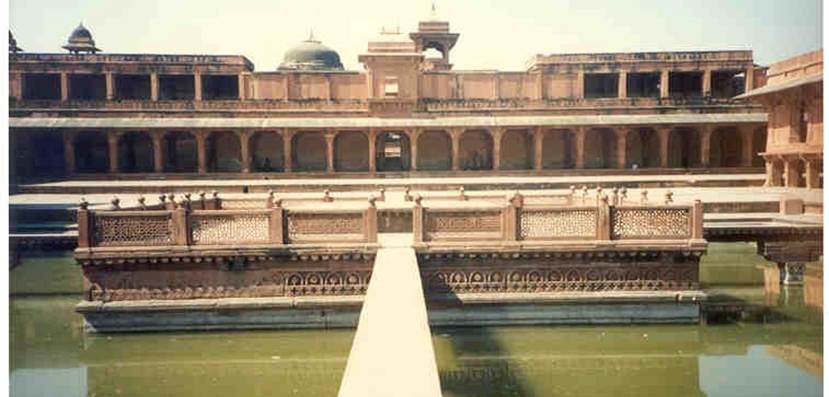
Photo by author, 1989
To the northwest of the pond, part of the private space of Emperor Akbar.
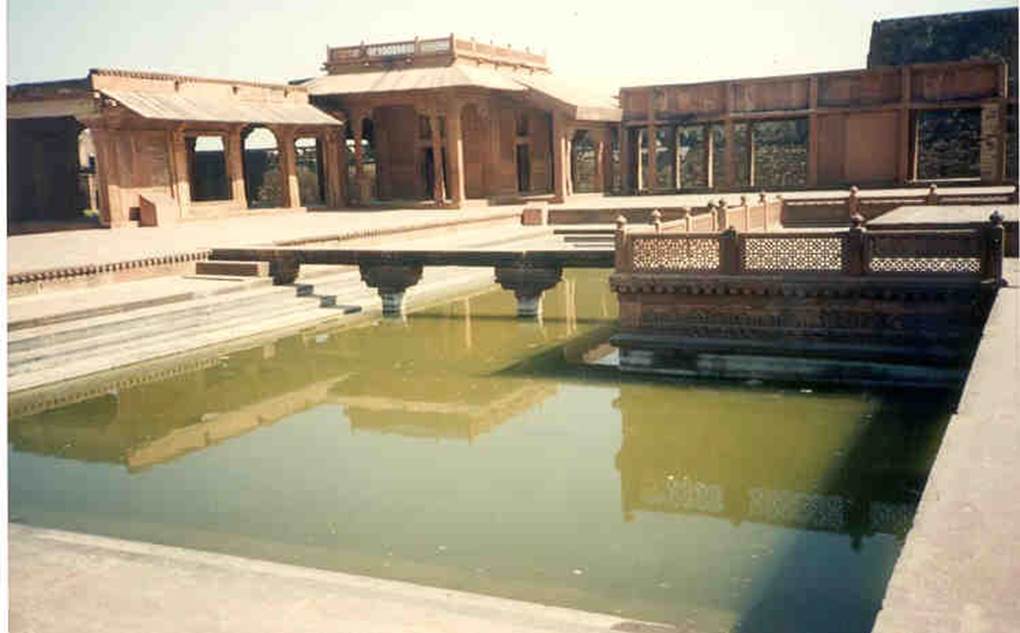
Photo by author, 1989
Panch Mahal
The five-storey building in this palace complex is called Panch Mahal and stands out from the rest of the individual buildings. A deep-eaves stone gazebo-style building called Chhatris (mentioned above) rises on the fifth level of the upper floor.
Looking up from the ground floor, it has a sublime feel. Another distinctive feature of this building is that it is set back as you go up the floors. Looking down from the fifth floor at the artificial pond and palace buildings below, you can experience the feeling of being a Maharaja.
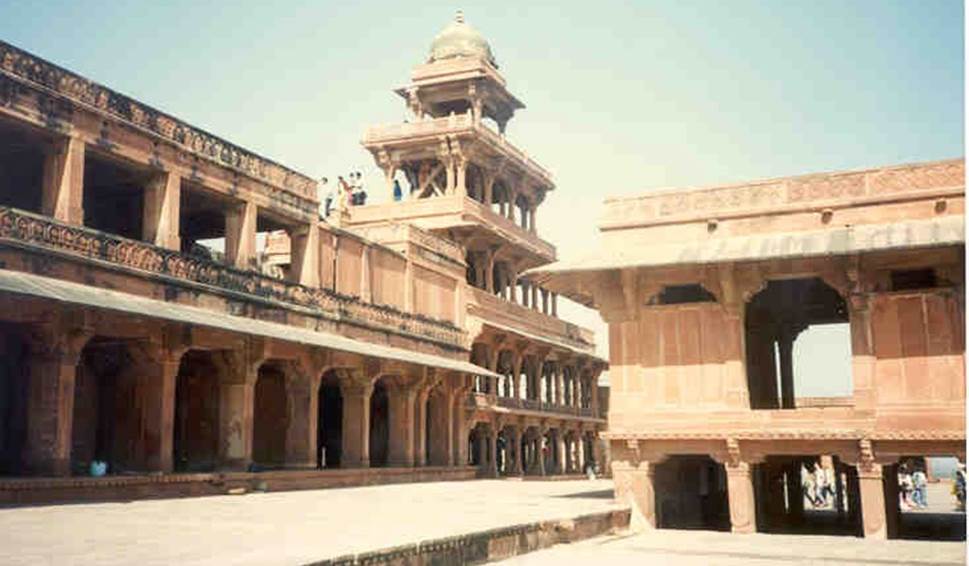
Photo by author, 1989
The name means the palace (mahal) of the five (panch) layers. It is characterized by the fact that there are no walls at all, and the four circumferences are composed only of independent columns. Excellent ventilation. It seems that it was not a place for habitation, but a place for cooling and recreation, making use of the evaporative cooling of the adjacent artificial pond.
The building consists of columns, beams, and railings. This open and relaxed feeling is reminiscent of Japan architecture.
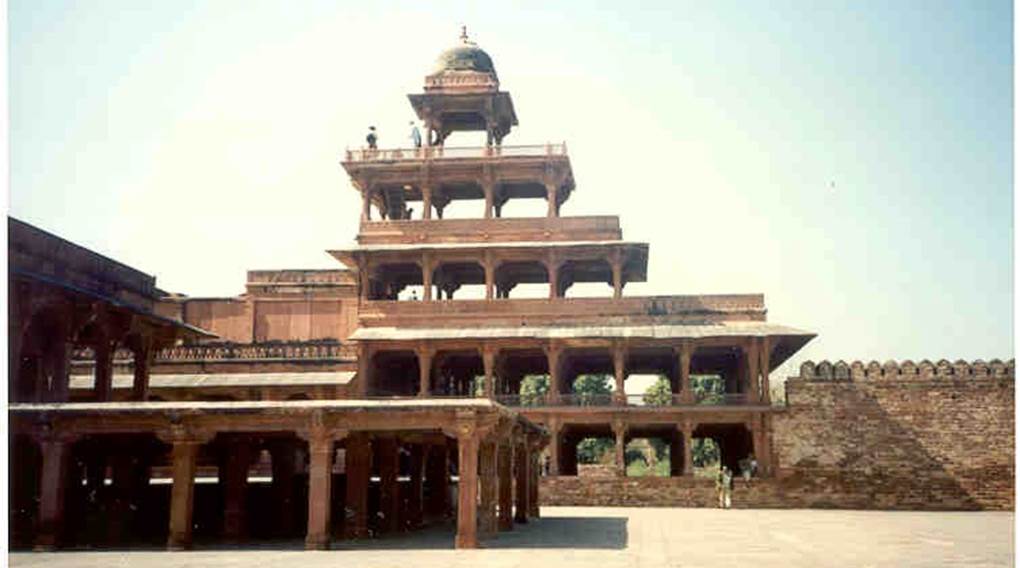
Photo by author, 1989
The top of the palace of the five (panch) layers. There were quite a few people there.
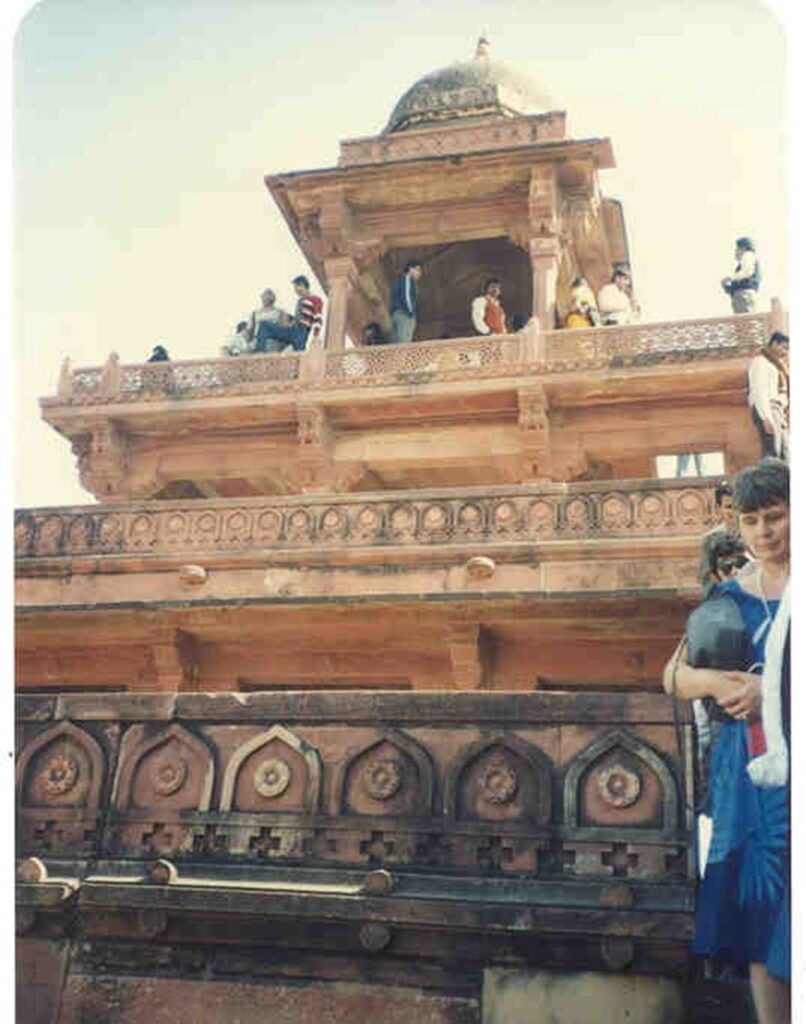
Photo by author, 1989

Photo by author, 1989
The ceiling floor is constructed of thick stone, and no plaster or glue is used at the seams.
There were traces of rainwater seeping out during the rainy season.
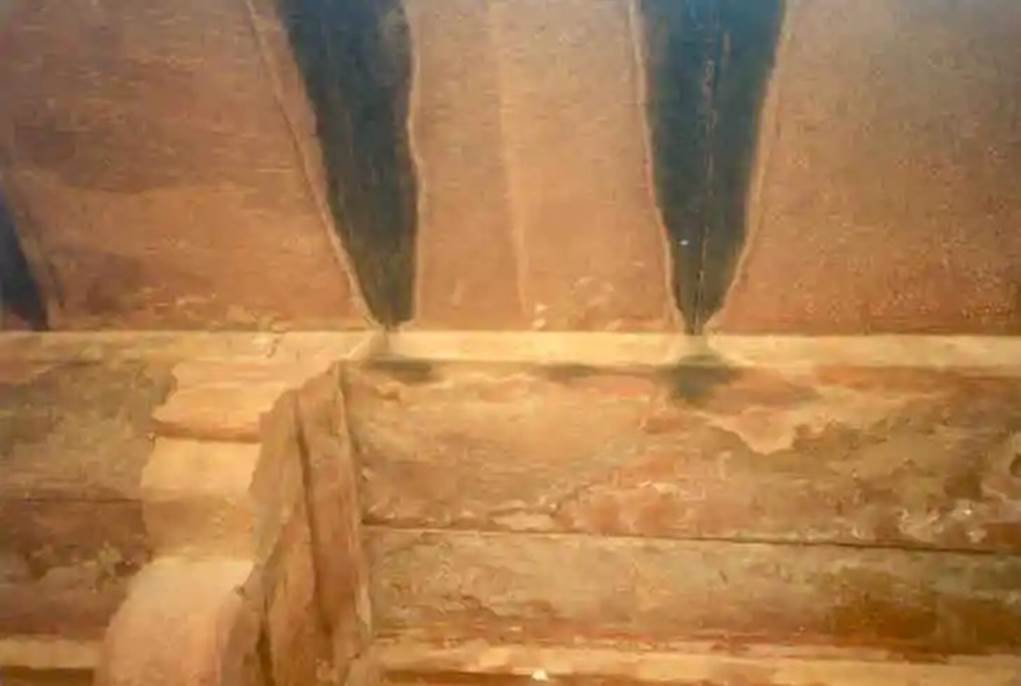
Photo by author, 1989
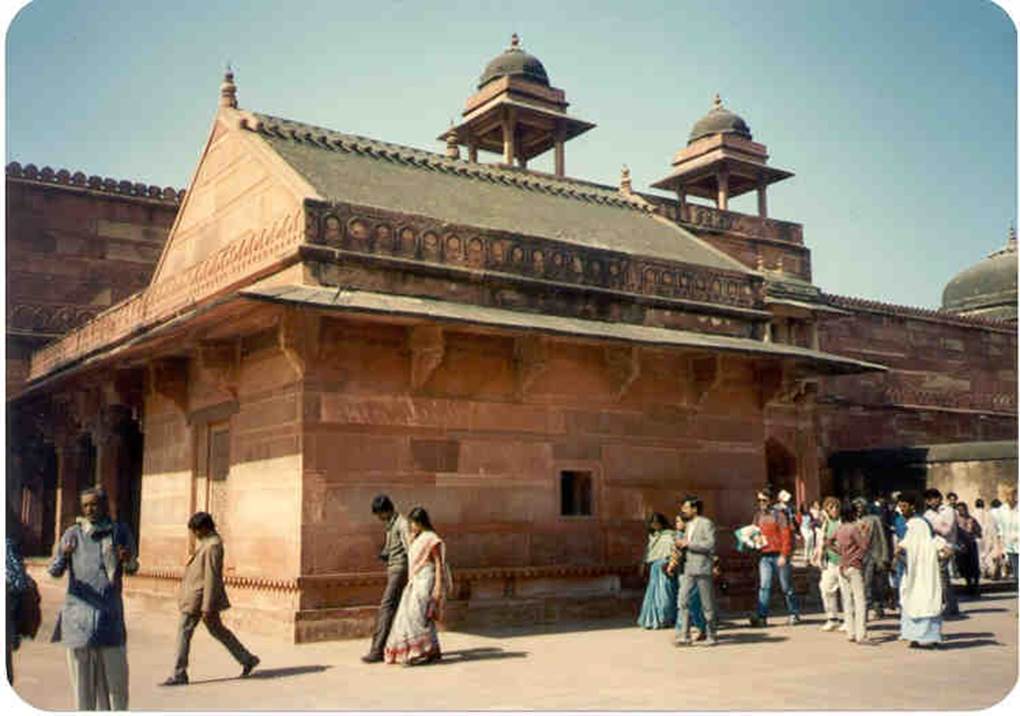
Photo by author, 1989
The lowest level of the Panch Mahal.
I visited in February, which is winter, but this shady, well-ventilated space would surely be very comfortable in the hotter months.

Photo by author, 1989
Indian red sandstone is continuously used as a building material, so there is a sense of unity.
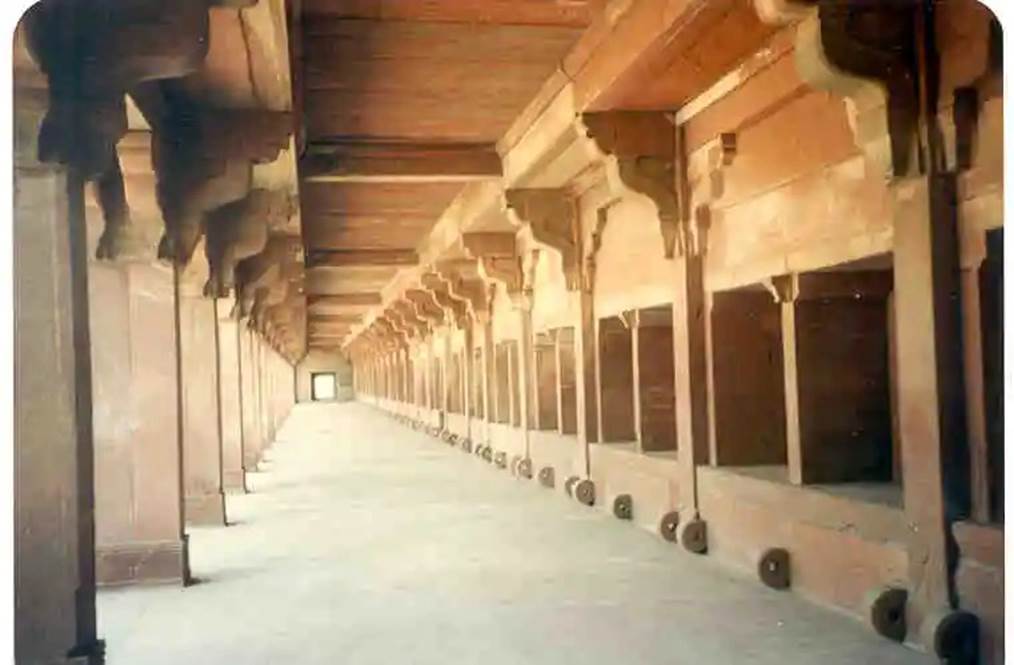
Photo by author, 1989
Fatehpur Sikri was built by the Islamic conquering dynasty, but if you look closely at the details of the building, you can see that the architectural methods and designs of Hindu temples that have been passed down for a long time, such as the shape of the pillars and the brackets that support the beams, have been inherited.
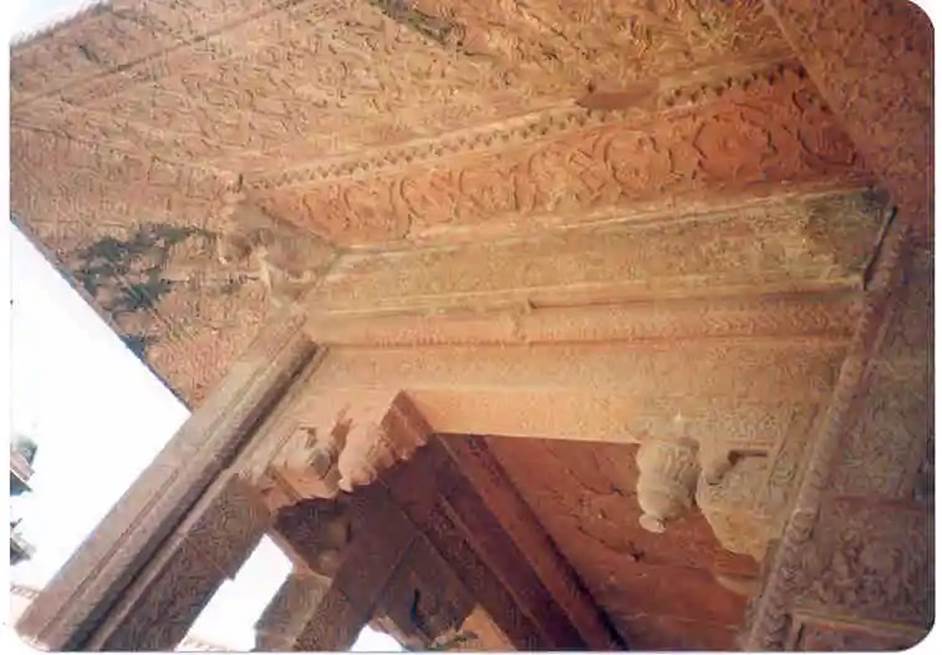
Photo by author, 1989
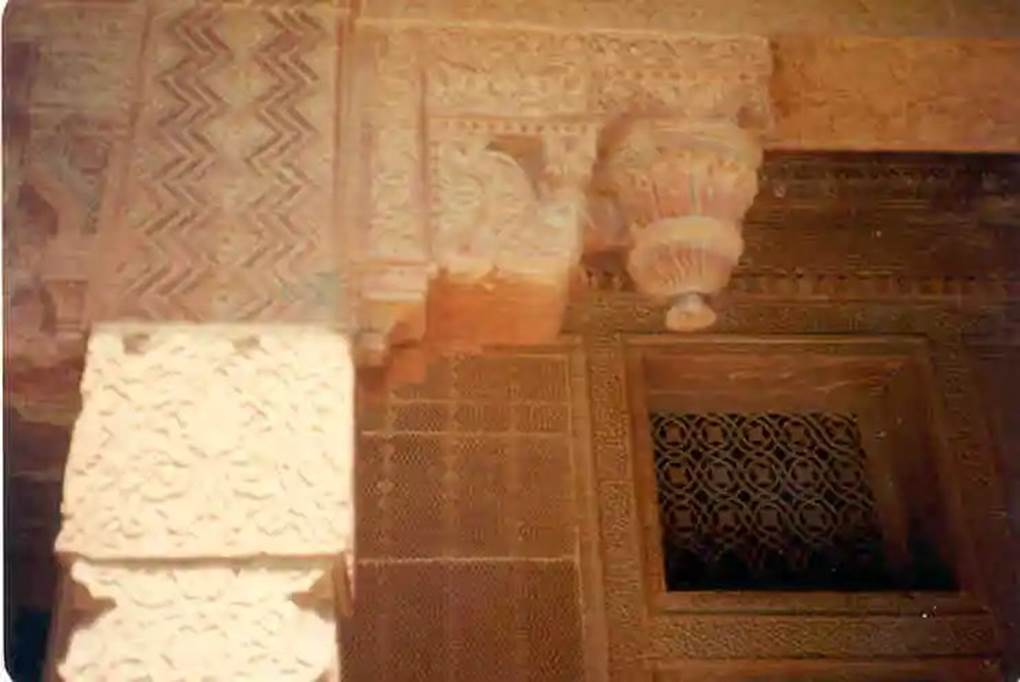
Photo by author, 1989
Photographed from the upper floor of Panchmahal.
Palace of Maryam in the background.
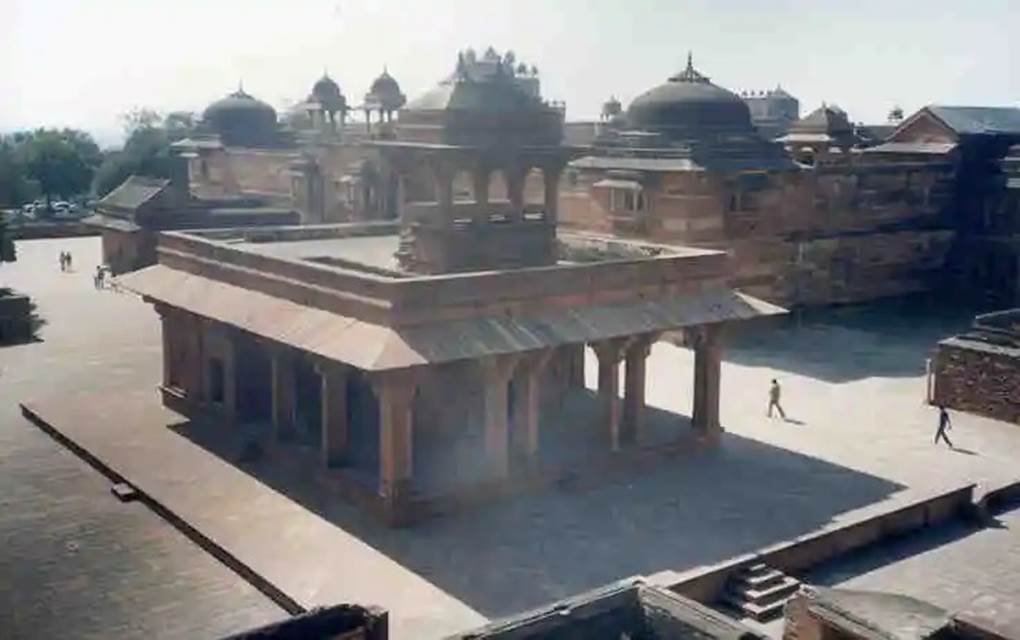
Photo by author, 1989
Jodha Bai (Mariam-uz-Zamani)’s Palace:
The exclusive palace of the third wife of the Mughal king Akbar.
She is the mother of Jahangir, the next king of the empire, and the grandmother of the next king, Shah Jahan. It was luxuriously furnished.
Akbar recognized that his wife Maryam was a Hindu and allowed a Hindu temple to be built inside the palace.
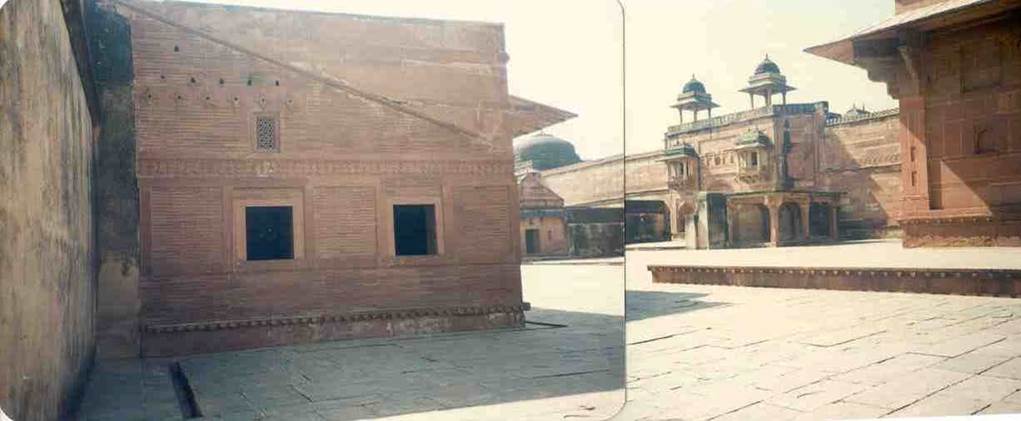
Photo by author, 1989
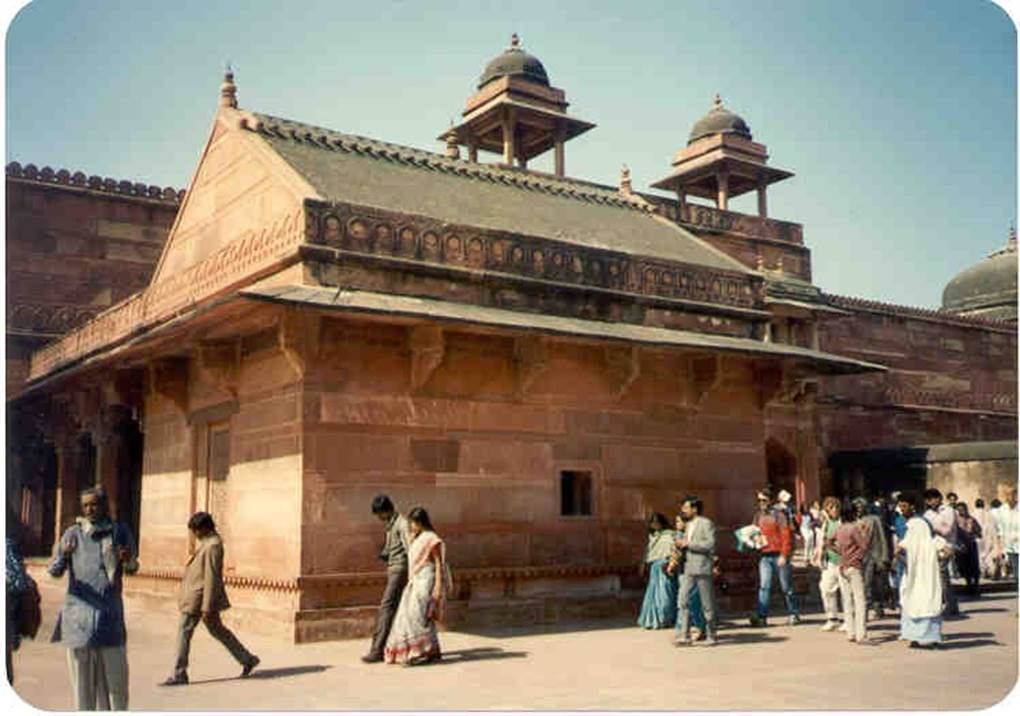
Photo by author, 1989
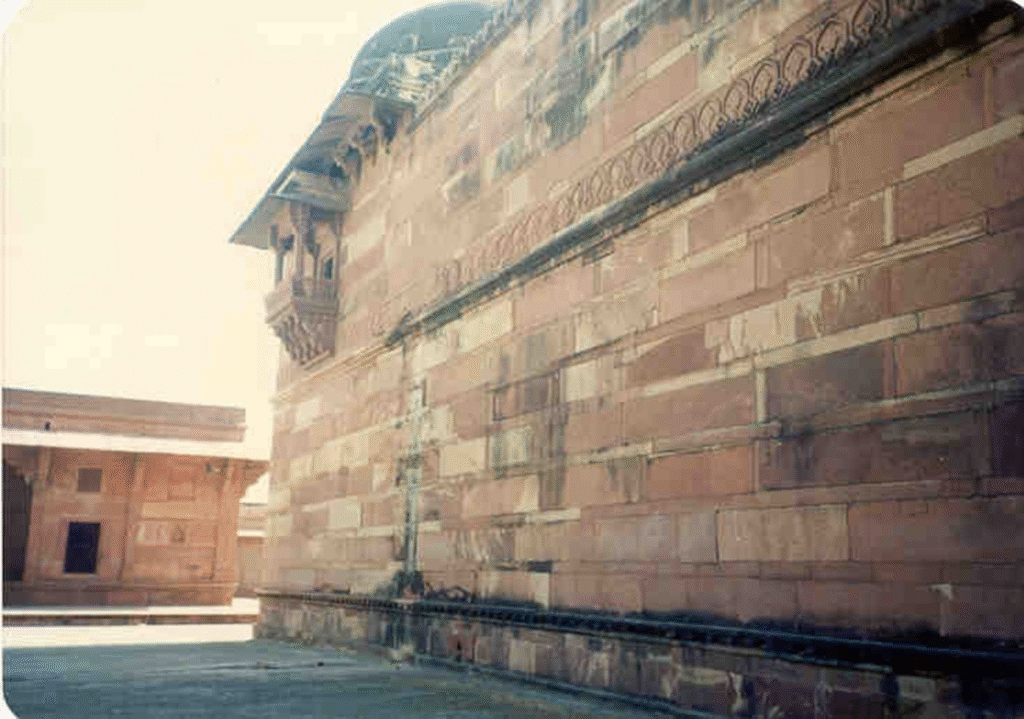
Photo by author, 1989
Birbal’s House:
The residence of Emperor Akbar’s favorite minister, Birbal. Deep eaves for awning, called chaj as, cover all four sides. Birbal is a Hindu, so the building is designed for him. Adjacent to it are the palace’s own camel and horse stables.
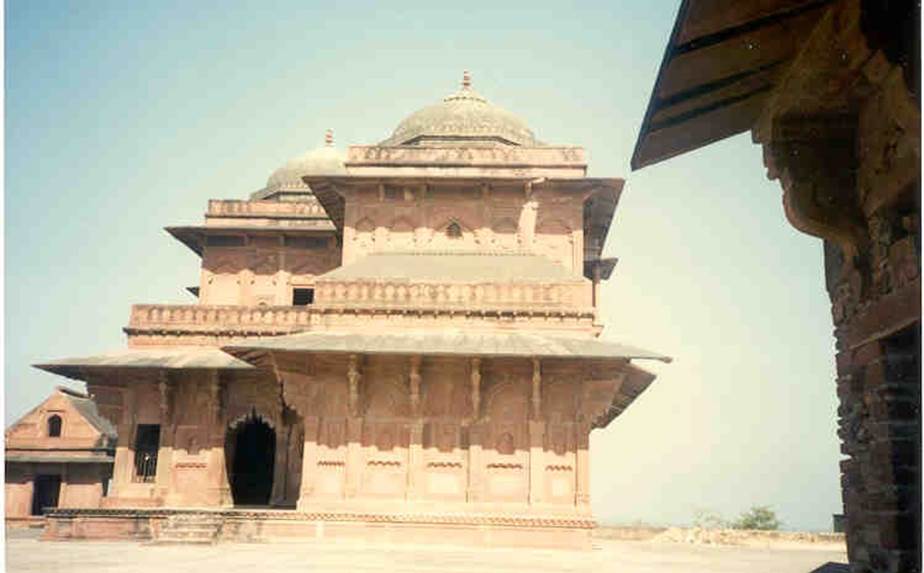
Photo by author, 1989
Jama Masjid: Friday Mosque
UNESCO World Heritage Site
To the southwest of Akbar Palace is the independent Friday Mosque.
The Jama Mosque is one of the earliest places of prayer in the Fatepur Sikri archaeological complex.
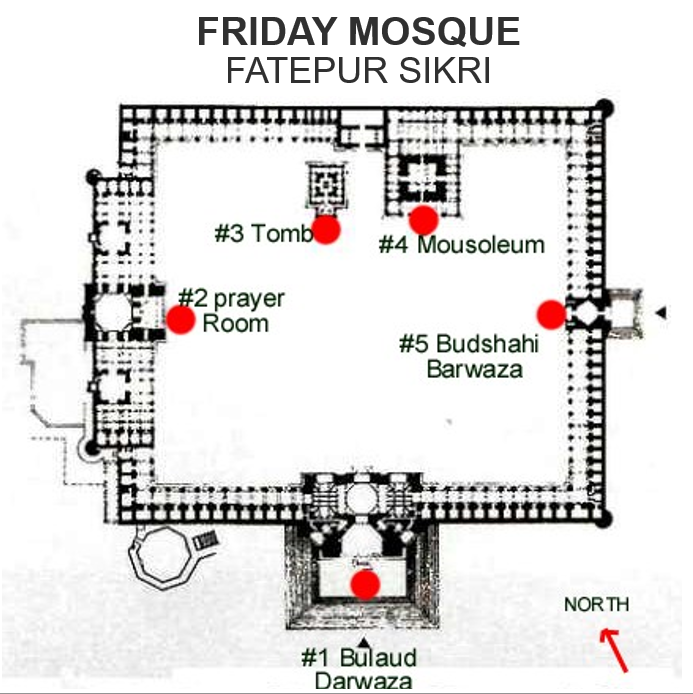
In the following, I have tried to explain the architectural composition of Islamic mosques, using this Friday mosque as an example.
#1 Gate of Buland-Darwaza Friday Mosque
The entrance gate to this huge plaza space is called Buland-Darwaza.
It has a height of 40 meters.
To enter a religious site, you have to take off your shoes and change into cloth bag-like footwear. You have to pay for it and change into a bag of cloth shoes prepared exclusively for mosques.
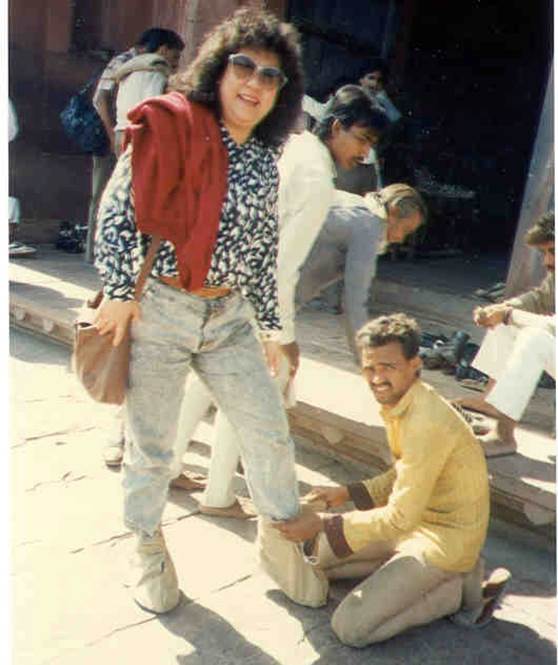
Photo by author, 1989
Aiming for a dramatic effect when entering a religious site, a huge steep staircase is placed in front of the gate. The gate of the Friday Mosque was built to commemorate Akbar’s conquest of Gujarat.
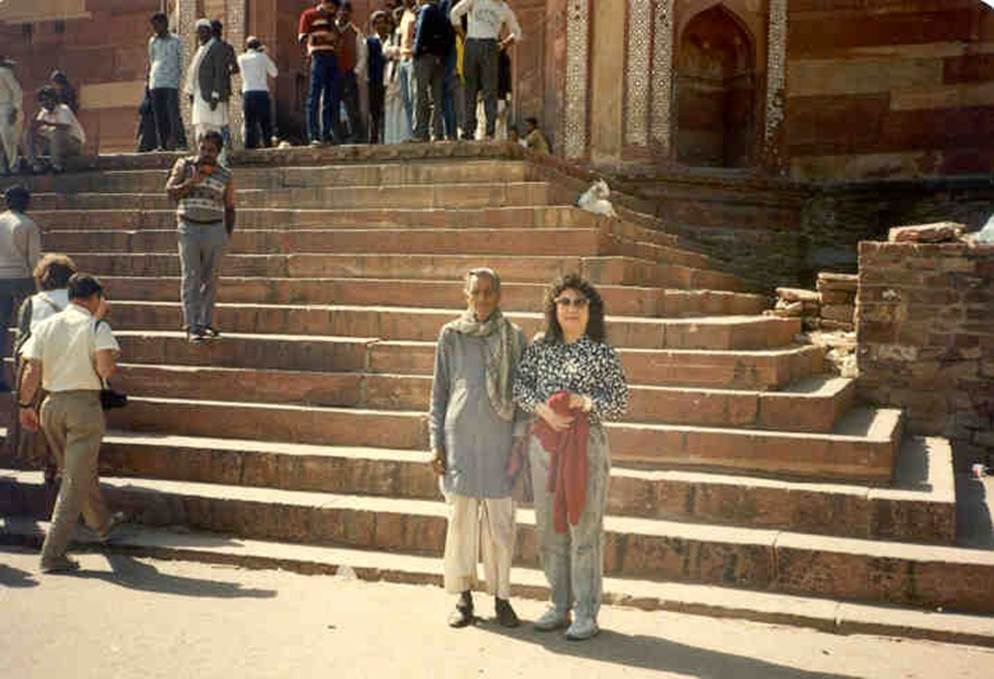
Photo by author, 1989
It has a huge iwan (see below) on the front, and countless chatri (see above) on the top and back. It’s too big to fit in one photo. The composition of red sandstone and white marble is stunning. Is the black one a bat’s nest?

Photo by author, 1989
Half-dome Ewan
This form is called “Chahar Iwan” (4 Yiwan)
Ewan refers to an open-fronted space covered with a semi-dome in Islamic religious architecture. It originated in ancient Persian architecture. In Persian mosques from the 11th century onwards, an iwan was placed in the center of each of the four sides of the courtyard, and these were connected to form an open corridor that surrounded the courtyard. Special effort was put into the design and construction of the iwan at the main entrance.
#2 PRAYER ROOM
The building in front is the worship space with an ewan at its center.
In this building, we pray in the direction of Mecca (westward).
The white building on the right is a mausoleum. Covered with deep white chajjas.
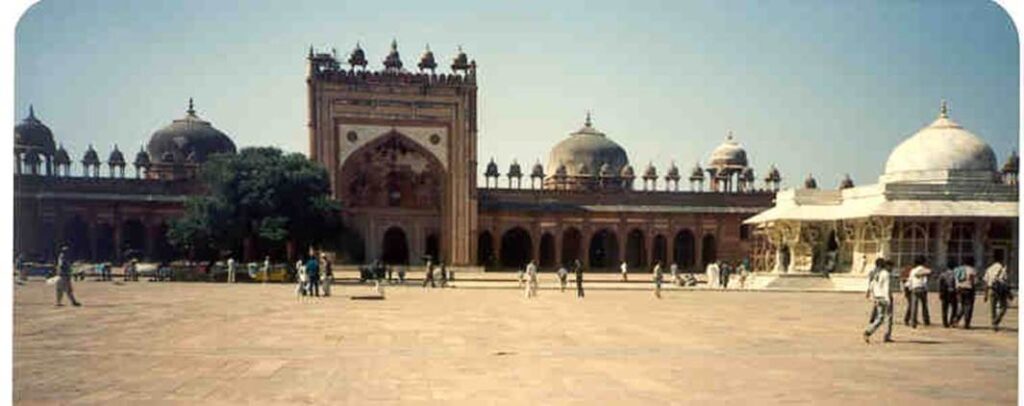
Photo by author, 1989
Above the prayer hall building, there is a row of chatri (mentioned above).
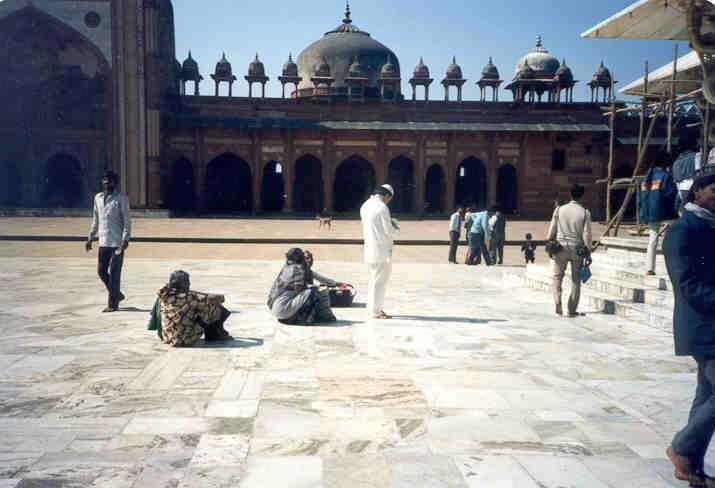
Photo by author, 1989
#3 TOMB
Marble columns and carved snake brackets support the awning canopy (chajjas). The marble carvings around this pillar are delicate and dense.
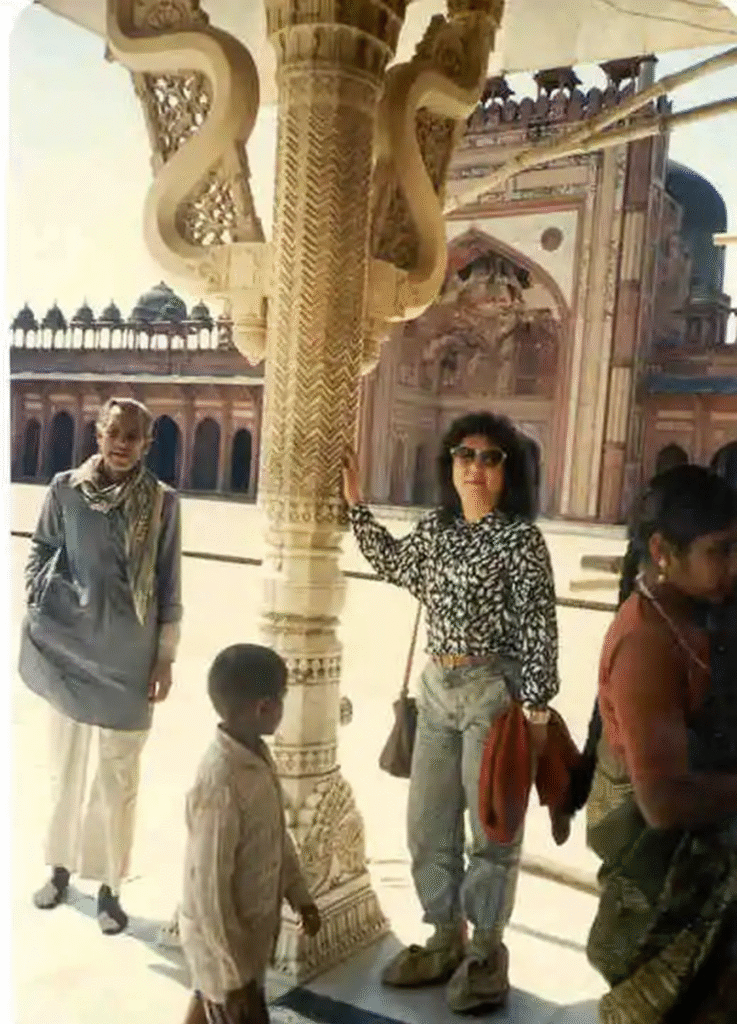
Photo by author, 1989
Inside the mausoleum. The base tone of the finish is white marble

The sunlight filtering through the white marble screen hits the floor, creating ever-changing patterns.
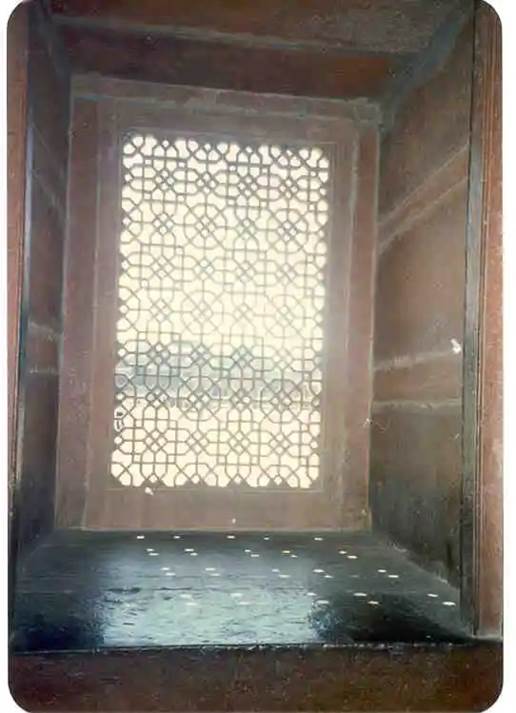
Photo by author, 1989
#4 MOUSOLEUM
The chhatri above the perimeter of the building is more decorative than practical.
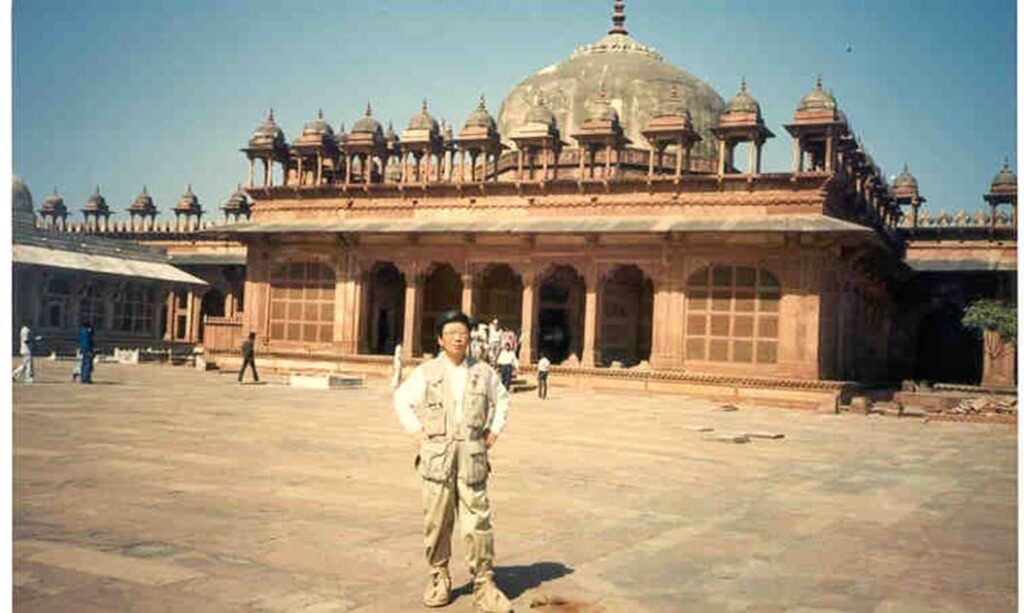
Photo of author, 1989
Fatehpur Sikri has been inscribed on UNESCO as a cultural heritage site, but the Friday Mosque is still in active use.
When I went outside, I saw a family selling fruit under the blazing sun.
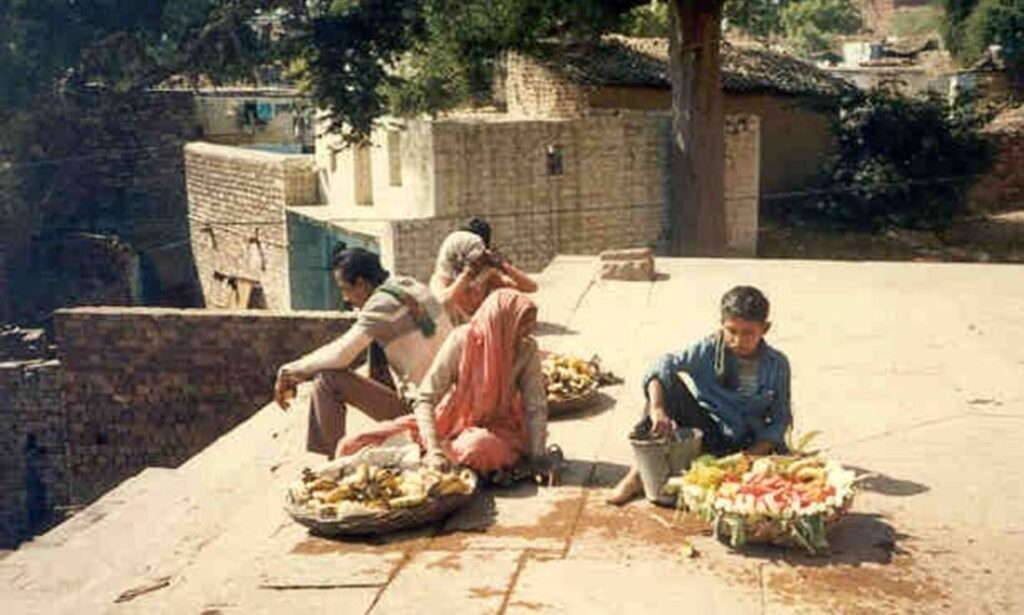
Photo by author, 1989