JAP | ENG
India Travelogue 1989
#9/26
Taj Mahal, Agra
Taj Mahal, World Heritage Site
The Taj Mahal site is approximately 300m east to west and 560m north to south, with the entrance on the south side.
If you go through the Great Gate in the south and proceed north through the large garden, you will come to a huge white marble building (mausoleum) in the center of a corner facing the Yamuna River at the northern end of the site.
At the western end of this is a mosque, and at the eastern end is a guest facility. (see Map below)

The Taj Mahal was built by Shah Jahan, the fifth Mughal emperor. It is the tomb of his beloved wife, Mumtaz Mahal. Construction began in 1632 and was completed in 1653, a major project that lasted 21 years.
The tomb is made entirely of marble, the materials being brought from Jaipur in Rajasthan (mentioned in earlier post), while the red sandstone for the mosque on the west side and the guest house on the east side is said to have been brought from the quarry in Fatehpur Sikri (mentioned in earlier post).
She is said to have died at the age of 36 while her husband was serving in the military. Our guide said that the Queen had given birth to 14 children by the age of 36. That’s hard to believe.
We bought our tickets in front of the Great Gate. There are a lot of tourists from all over the country here
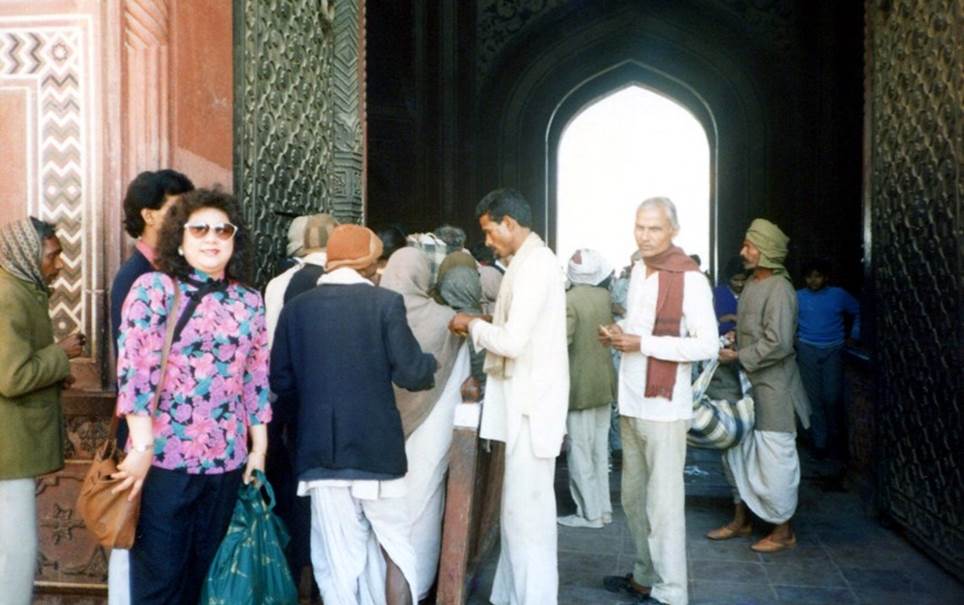
Photo by author, Feb 7 & 8, 1989
Once you pass through the GREAT GATE, this view appears.
A white building appears far beyond the vast garden.
This white building is a mausoleum, and with four 42m-high minarets placed at the four corners of the base, the design was carefully designed to create a sense of perspective and maintain visual balance, and it has been successful in doing so.
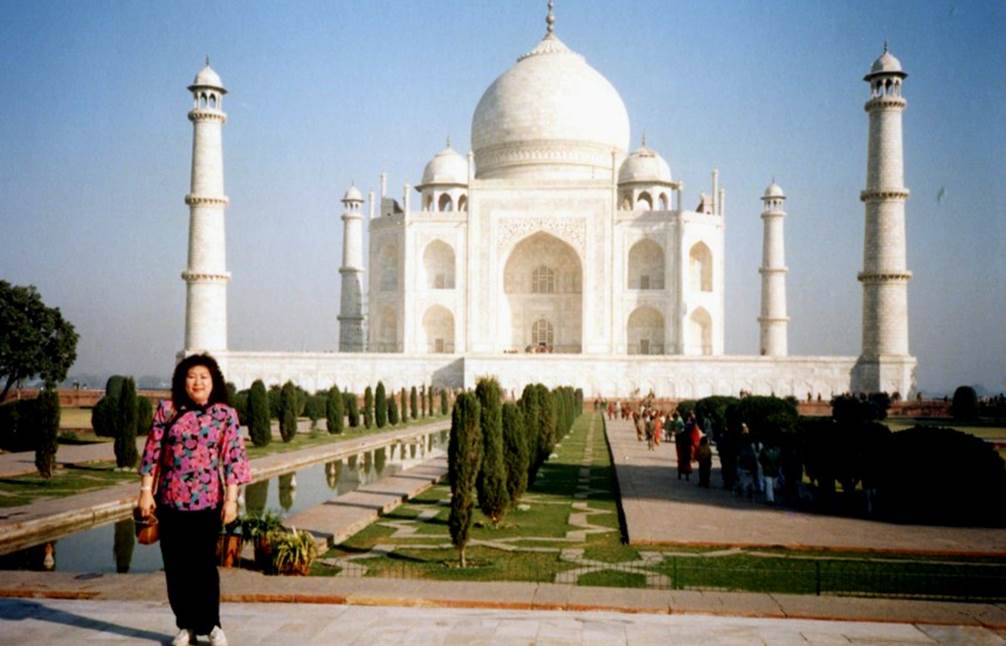
Photo by author, Feb 7 & 8, 1989
A white building ! All made of white marble!
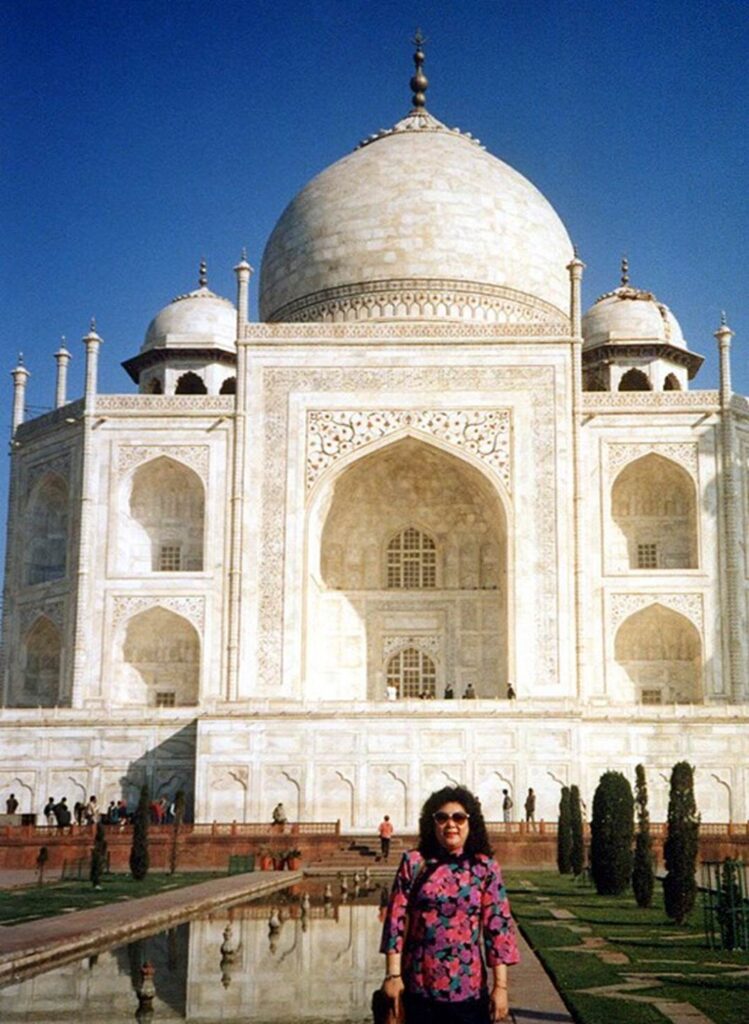
Photo by author, Feb 7 & 8, 1989
Just before the marble platform, visitors change into the provided slippers, which is mandatory for all visitors.
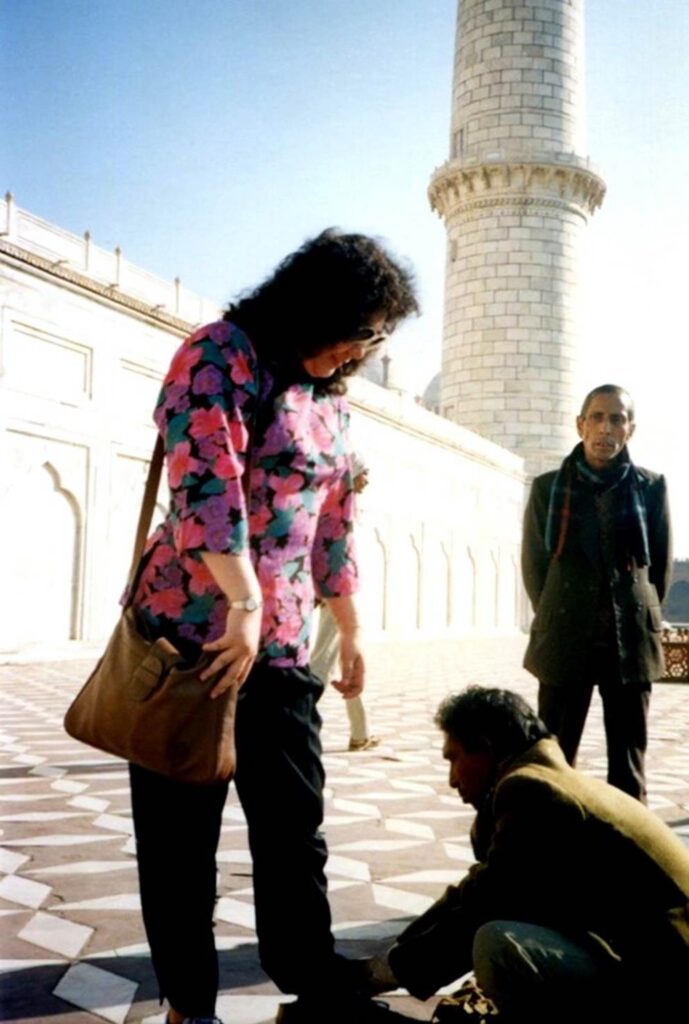
Photo by author, Feb 7 & 8, 1989
The façade of the building is composed of five large and small ewans (half-domes), and the proportions are exquisite.
The ceiling of the dome is also all white marble!
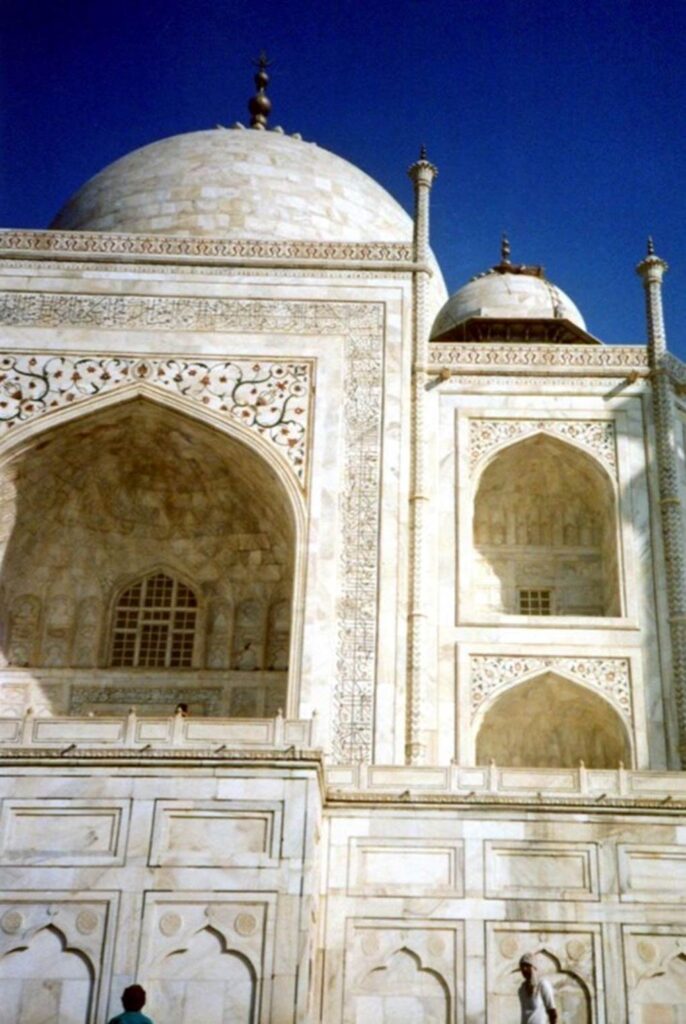
Photo by author, Feb 7 & 8, 1989
The four corners have been carved away to create a deformed octagon, and an iwan (half dome) is also installed there. The dome ceiling is also made of intricately crafted white marble!

Photo by author, Feb 7 & 8, 1989
A pure white minaret shines in the blue sky.

Photo by author, Feb 7 & 8, 1989
A minaret is placed at the corner of the building’s base. In the background is a red sandstone reception facility (guest house). The lower part of the base on the north side is also made of red sandstone. (Below) This is the northern end, and the Yamuna River flows to the north, from which you can get a panoramic view.
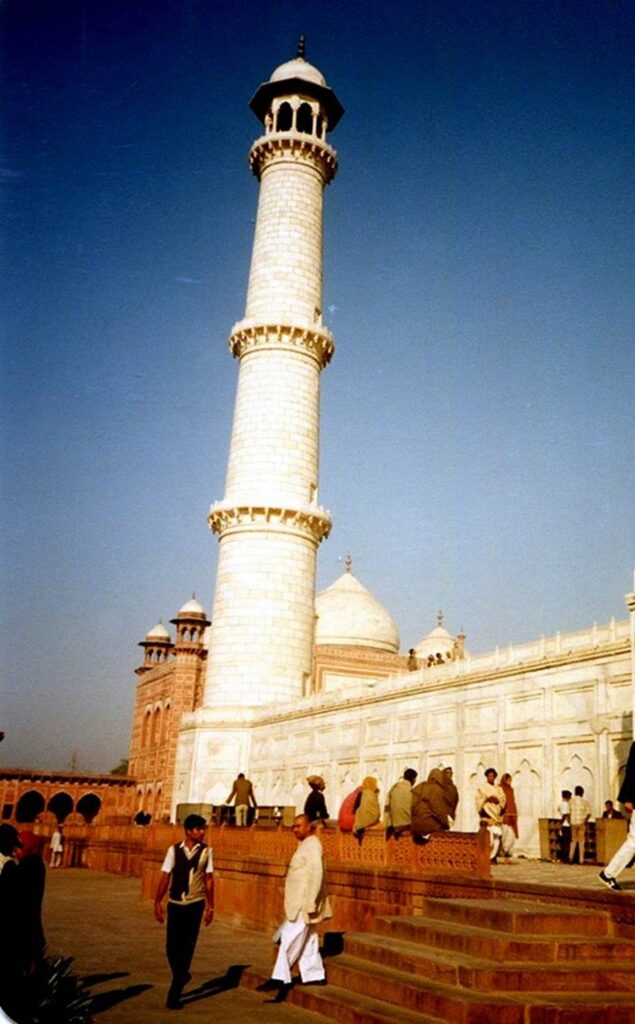
Photo by author, Feb 7 & 8, 1989
The entrance to the basement.
Going down, you will find the queen’s sarcophagus.

Photo by author, Feb 7 & 8, 1989

Photo by author, Feb 7 & 8, 1989
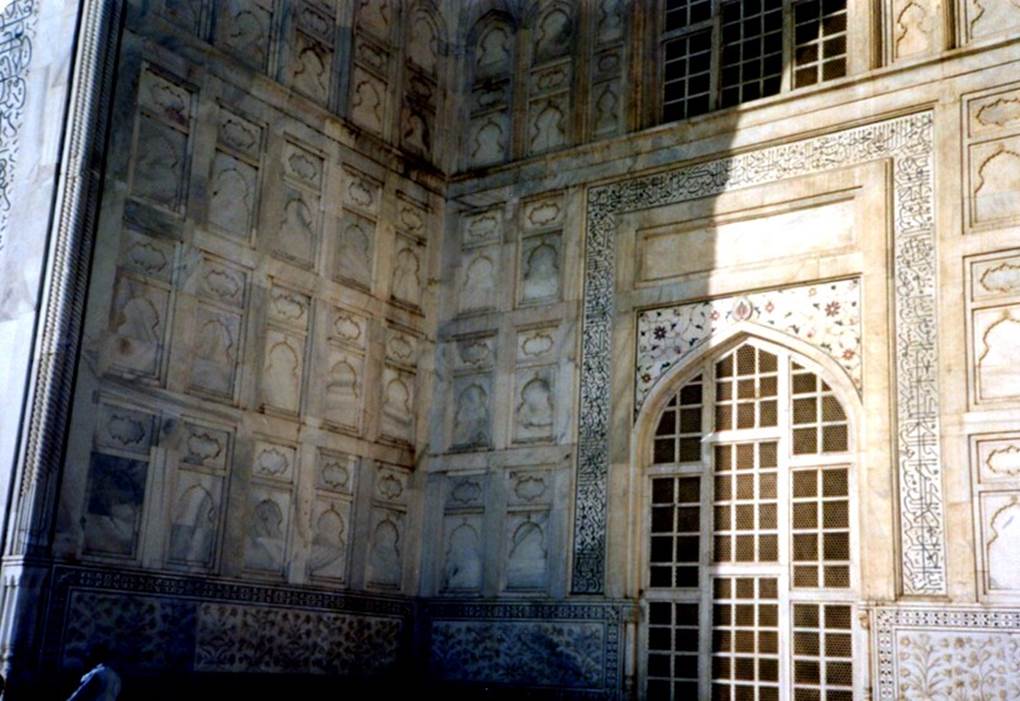
Photo by author, Feb 7 & 8, 1989
The crowd returns home after the viewing.

Photo by author, Feb 7 & 8, 1989
There are various types of natural stone used for the exterior of buildings.
Among them, white marble is one of the materials that is vulnerable to ultraviolet rays from the sun.
It is also susceptible to the chemical effects of air pollutants.
It will take extraordinary efforts to maintain the beauty of the natural stone exterior of this mausoleum for many years to come.

Photo by author, Feb 7 & 8, 1989
After ending the tour, we will head to our next destination, the Red Fort in Agra city.

Photo by author, Feb 7 & 8, 1989
Shah Jahan is said to have wanted to build a black marble tomb for himself across the Yamuna River to rival the Taj Mahal, but this never came to fruition.

Agra Red Fort,
UNESCO World Cultural Heritage Site
The map above shows the location of the Red Fort and the Taj Mahal in Agra.
Akbar the Great began construction of the castle in 1565 and completed it in 1573. This was 80 years before the start of construction of the Taj Mahal.
Later, the residence of Akbar the Great was inherited by the third generation of Shah Jahan. After that, a succession struggle arose between his sons, and Aurangzeb won the succession battle. He was the father of Shah Jahan.
As a result of the feud with his father Shah Jahan (the builder of the Taj Mahal), he imprisoned Shah Jahan in the Tower of Imprisonment (Musamman Burj) in the fort and moved to Delhi.
Amar Singh Gate
Amar Singh Gate is the tourist entrance to Agra Fort. This gate of the Agra Fort, surrounded by red sandstone walls, is heavy and quite tall, and the inside of the gate is triple-layered for added defence.
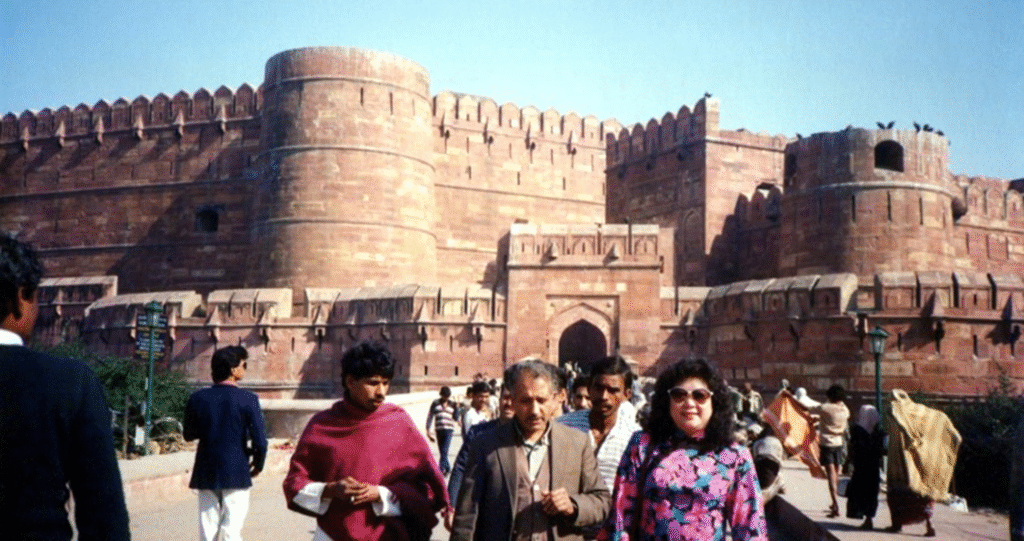
Photo by author, Feb 7 & 8, 1989

Photo by author, Feb 7 & 8, 1989
The ramp leading to the defensive gate. It is paved with non-slip cobblestones.
There is also a small gutter for storm drainage.

Photo by author, Feb 7 & 8, 1989

Photo by author, Feb 7 & 8, 1989
To reach the palace within the castle, one must pass through an access road surrounded by high walls like this one and go through several gates.

Photo by author, Feb 7 & 8, 1989
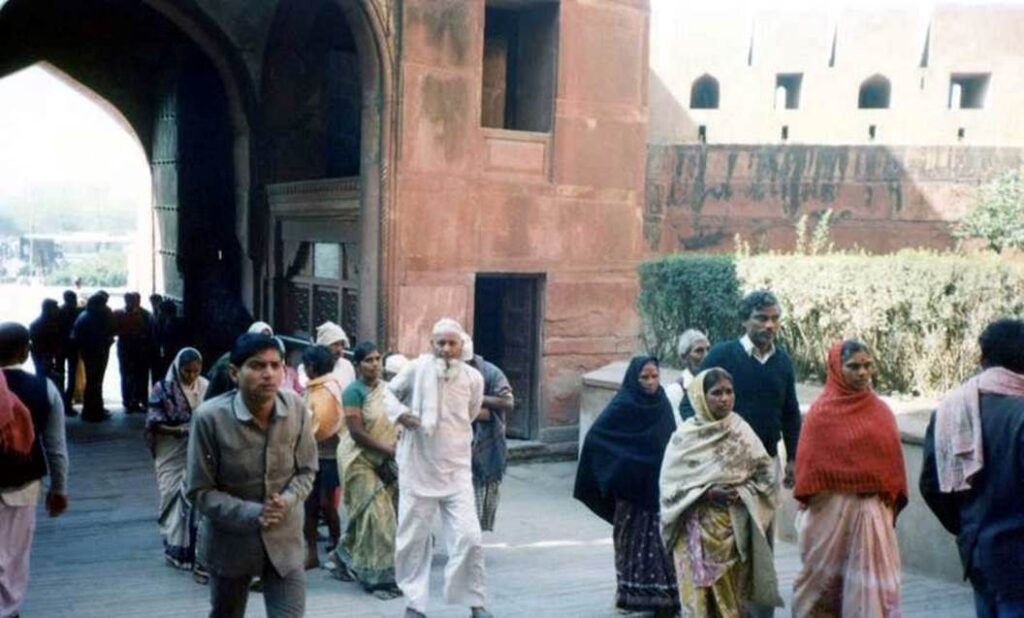
Photo by author, Feb 7 & 8, 1989
The Captive Tower
It is said that Shah Jahan (the founder of the Taj Mahal) used to look at the Taj Mahal that he had built from this place in the Agra Fort where he was imprisoned every day and remember his beloved Queen Mumtaz Mahal.
Shah Jahan must have envisioned the construction of his own black marble mausoleum on the opposite bank of the Yamuna River

Photo by author, Feb 7 & 8, 1989
Shah Jahan (the founder of the Taj Mahal) was imprisoned here.
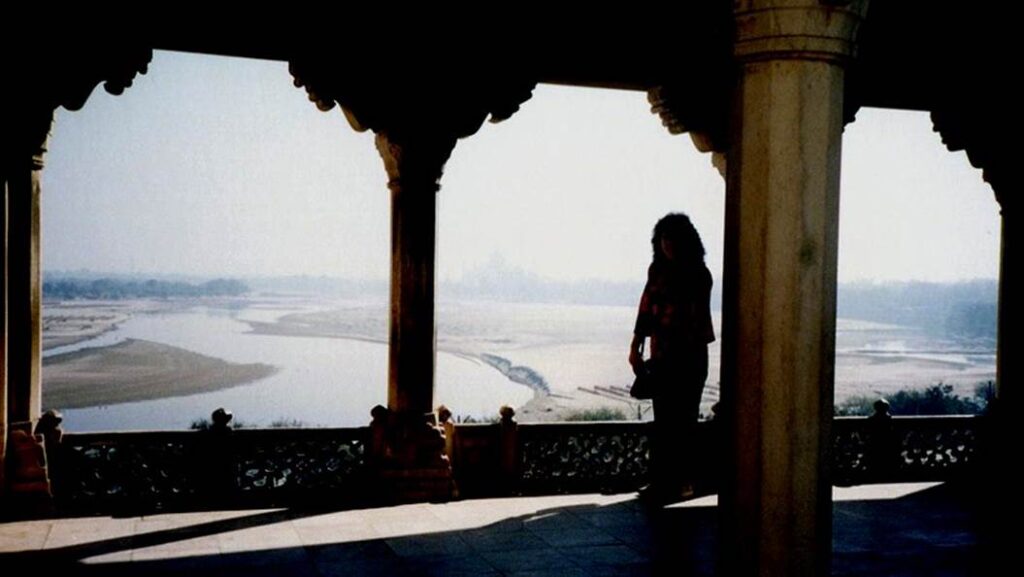
Photo by author, Feb 7 & 8, 1989
The slightly protruding octagon at the far end is the Captive Tower.

Photo by author, Feb 7 & 8, 1989
Balcony overlooking the Yamuna River.
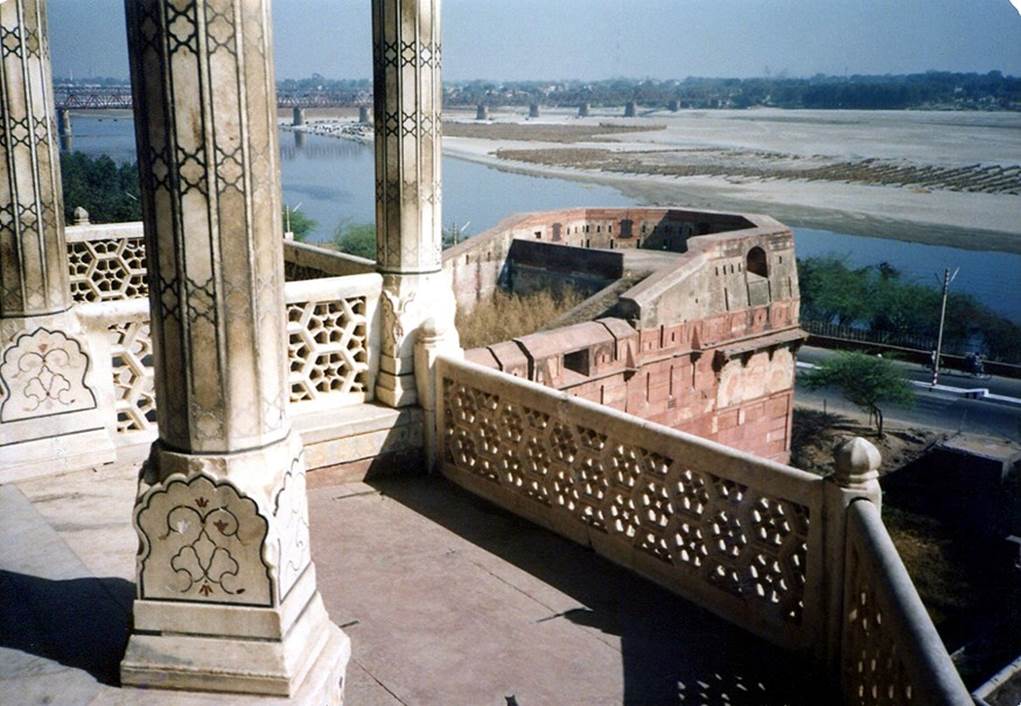
Photo by author, Feb 7 & 8, 1989
The Red Fort Fort in Agra was built by Akbar the Great and is made of red sandstone. The part made of white marble is said to have been made by Shah Jahan.
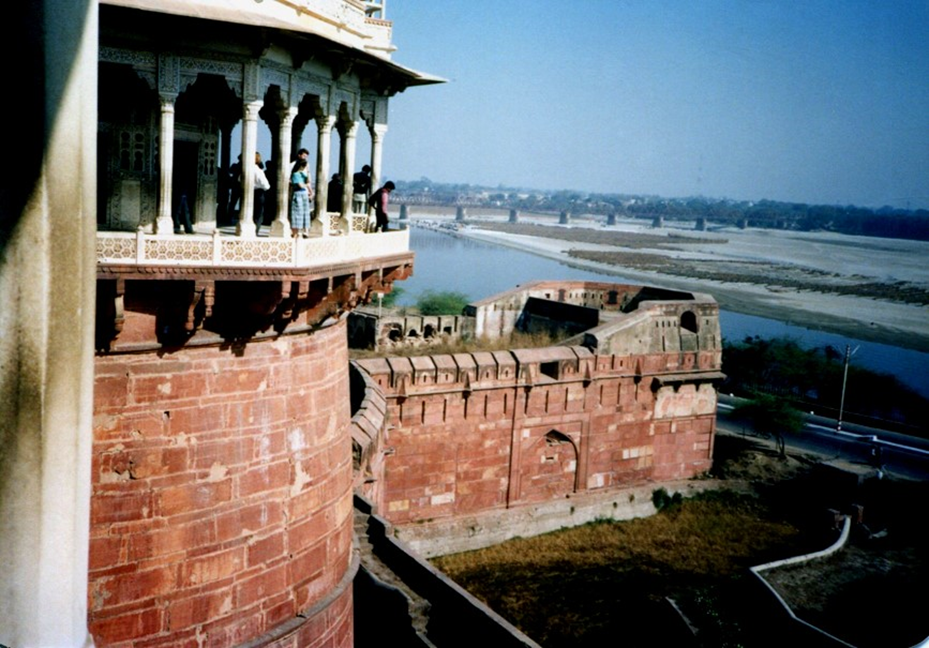
Photo by author, Feb 7 & 8, 1989
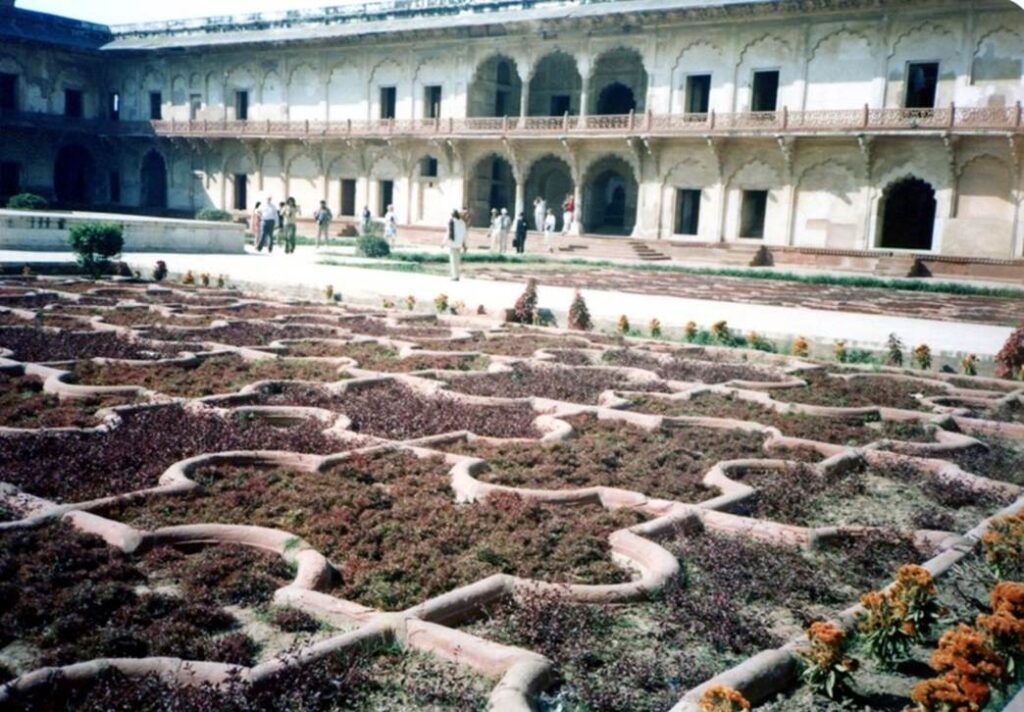
Photo by author, Feb 7 & 8, 1989
Audience Room (Diwani Arm)
Distant view of the Audience Room (Diwani Arm) in the palace within the castle. The place where the emperor’s throne is located in the back of the center is said to be designed so that it is hidden by a pillar from any angle.
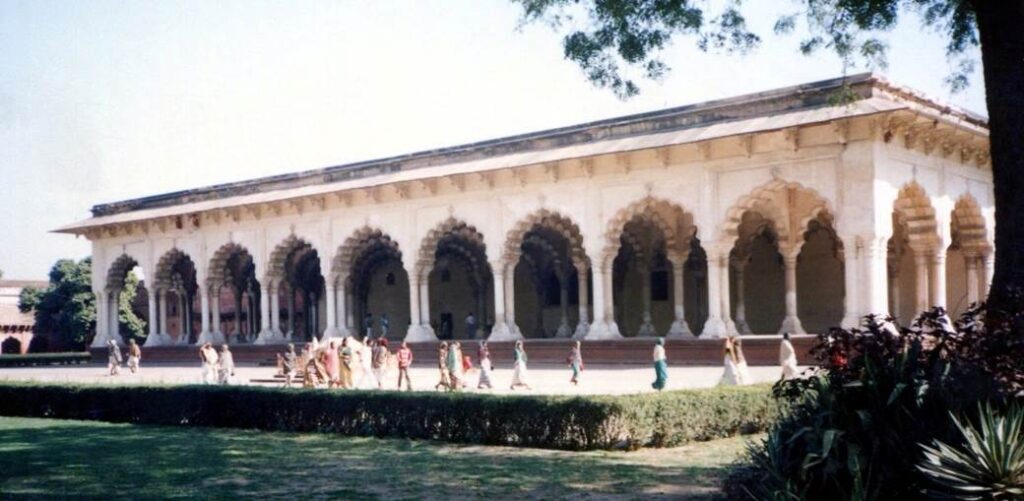
Photo by author, Feb 7 & 8, 1989
White marble water basin!
Fresh water was being drawn. It will be for washing your feet.
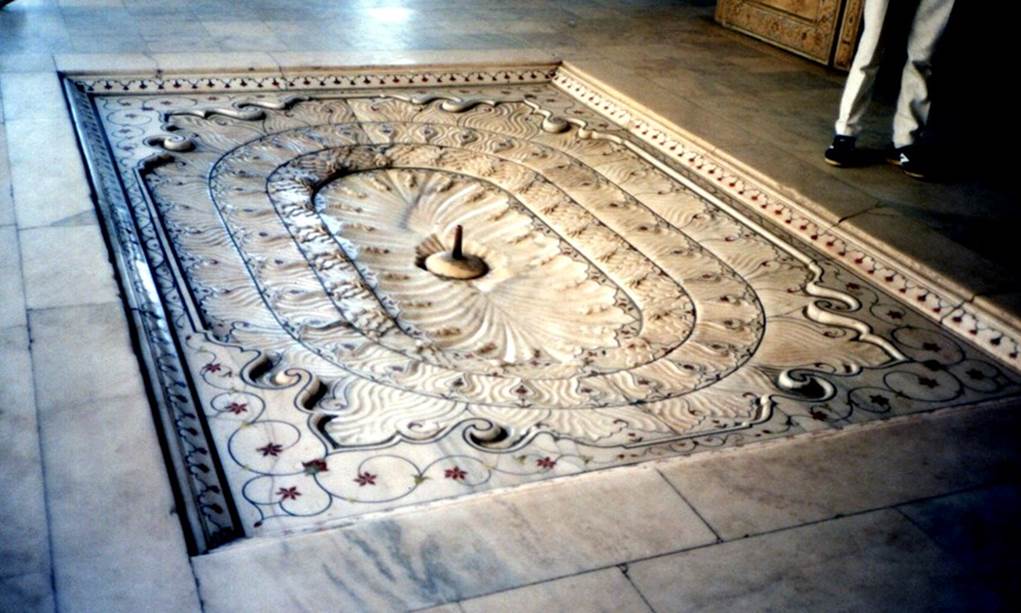
Photo by author, Feb 7 & 8, 1989
Palace architecture, design of the base. Extraordinary workmanship. Great attention to detail.
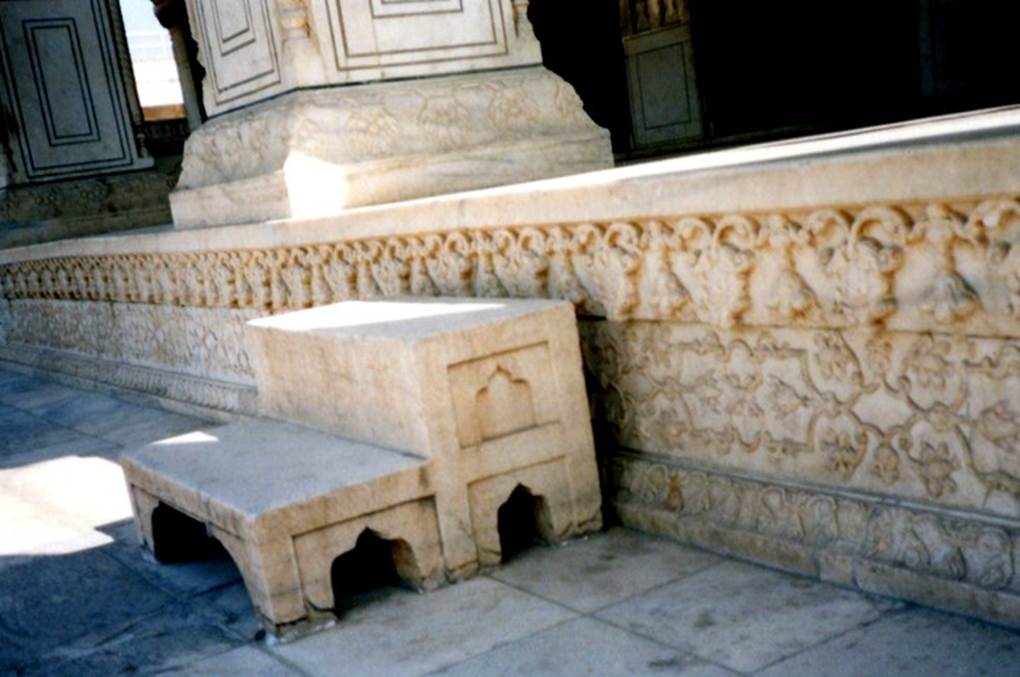
Photo by author, Feb 7 & 8, 1989
Rainwater treatment drains are handicrafted like works of art.
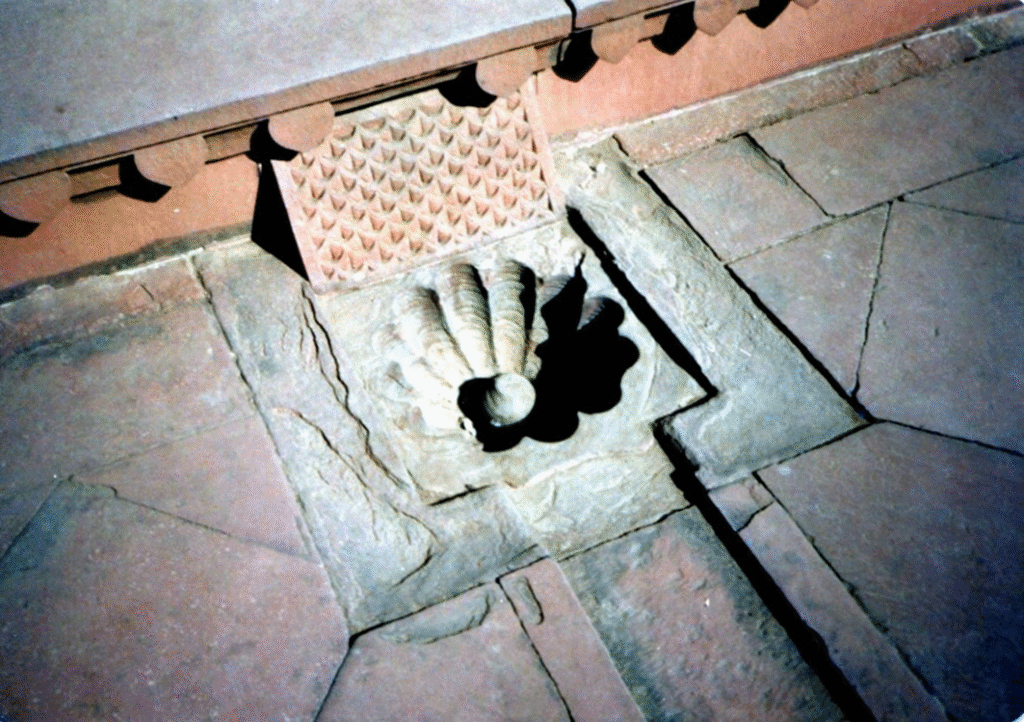
Photo by author, Feb 7 & 8, 1989
Traces of wells?

Photo by author, Feb 7 & 8, 1989

Photo by author, Feb 7 & 8, 1989
The Yamuna River flows below in the foreground, and the vast Hindustan Plain stretches out in the distance
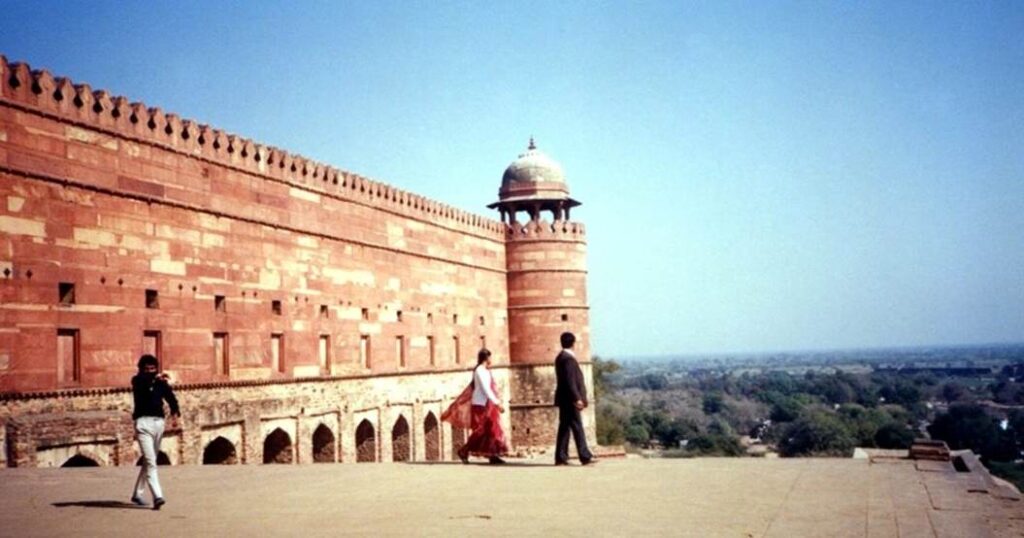
Photo by author, Feb 7 & 8, 1989
The city wall on the side of the Yamuna River. Traces of moats are also observed.
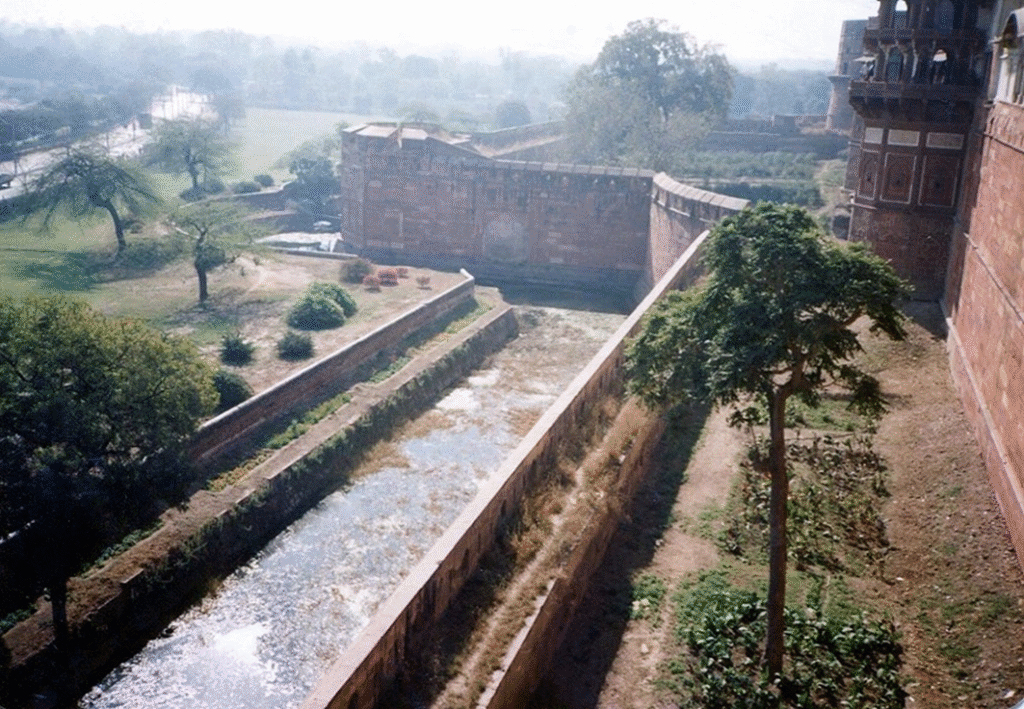
Photo by author, Feb 7 & 8, 1989

Photo by author, Feb 7 & 8, 1989
Aurangzeb’s successors began to swarm and disperse in various places, unable to suppress the feudal kings who had strengthened their independence, and the Mughal Empire weakened.
Agra Fort was twice occupied by the Maratha legions, and the soldiers plundered it.
In 1803, when the British occupied the palace, the palace had already been looted and in disrepair.
Agra Fort
The scenery inside and outside the castle is so different.
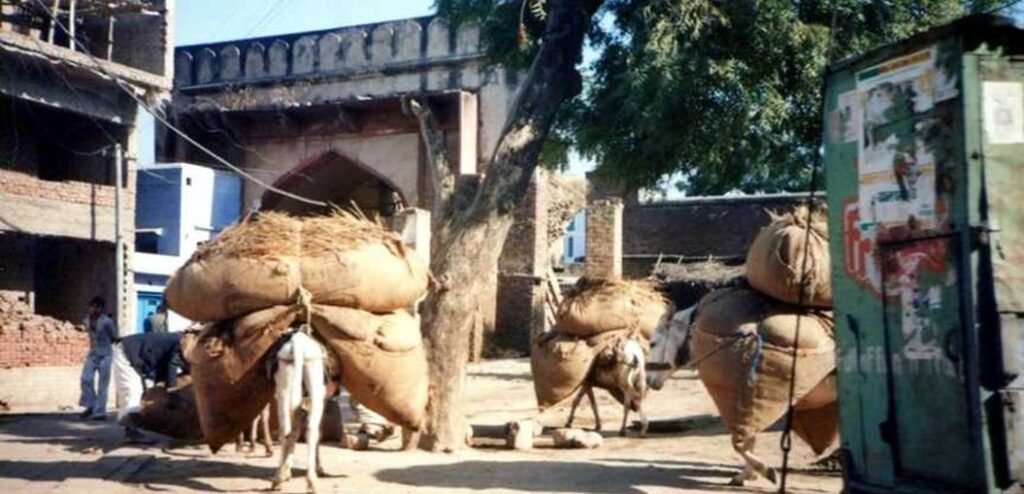
Photo by author, Feb 7 & 8, 1989
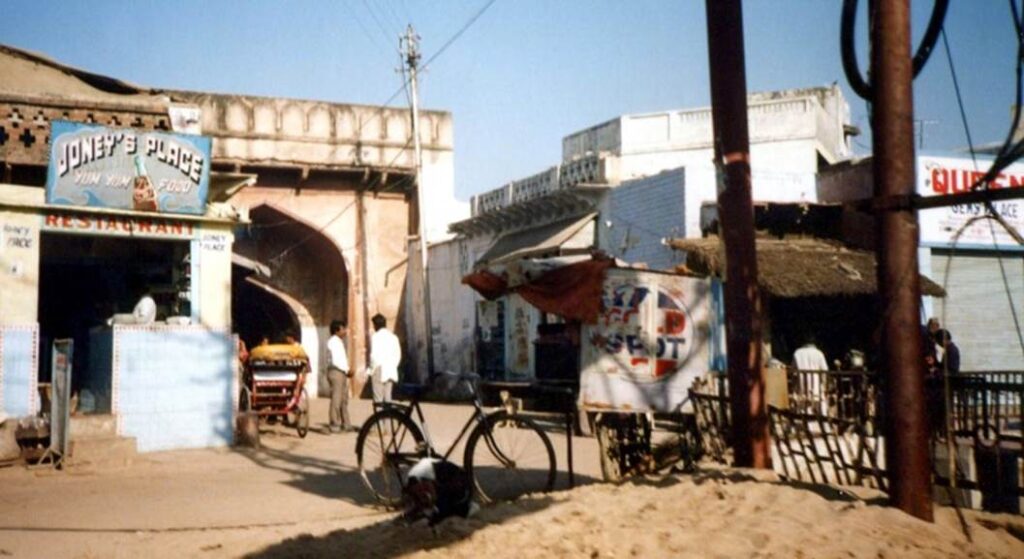
Photo by author, Feb 7 & 8, 1989
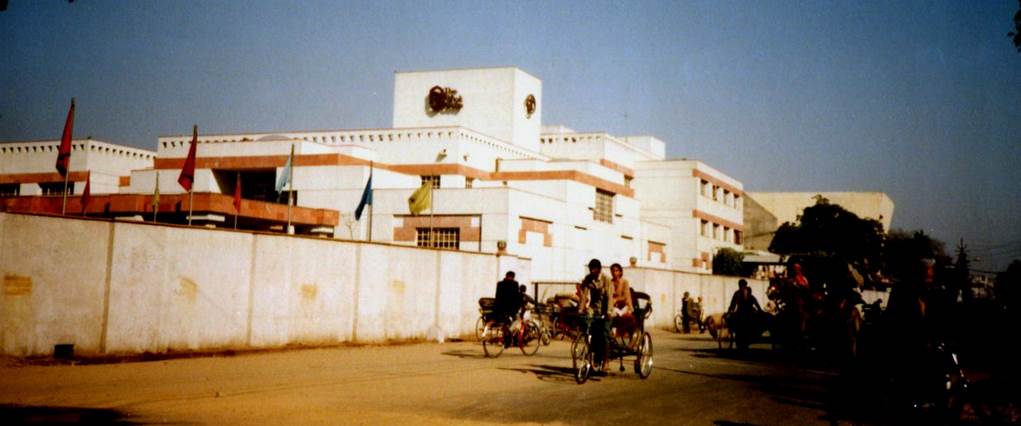
Photo by author, Feb 7 & 8, 1989
It is the office of a travel agency in Agra.

Photo by author, Feb 7 & 8, 1989

Photo by author, Feb 7 & 8, 1989
Stonework workshop
There was a stonework workshop nearby.
It must be a traditional craft under the Agra Fort.
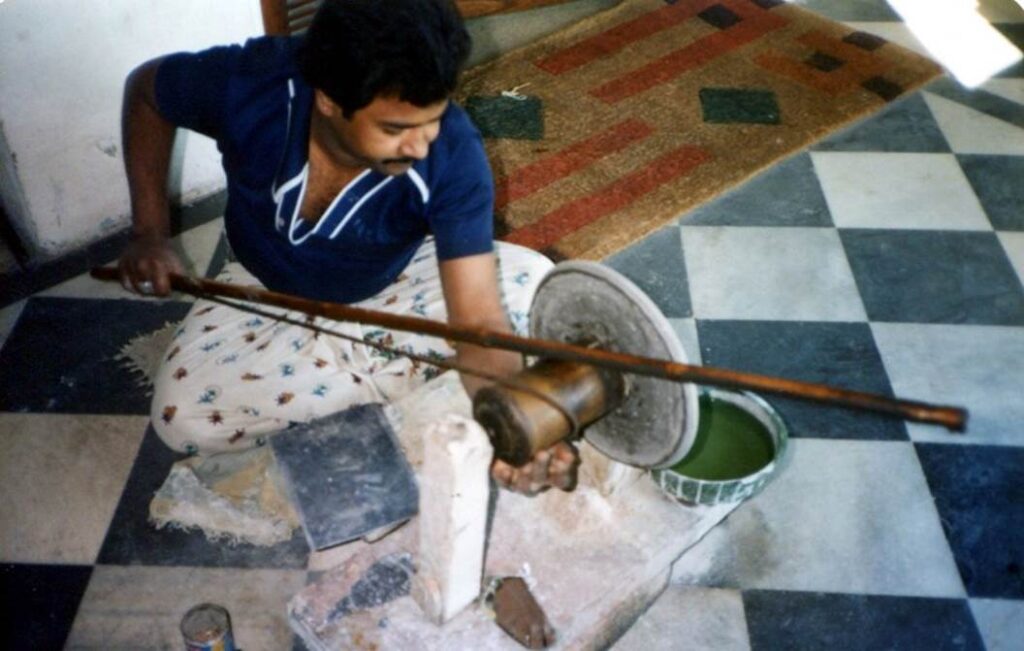
Photo by author, Feb 7 & 8, 1989
Traditional crafts
The man is working on a stone inlay for a table top.

Photo by author, Feb 7 & 8, 1989
Shop’s showroom
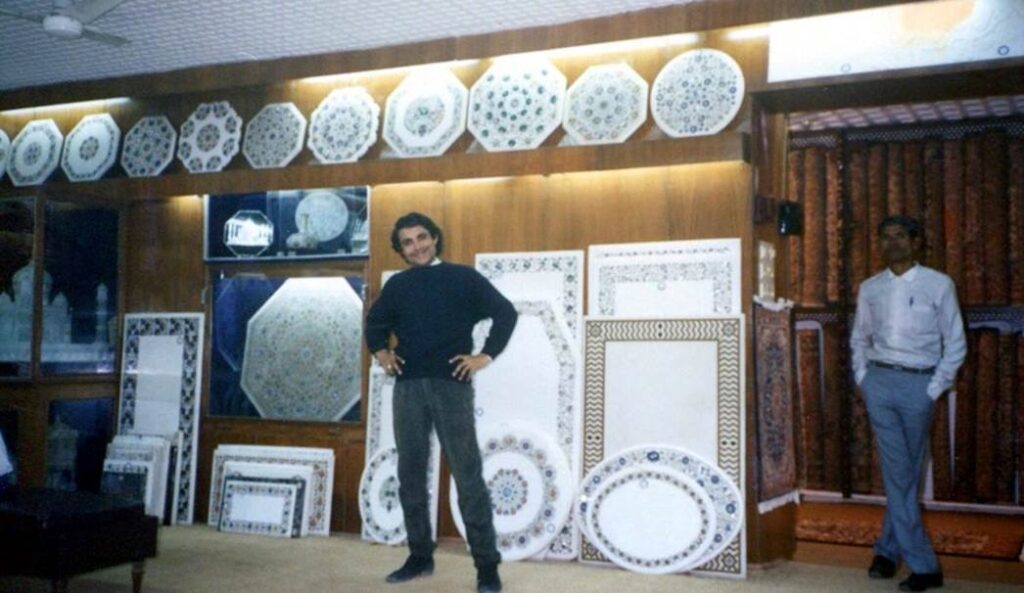
Photo by author, Feb 7 & 8, 1989
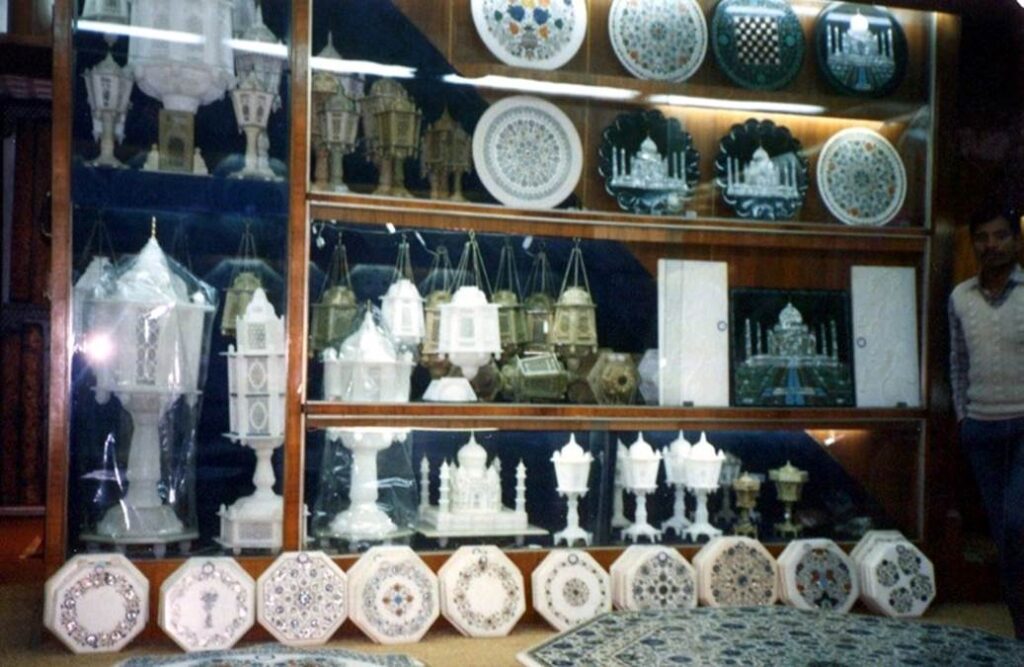
Photo by author, Feb 7 & 8, 1989
I saw two Muslim women riding a three-wheeled taxi in the city.
The lady on the left has a veil on her face.
The one on the right has her face completely hidden.

Photo by author, Feb 7 & 8, 1989
On February 8, 1989, I checked out of the Sheraton Ashok Agra Hotel. 13; 00 depart, domestic flight to Khajuraho.
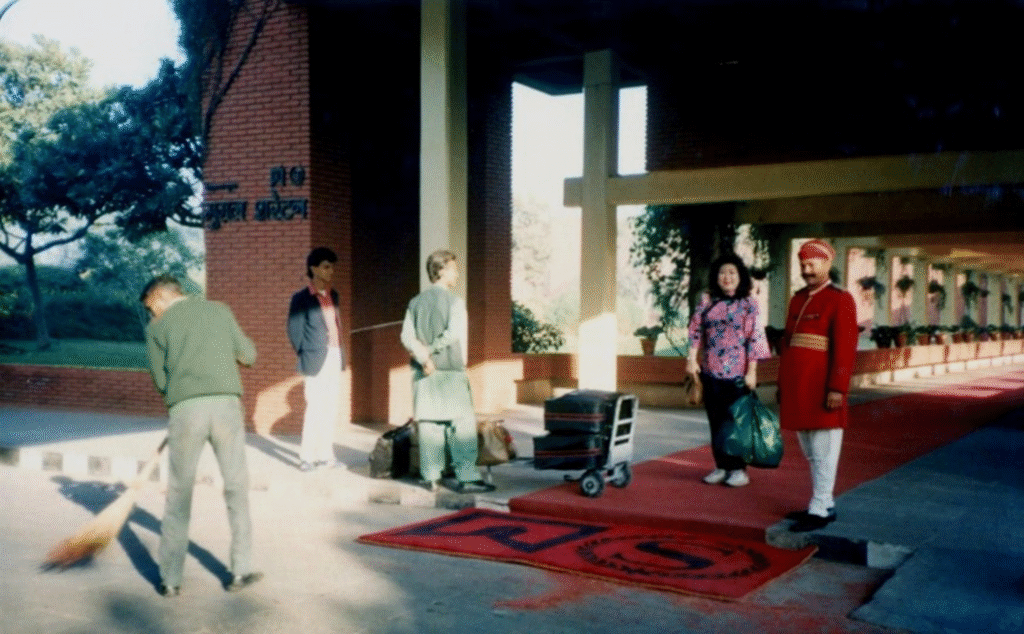
Photo by author, Feb 7 & 8, 1989