JAP | ENG
Around Bali #3/10
Cultures
The origin of Balinese culture, the Majapahit Kingdom
There was a dynasty in eastern Java that ruled all of Southeast Asia.
The Majapahit dynasty ruled on the basis of Hinduism from about 1200 to 1300.
In Japan, it was about 100 years from the end of the Kamakura period to the Muromachi period.
In 1981, my company signed a contract in Surabaya, Indonesia, to design a 7.5-hectare land complex for a hotel and shopping mall complex.
As a result, I had the opportunity to visit the site about 20 times during the 3-4 years during the project. In the suburbs of Surabaya, there are Hindu ruins from the Majapahit dynasty, and I visited them every weekend because I took on the challenge of reflecting their cultural heritage in modern architecture.
Candi Tikus in the former Majapahit Kingdom of East Java before the restoration, which has now been restored.

Photo by author, 1982
Since the Islamic invasion in the 16th century, the royal families, monks, and artisans of the Majapahit period have fled to Bali, where their architectural styles have been passed on, and they have contributed to the formation of the multi-layered Balinese culture. The prototype of present-day Bali can be seen in these architectural ruins from the Majapahit period in East Java.
Stupa of the former Majapahit Kingdom of East Java on the outskirts of the village.
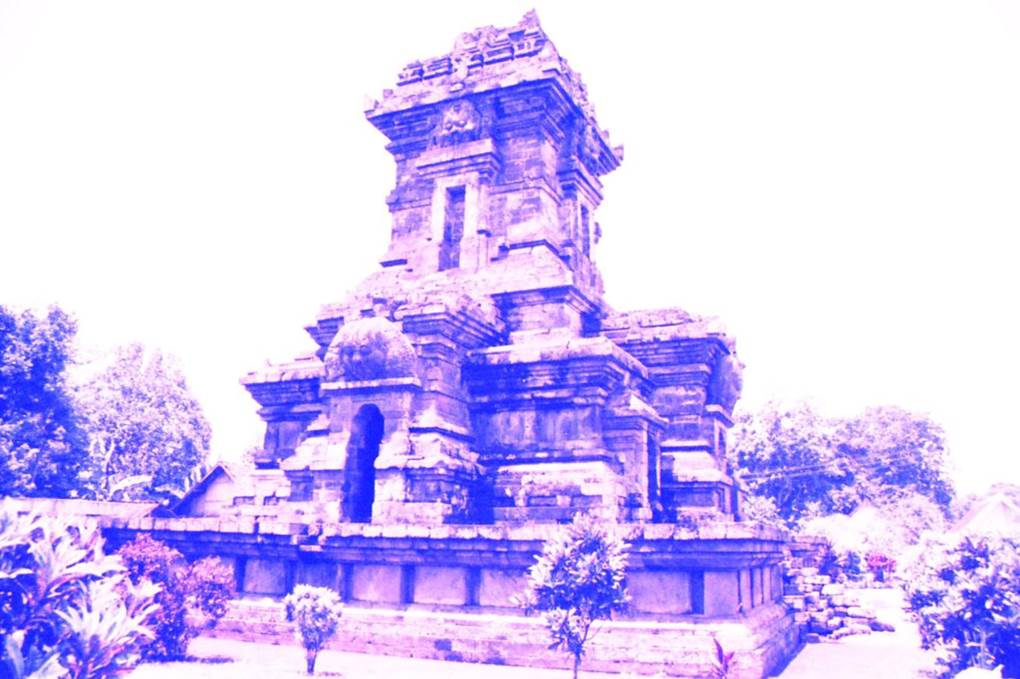
Photo by author, 1982
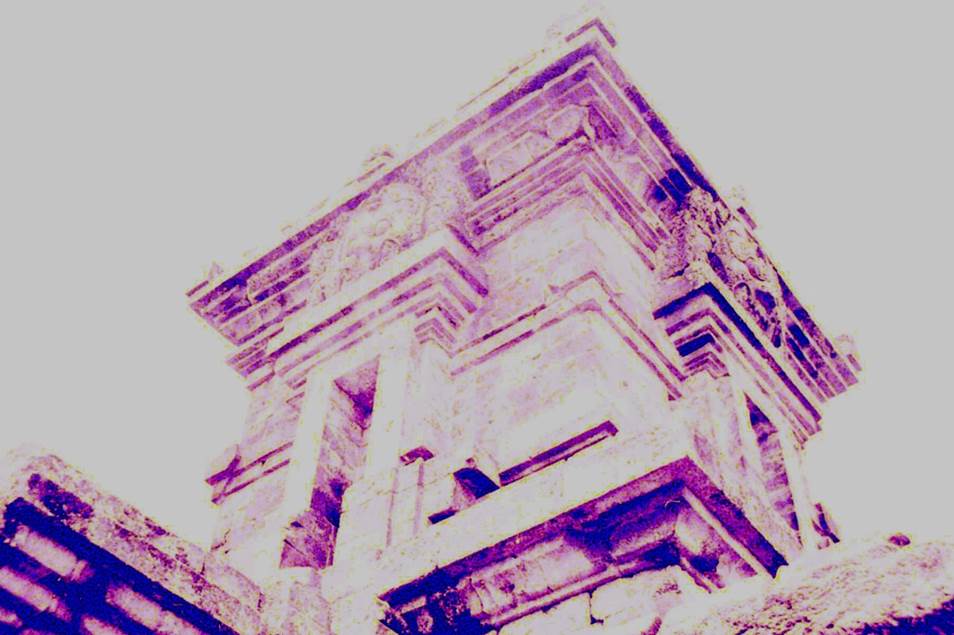
Photo by author, 1982
The Brantas River flows through the plains between the volcanoes of Java.
In this corner of the plain, the Majapahit dynasty arose, and at its peak, it took control of Indonesia and the Malay Peninsula. It later collapsed. The Brantas River, which flows through East Java, is the hometown of the former Majapahit Kingdom

Photo by author, 1982
Cultural transfer from the former Majapahit Kingdom to Bali.
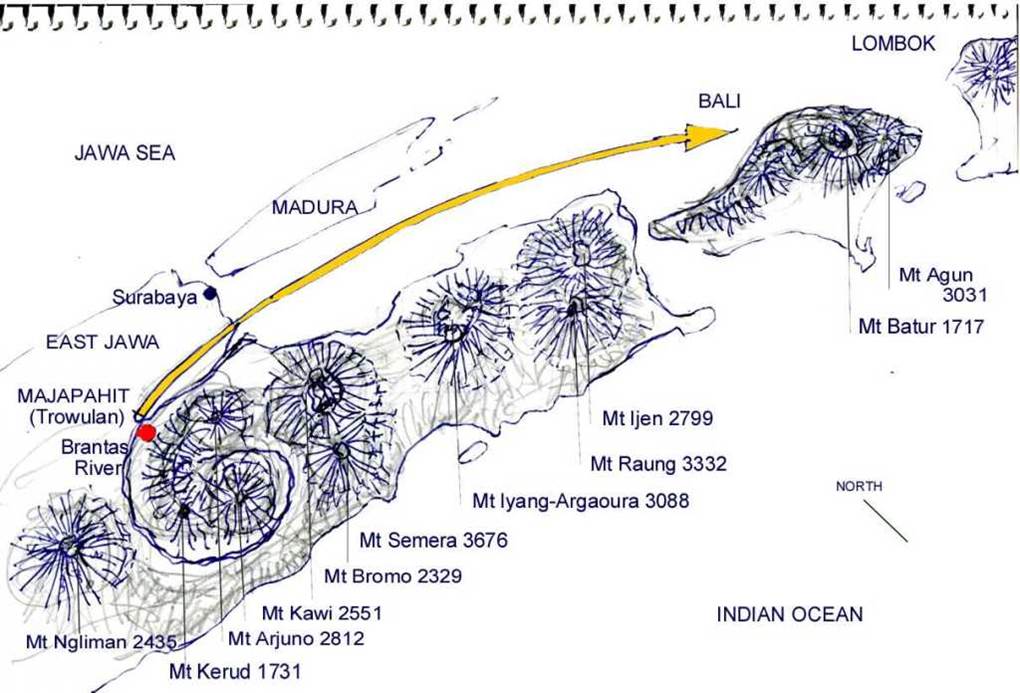
Author’s sketch
Topography of Bali
Bali has an area of 5,780 km2, which is about 4.1 times the size of the main island of Okinawa and less than 1.2 times the size of Chiba Prefecture.
It takes 7 hours to fly directly from Tokyo’s Narita Airport, almost the same flight time from Tokyo to Hawaii.
There is a ridge on the east and west sides of the island, and it consists of a connection of six volcanoes of 2,000 m in height.
At its eastern end is Bali’s tallest active volcano, Gunung Agung, at 3,013m.
Mount Agung is the object of worship of Balinese Hindus.


Author’s sketch
Speaking of volcanic islands, there are other world-famous tourist destinations such as Hawaii, Oahu (1,545 km2), Santorini in the Aegean Sea (76 km2), etc., but Bali can be said to be a relatively large island when comparing the size of them.
In Bali and Java, the Indian Ocean Plate is submerged in the Pacific Plate.
The lava and ash that flowed down from these volcanoes formed as a result form the skeleton of the island. This can be easily seen and understood when approaching from the air or sea.
The calderas formed by volcanoes, and the lava and volcanic ash that flow out from the outer rim, define the contours of Bali’s topography.
The mountains and their ridges are considered sacred areas where the gods worship, and the rivers that arise from the source of the mountains flow almost cone-shaped on the surface of the earth and reach the sea.
The sea below where the rivers flow is considered to be a realm of impurity, a realm of emissions, and a realm of death.
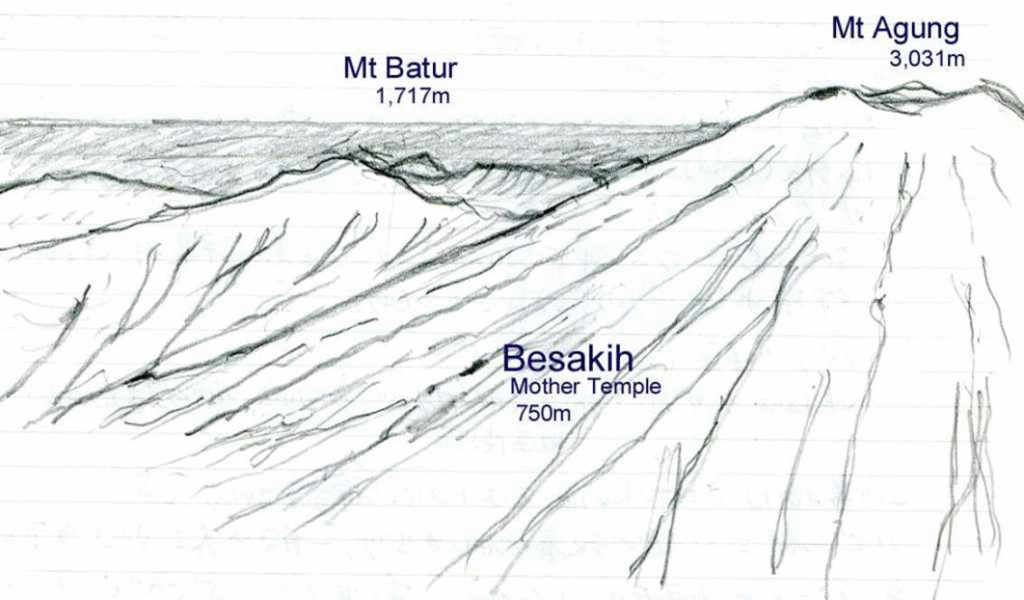
Author’s sketch
Between the sacred and unclean areas lies the domain of humans.
The fertile volcanic soil that originates from the mountaintop, the water veins that also originate from the mountaintop, and the land of blessings that they form.
These rich soils, constant veins of water, and abundant tropical sun gave rise to the metaphysical philosophy of Tri Hita Karana.
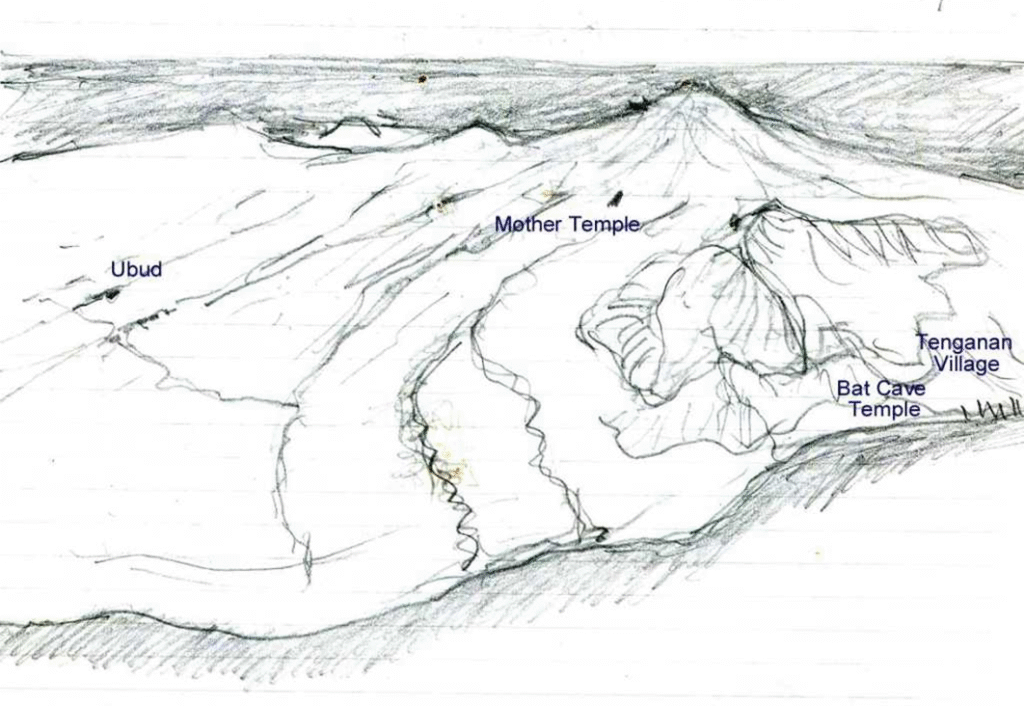
Author’s sketch
The Unique Philosophy of Tri Hita Karana
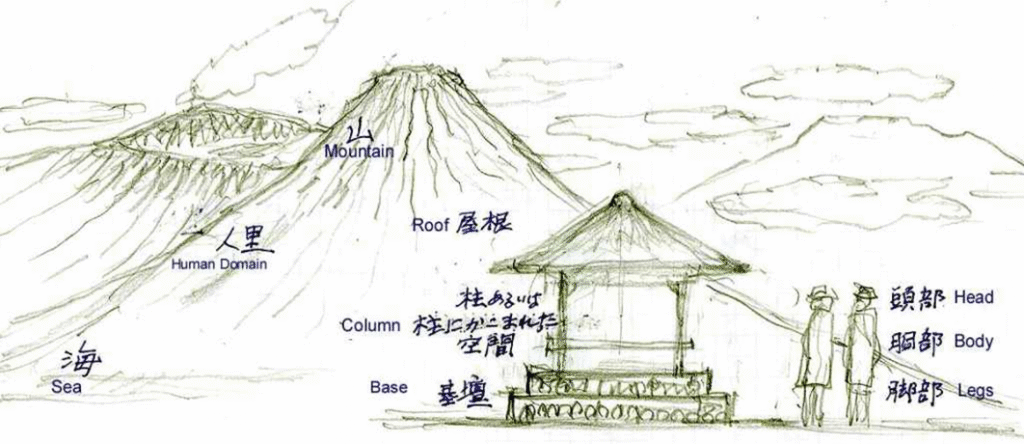
Turi Hita Karana, which means “three good things,” is a unique Balinese Hindu philosophy that defines the relationship between man and God, man and nature, and man and man.
In the relationship between man and God, for example, he makes offerings to the gods every morning and holds regular festivals.
In the relationship between people and nature, we aim to harmonize with the natural environment and strive for sustainable development.
In the relationship between people, it is cooperation and mutual help through the community, etc.
The following sketch is a representation of Turi Hita Karana’s philosophy of “nature,” “buildings,” and “the human body.”
Author”s sketch
Subak
Subak is an irrigation system for small-scale rice paddies (terraced rice fields) that has been around for a long time, embodying the Tuli Hita Karana.
It is a public irrigation water conservancy system that distributes irrigation water fairly to each beneficiary paddy field.
From before the Dutch colonial period until today, cultivation, including religious ceremonies, has been managed sustainably by self-governing peasant organizations.
The Irrigation weir structures is quite large.
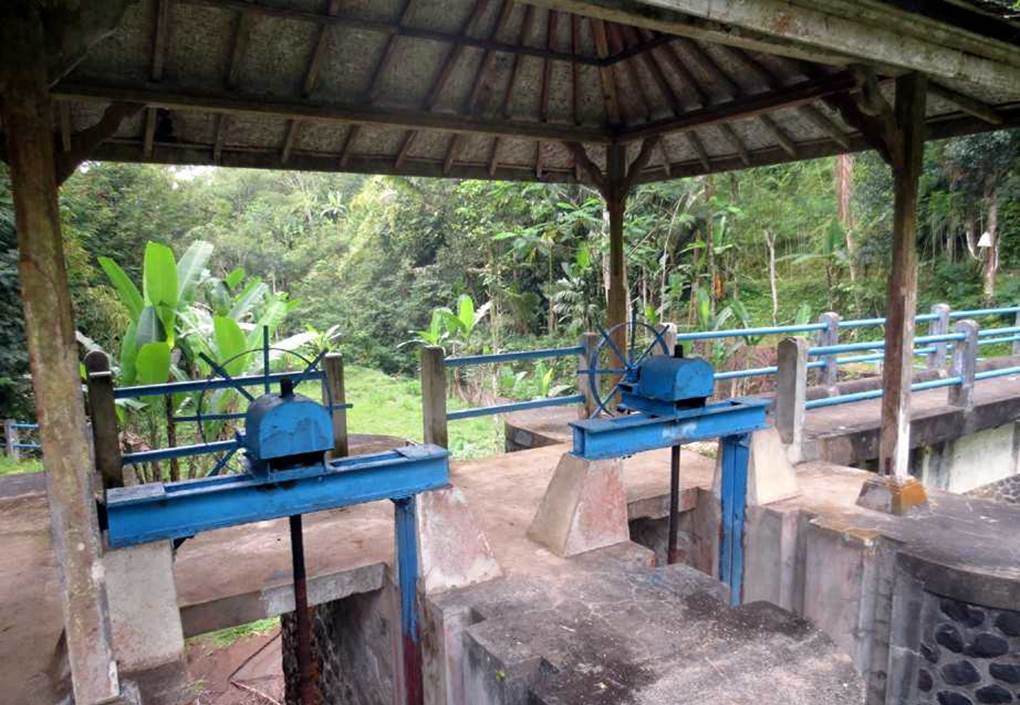
Photo by author
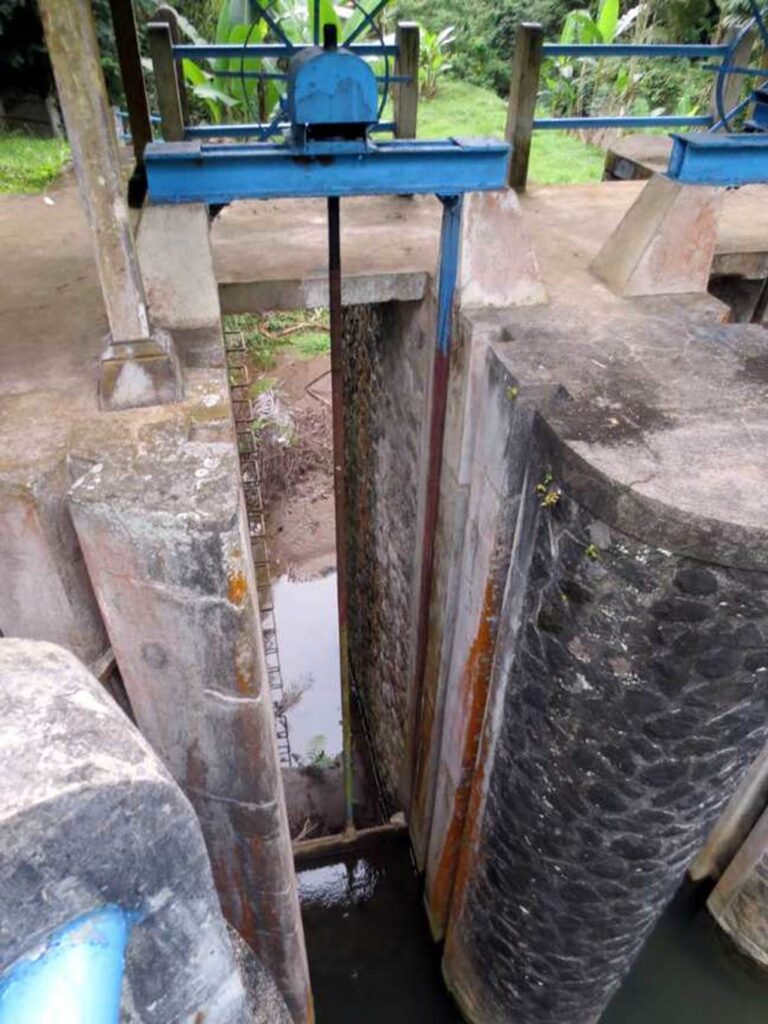
Photo by author
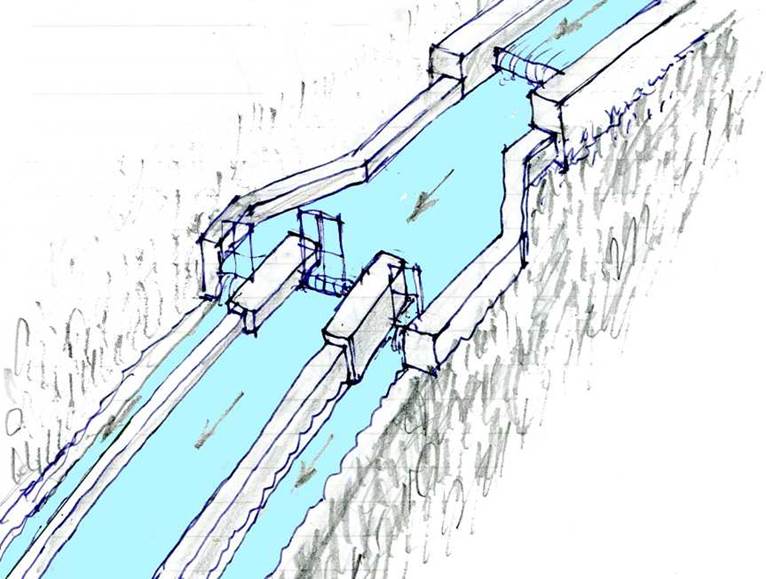
The Subak system, a system of natural irrigation, is managed autonomously by local communities, with waterways and dams.
This philosophy has also had a wide influence on the spatial composition of villages, buildings, and private houses.
A small dam. There are countless such facilities in Bali, which are managed by each farmer on their own.
Author’s sketch
Streams and springs from the mountains carve deep gorges into the volcanic ash slopes. Irrigation channels run like a network on the plateaus between the gorges and valleys. The rice paddy areas, including the rice terraces, create a landscape of rice fields that are grown three times a year.
The canyon, which has been carved out of volcanic ash, flows from the mountains to the sea and from north to south at intervals of several kilometers in the middle of the mountain.
A road is built in the middle of a gently drained plateau running north and south, and settlements are formed.
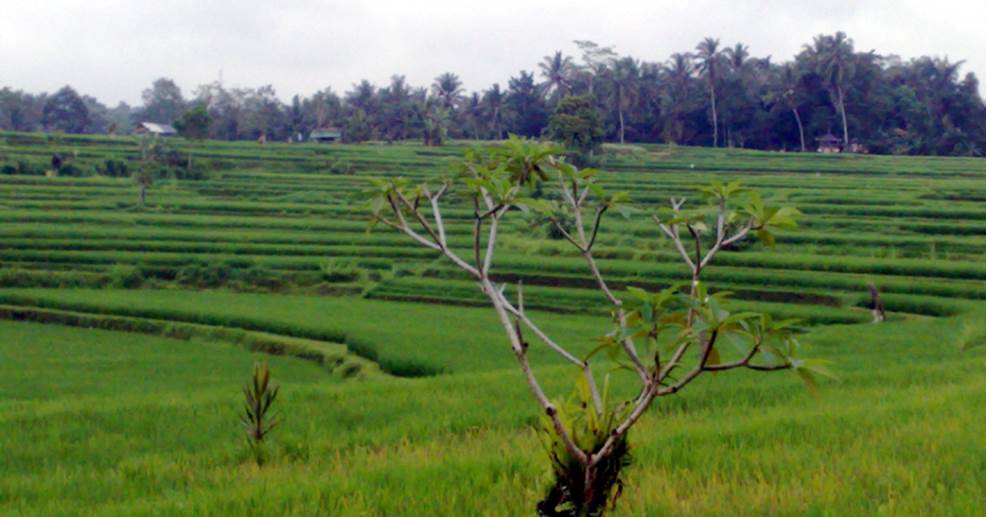
Photo by author, 2000s
The natural forests left in the vicinity of the canyon, the irrigation water and rice paddies open on the plateau, the villages, houses, and temples in the rice paddies all come together to embody the philosophy of Tuli Hita Karana on the earth.
It can be said that the “unique scenery” that travellers and foreigners see when they visit Bali is formed from this unique philosophy of Bali.
Rice terraces as a backdrop to a resort hotel in Ubud.

Photo by author, 2000s
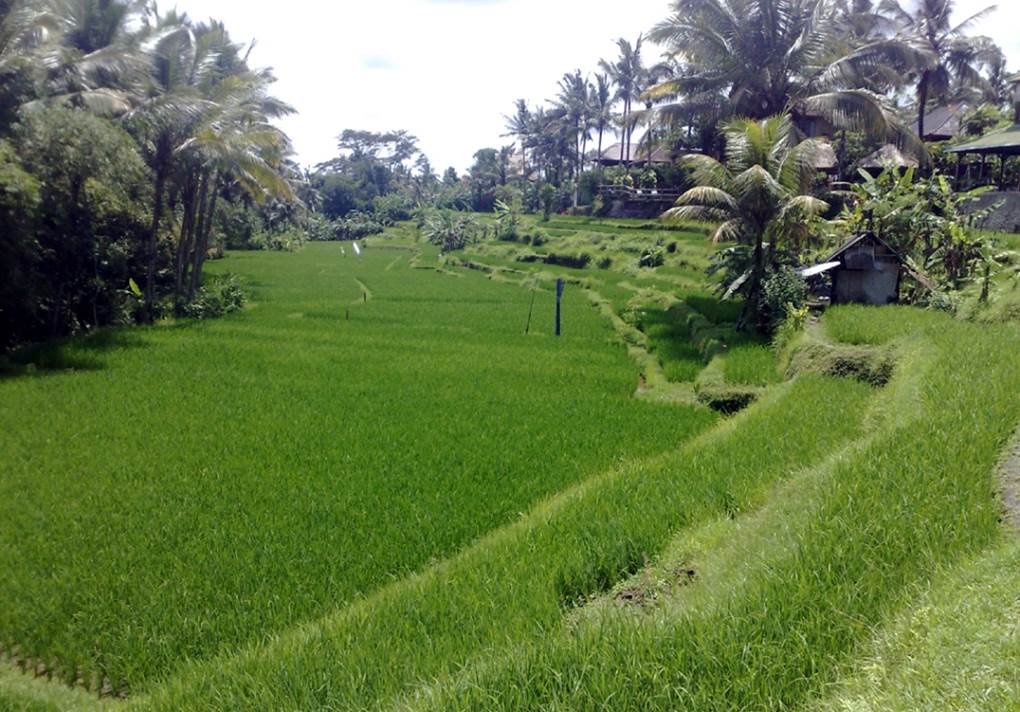
Photo by author, 2000s
Jatiluwih rice terrace UNESCO World Heritage Site

Photo by author, 2000s
Bali village, “Desa”
The ancient villages in Bali are called Desa. The designation “desa” is not only a geographical concept, but also a concept of a cohesion of the people who live there. It is also a religious group, and it can be said that the members and their families who live there share a certain spirituality.
The members of the Desa make arrangements for the village based on the Balinese Hindu religious siquitari known as desa adat and perform religious ceremonies according to the Bali calendar, in which villagers voluntarily participate in it.
The layout of the village “Desa”
In a north-south direction, villages are formed along the axis of Kaja Kerod.
Kaja is the mountain side of the axis, and is higher than Kelrod in the direction above where the gods are. Kelrod is on the seaward side of the axis, at a lower elevation than the direction of Kaja.
Conceptual diagram of Kaja Kerod.
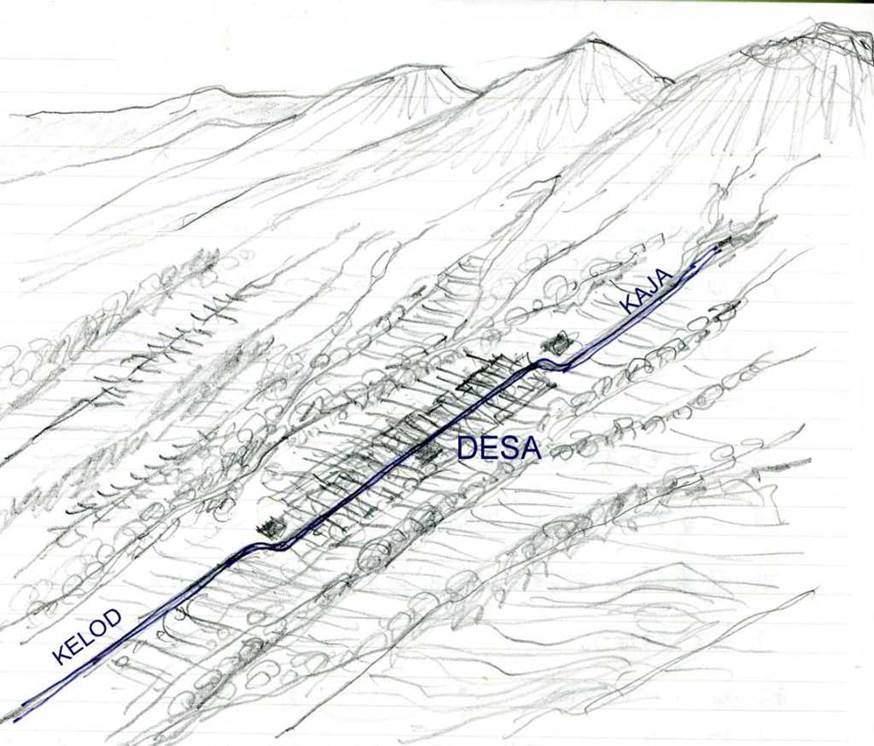
Author’s sketch
“Split Gateway” Candi Bentar
At the entrance and exit of the village (Desa), a “split gateway” (Candi Bentar) is set up to create a barrier and visually form the unity of the village.
After passing through the split gateway, the road winds into a key, as in the old Japan castle town, and then a straight road leads to the center of Desa, where the meeting hall and markets are located.
The reason why the road into the village is shaped like a key is because impure spirits can only go straight, but cannot turn. This is a kind of talisman.
Such considerations are also provided at the entrances of traditional Balinese houses and mansions. A similar example can be found at the entrance of a traditional Okinawan house.
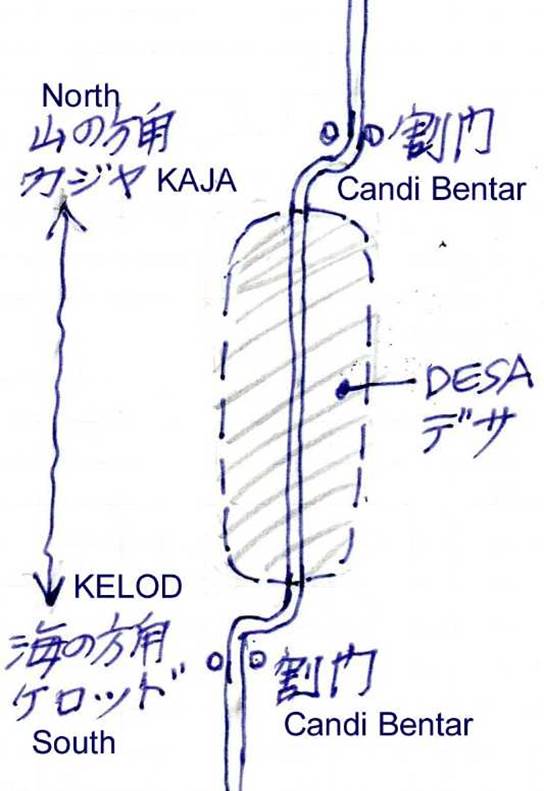
Author’s sketch
Later, even after the place has become a car-oriented society, in order to enter Desa from the outside, the view was usually blocked by the wall of the temple or the plantings at the key-shaped part, so the system was still alive today, as it is necessary to slow down and pay attention to invisible oncoming vehicles.
The diagram below is a conceptualization of a village in Bali.
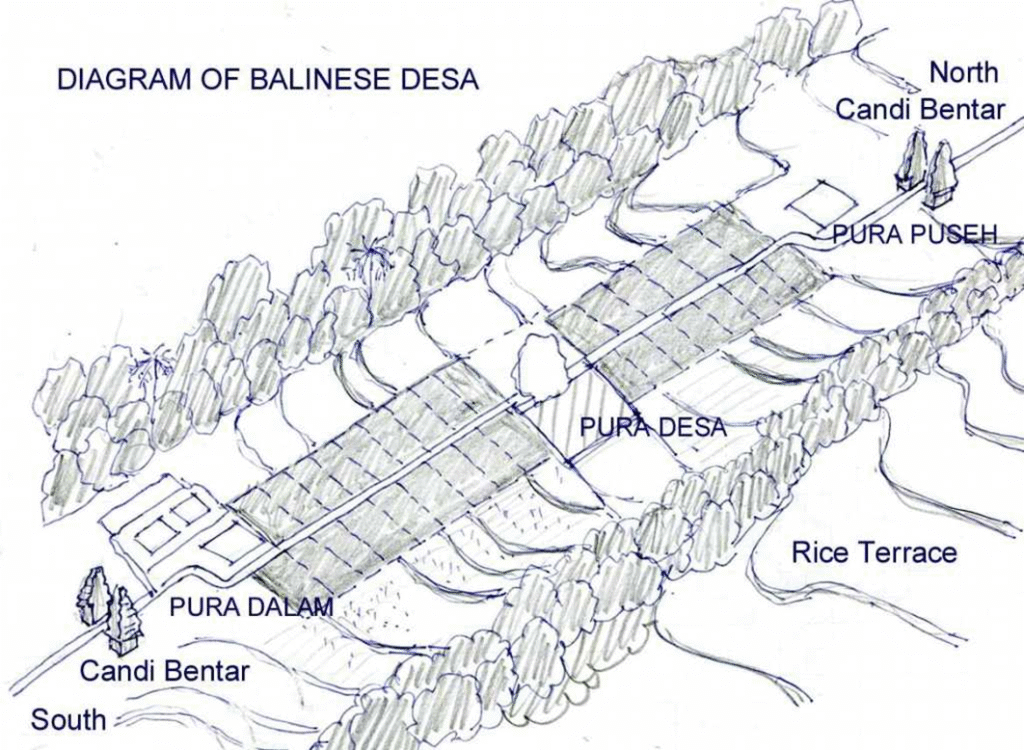
Author’s sketch
In the heart of Desa.
The central area of the desa is where the public community is established. There is a meeting place (Bale Agung) where villagers gather to make decisions about the village, a cockfighting arena for entertainment (Wantilan), a market for shopping, and a temple (Pura Desa) and a square.
In addition to Pura Desa, the central temple of Desa, there is a temple (Pura Puseh) on the outskirts of the high-altitude village on the north side of the axis to commemorate the ancestors of the founder of the village. On the outskirts of the low-lying villages to the south are the crematoriums and cemeteries (Pura Dalem).
These three temples are collectively known as Kahyangan Tiga. Each village basically has these three temples. The definition of a desa can be said to be a regional, local village community that has a Kahyangan Tiga.
A bit more on the three temples:
- Pura Desa: Dedicated to Lord Brahma, the creator.
- Pura Puseh: Dedicated to Lord Vishnu, the preserver.
- Pura Dalem: Dedicated to Lord Shiva, the destroyer.
Typical community facilities located in the center of a village.
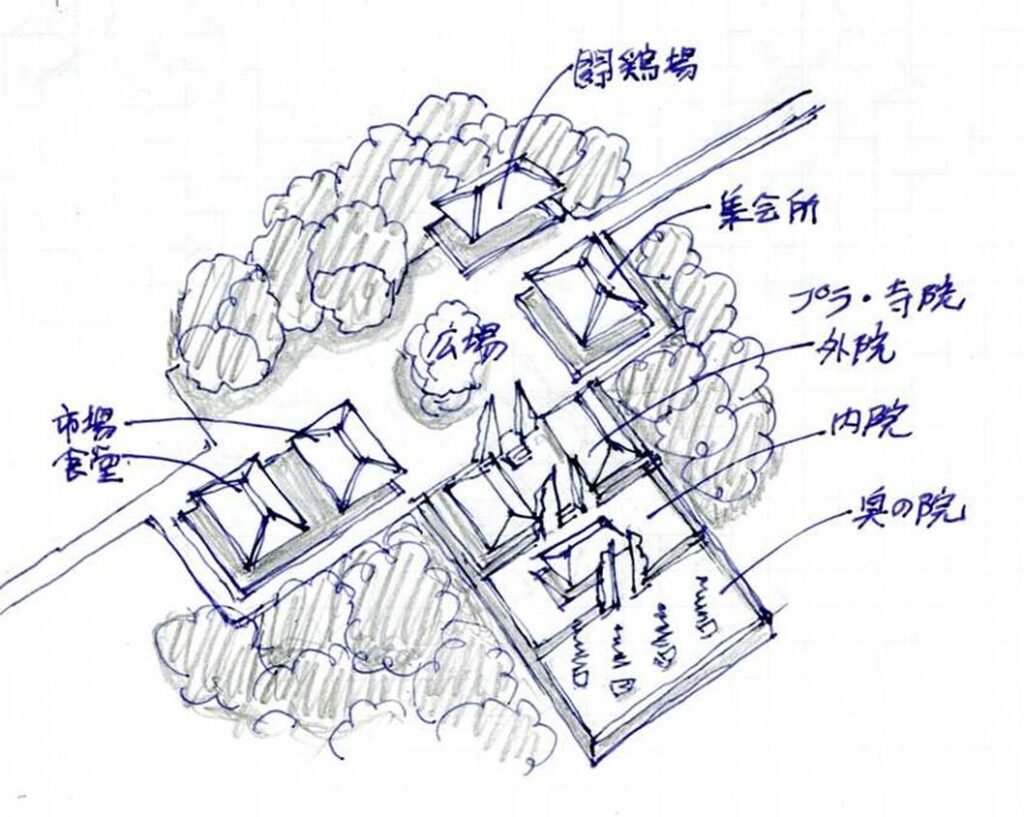
Author’s sketch
A meeting place (Bale Agung) in the center of Desa.
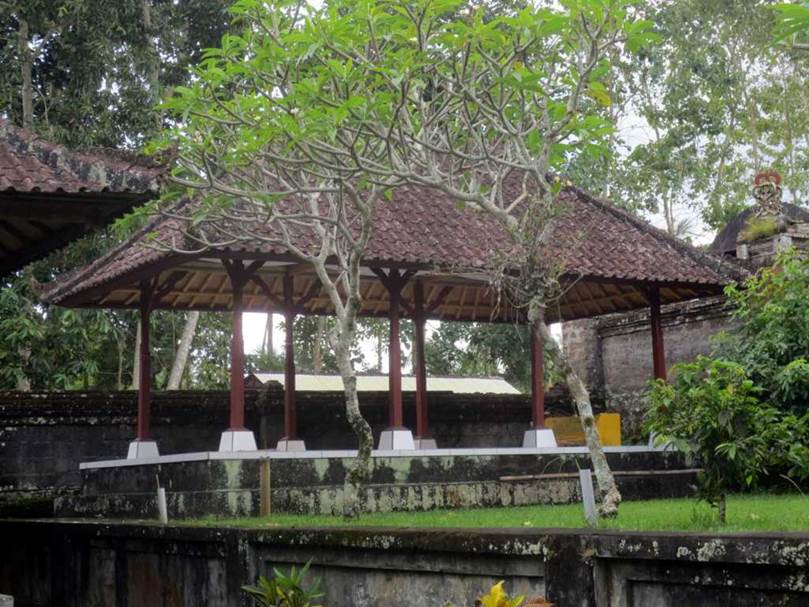
Photo by author, 2000s
A cockfighting arena (wantilan) in the center of Desa.
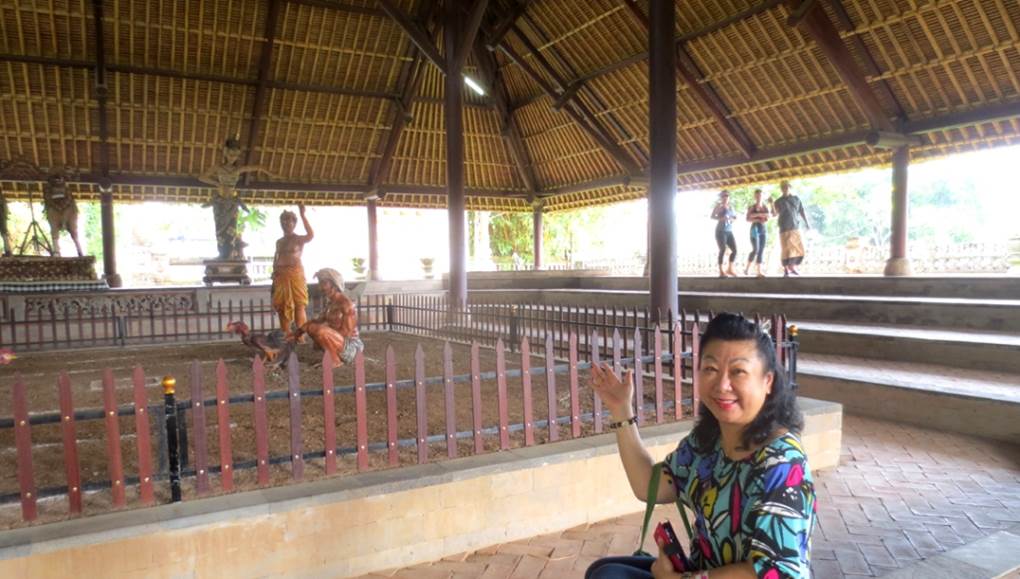
Photo by author, 2000s
Banjar
Banjar is a community of married men living in Desa as members. It arranges the legal, material, and moral conditions for the life of its members, and makes joint decisions and agreements on inheritance, sale, and use of land in villages. It discusses and implements the fair distribution of irrigation water based on the basic principle of Subak.
Each Desa has strong personal and institutional cohesion, with people exchanging greetings with each other every day and maintaining a sense of unity, making it difficult for outsiders to infiltrate and resulting in extremely low crime rates.
Photos by author, 1980-2000’s