JAP | ENG
Cordoba, Spain
October 2013
#1/2
CORDOBA
Cordoba was the capital of a Roman province during the Roman period. From 415 to 711, it was ruled by the Germanic Visigothic kingdom.
In 711, the Muslims conquered the Visigothic kingdom, and the Islamic dynasty made Cordoba its capital, and along with Toledo, it developed as the center of western Islamic culture. Córdoba became the world’s most populous city in the 10th century.
At the end of the 15th century, with the completion of the Christian Reconquista, the Islamic forces withdrew from the Iberian Peninsula and the Catholic church section was added to the Mosque.
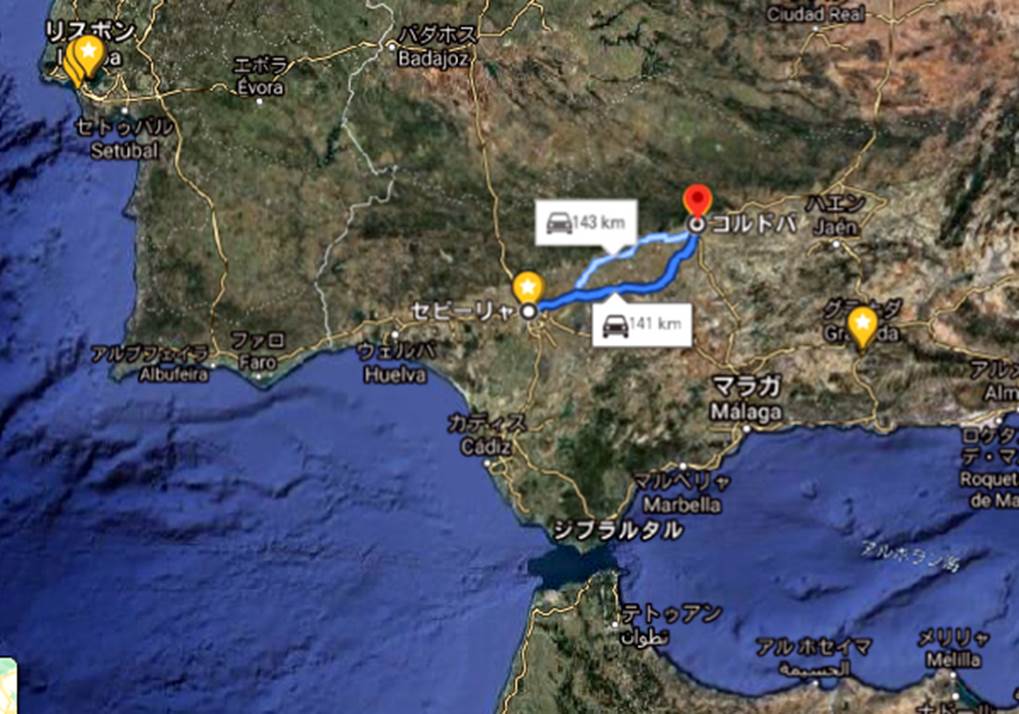
Historic Centre of Cordoba World Heritage Site
The Mezquita is a mosque whose construction began in 784. Mezquita means mosque in Spanish. It is derived from the Arabic word “Masjid”.
It continued to expand until the 10th century, and after the Reconquista it became a Christian cathedral, which to this day is still called the Mezquita.
Officially, it is the Cathedral of St. Mary of Córdoba (Catedral de Santa María de Córdoba), but from here on, I will refer this World Heritage cathedral as the Mezquita.
The map below shows The Mezquita and the Roman Bridge.
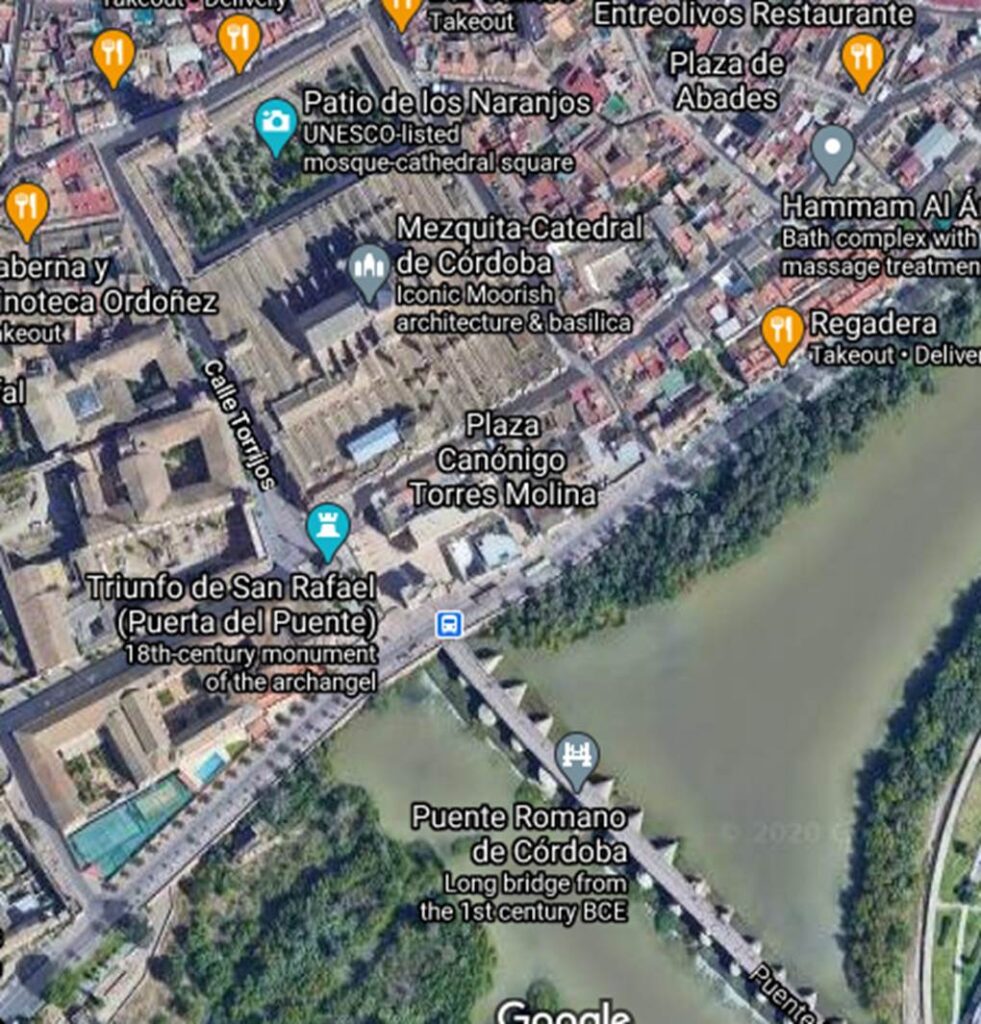
Roman Bridge of Cordoba (Puente Romano de Cordoba)
World Heritage site
To enter the historic centre of Córdoba, enter from the south side.
The Roman Bridge over the Guadalquivir River came into view.

As the name suggests, the bridge has been in the same place since ancient Roman times, Visigothic times, Islamic times, Catholic times and through to the present day, and while it has been repaired many times, it has served as the main access point to Cordoba.
The bridge is 331m long and stretches to the opposite bank where the Mosque and the historic district of Cordoba are located.

Photo by author, 2013
In the center of the 230-metre-long bridge, supported by 16 arches, stands a stone statue of Saint Raphael. He is the patron saint of the city.

Photo by author, 2013
A shot from a perfect spot for distant view of the Mezquita.
This single photograph captures everything from the ruins of the Roman provinces, the legacy of the Islamic dynasty, and the added Christian architecture. It is a world cultural heritage site like no other.

Photo by author, 2013
I was told that it was a former mill which uses hydraulic power remaining on the Guadalquivir River.
The other side of the photo shows the downstream river, passing through Seville and reaching the ocean.

Photo by author, 2013
Calahorra Tower (Torre de la Calahorra)
World Heritage Site
The Tower of Calahorra is the fortress of the Roman Bridge of Córdoba.
It was built in the 14th century as a defensive building and is now used as a museum.
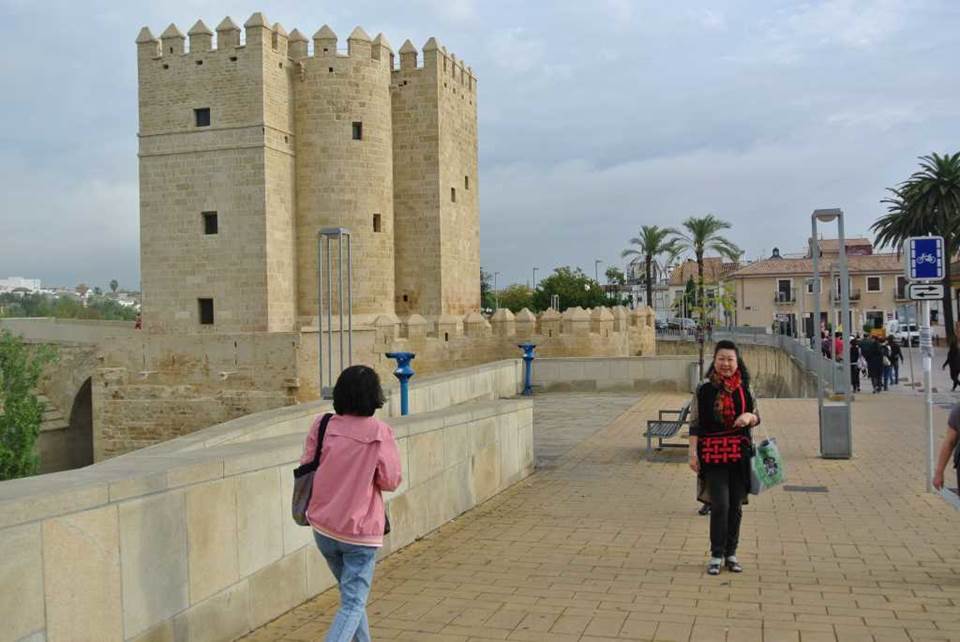
Photo by author, 2013

Photo by author, 2013
Mezquita of Córdoba
World Heritage Site
Exterior view of the Mezquita in Córdoba (below).
Mezquita means a Muslim place of worship or mosque.
It was built between the 8th and 11th centuries and was used as a Christian chapel after the Reconquista in the 13th century.
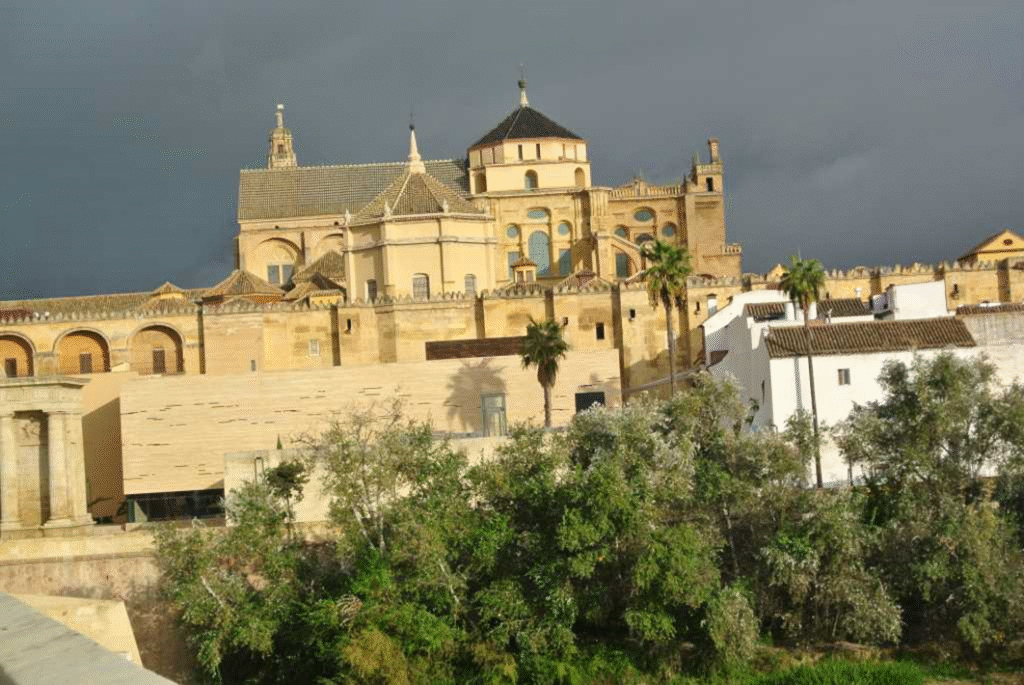
Photo by author, 2013
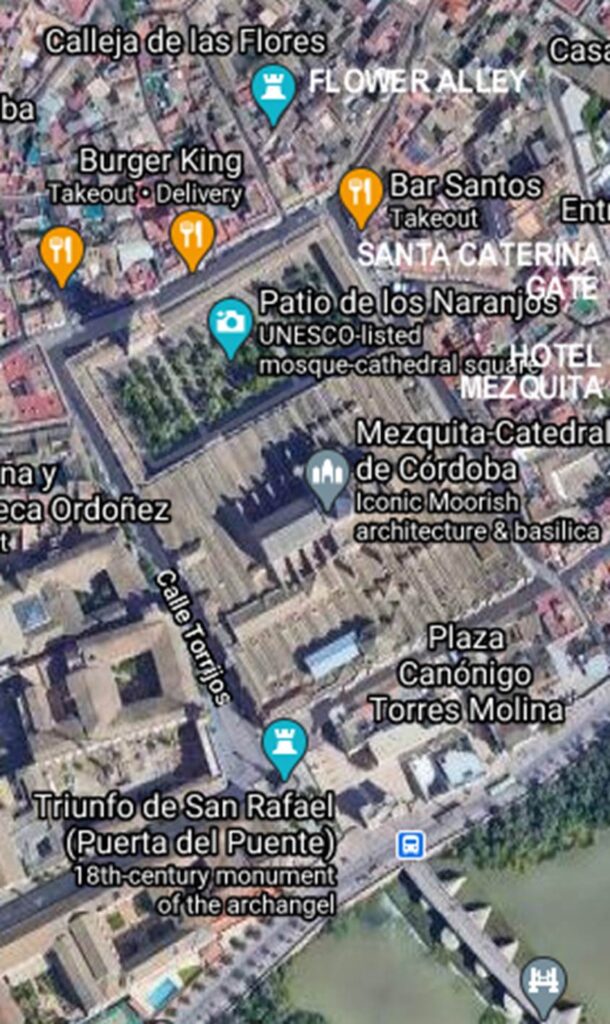
Bird’s eye view of the Mezquita
The historic center of Cordoba, including the former Jewish quarter, is a World Heritage Site.
In the beginning, Muslims and Christians coexisted, and there was a time when Christians prayed on Sundays and Muslims prayed in groups on Fridays in a prayer hall built in the mosque.

Photo by author, 2013
These continuous arches seem to follow the Roman style.

Photo by author, 2013
The remains of what appear to be the foundations of a Roman building.
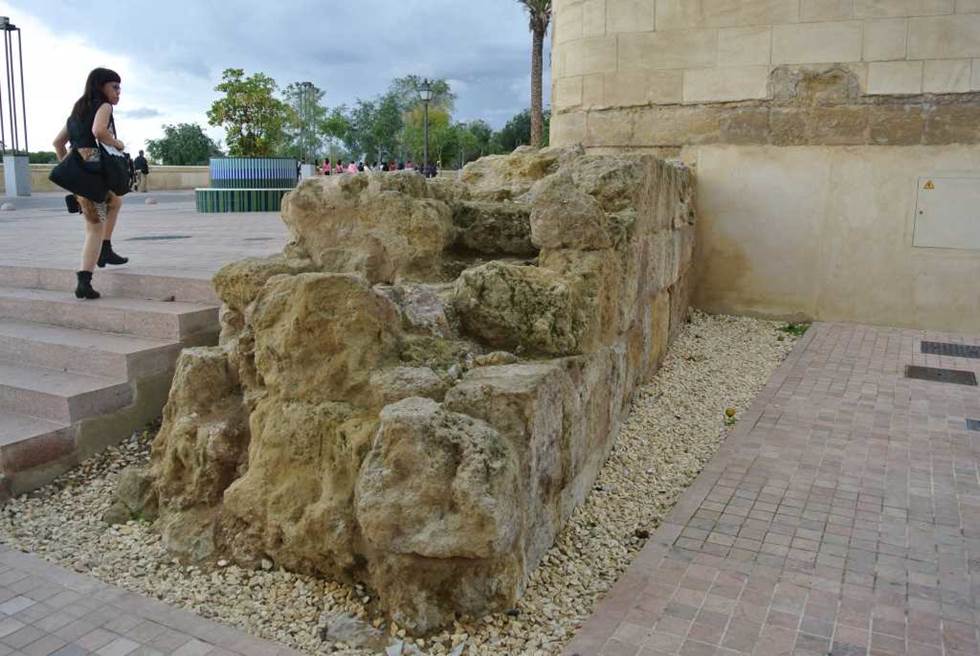
Photo by author, 2013
Torrijos Street (Calle de Torrijos)
Calle de Torrijos on the west side of the Mezquita. It has a gentle slope.
It’s a shame that the view would be better if cars were not allowed to enter.

Photo by author, 2013
San Miguel Gate (Porta San Miguel)
This is the San Miguel Gate on Calle de Torrijos on the west side.
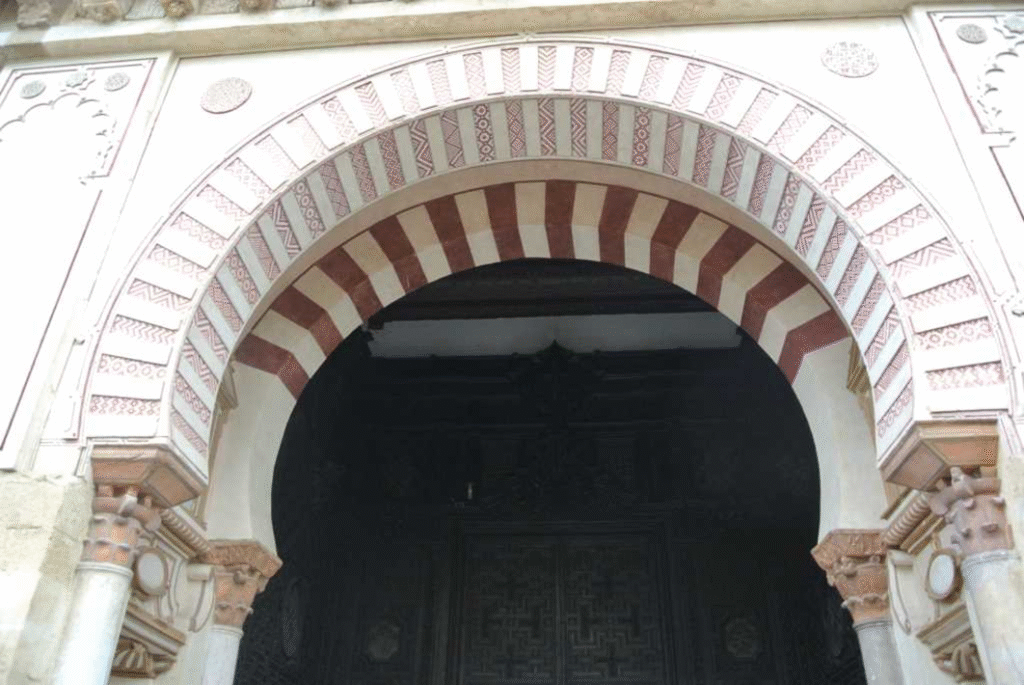
The San Miguel Gate is very elaborate, with a horseshoe-shaped arch above the door, a cross-arch above it, and multi-valve arches on the left and right.
This was the gate reserved for the Caliph. It is no longer in use.

Photo by author, 2013
The gate dedicated to the Caliph. San Miguel Gate.

Photo by author, 2013
Alminar Tower Mezquita Bell Tower
World Heritage Site
Admiring the Aluminar Tower from the residential area surrounding the Mezquita.
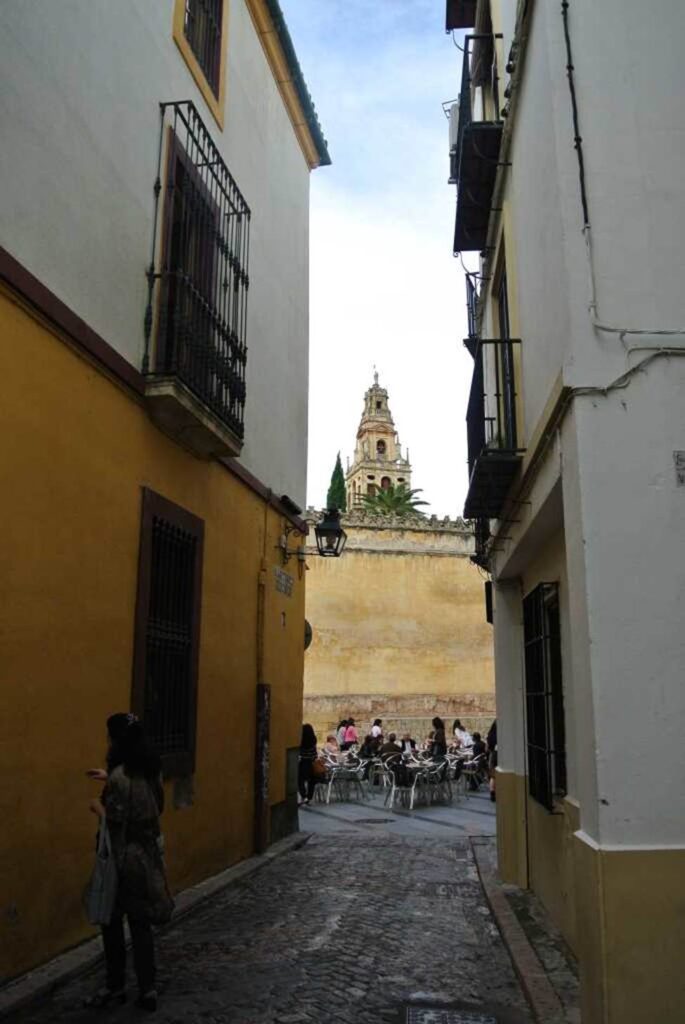
Photo by author, 2013
The bell tower of the Mezquita in Córdoba is the tallest building in Córdoba and is a symbol of the city, standing at 54 metres.
When it was a mosque, it was a minaret.

Photo by author, 2013
Shot from inside the orange garden.
In Mezquita, in addition to orange trees, palm trees are also planted.
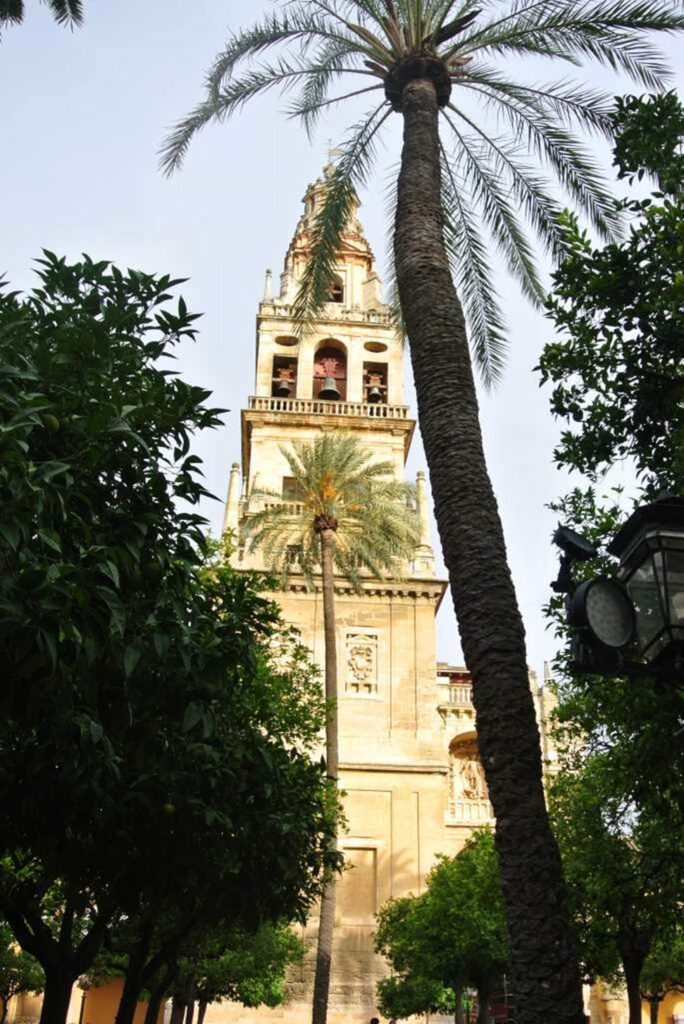
Photo by author, 2013

Photo by author, 2013
Mezquita
At the beginning of Islamic rule, the Caliph purchased the Church of St. Vicente, which had been used by the Visigoths, and began building a mosque in 785.
As the number of Muslims increased, the mosque became too small, so it was repeatedly expanded during the reign of later caliphs, and by the end of the 10th century it had grown to a size large enough for 25,000 people to worship (including the Orange Garden).
The current Mezquita.
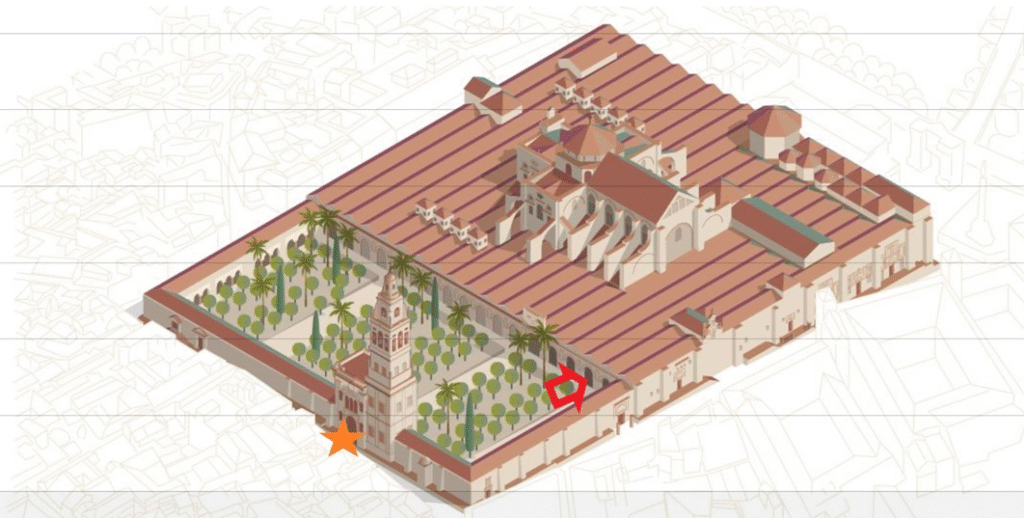
Source: emispain.com/mezquita2
Admission to the Mezquita Cathedral
Orange Tree Courtyard(Patio de los Naranjos)
As we have seen in the Seville Cathedral of Seville, the area of the Mezquita Cathedral of Córdoba is also accompanied by an Islamic patio and an orange garden.
To get to the Mezquita, as in the Seville Cathedral, the customary way is to first enter the Orange Tree Courtyard and then approach the Mezquita.
The wall between the orange tree courtyard and the chapel was unblocked, and the 19 openings made it a seamless space inside and out. In the orange tree courtyard here, the Muslims cleansed their hands and feet with water, rinsed their mouths, purified their bodies, before proceeding to the prayer hall.

Gate of Glory
The Gate of Glory is one of the arches that was not blocked.
Señorita with the Japanese flag.
In front of the Gate of Glory, the entrance to the Mezquita, a Señorita (unmarried Spanish lady) guide was standing with a Japanese flag.
It’s a sight that shines against the backdrop of the Mezquita.
The flag of an island nation at the eastern end of the Eurasian continent is raised by a Señorita in Andalusia, at the western end of the same Eurasian continent, making a powerful presence.
I was so impressed by it that I asked her to take a picture with me.

Photo of author with a Spanish guide
By the way, if you look at the design of the capitals of the marble columns in the background, it looks like the Greek Corinthian style. The pattern of the metal door on the left is clearly Islamic.
The Mezquita of Córdoba (interior)
Once inside, you will see beautiful columns and arches.
Many of the pillars were said to be repurposed from Roman temples and Visigothic churches.
We went inside. It was a Forest of 850 pillars and arches.

Photo by author, 2013
The red-and-white Madara Islamic arch is double-layered.
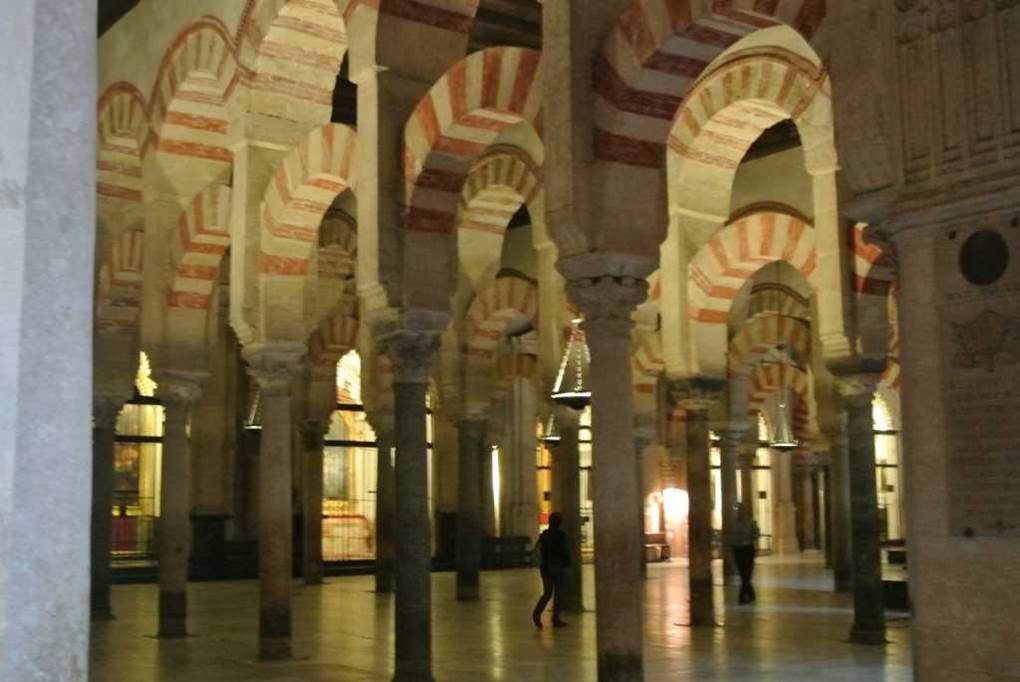
Photo by author, 2013
A forest of double arches.

Photo by author, 2013
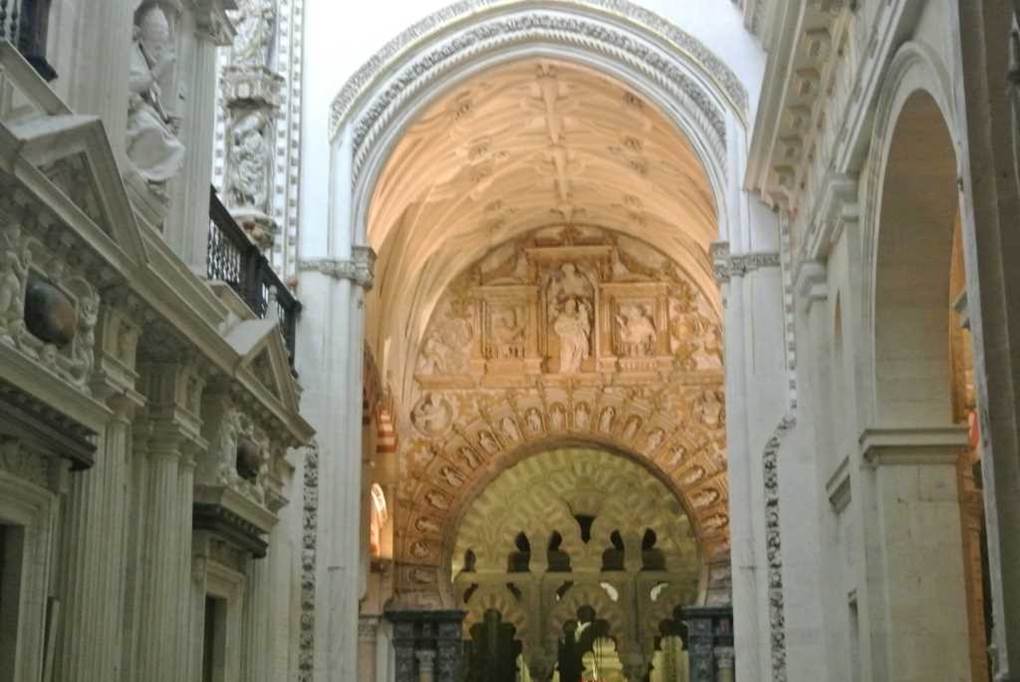
Photo by author, 2013
The Christian white dome is on top of the red and white spotted Islamic arch (in the back).

Photo by author, 2013
The ceiling arch of the cathedral fits perfectly on the arch of the old mosque!
It is true that it is a patchwork structure, but perhaps it is also proof that the builders paid respect to the architectural heritage of the past.

Photo by author, 2013
On the left is the existing Islamic arch, and on the right is the part of the extension and renovation.
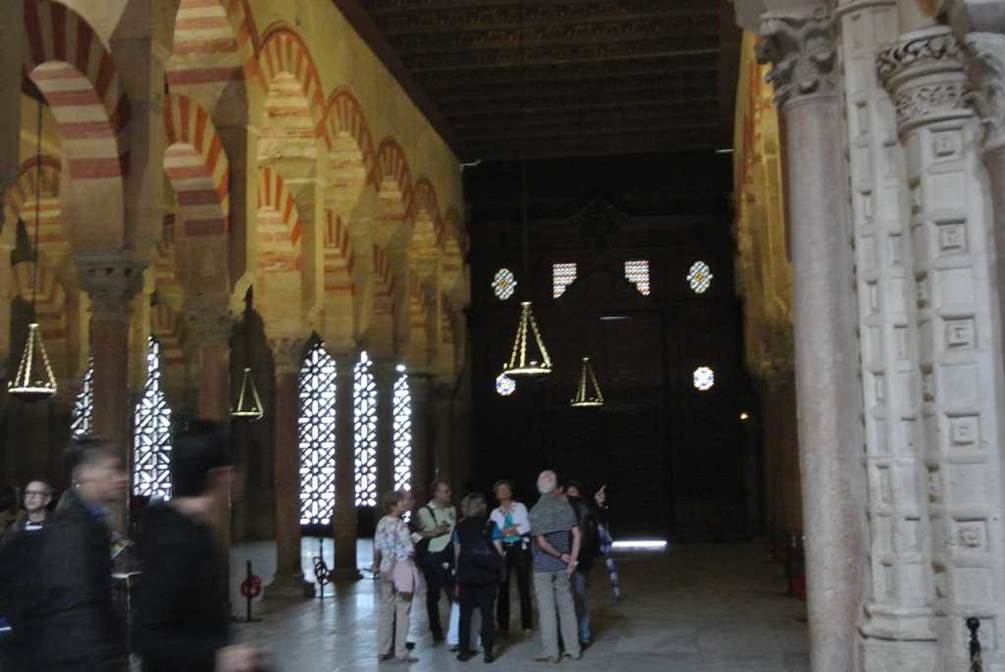
Photo by author, 2013
The wall on the left is in the Greek Renaissance style, with elements of a completely different style.

Photo by author, 2013
When I was a student, there was a photograph of the Mezquita in Córdoba in the textbook of the “History of World Architecture” in the Department of Architecture, and I think it was in black and white, but I was very interested in the photo and the explanation. Now, the real thing is right in front of me..
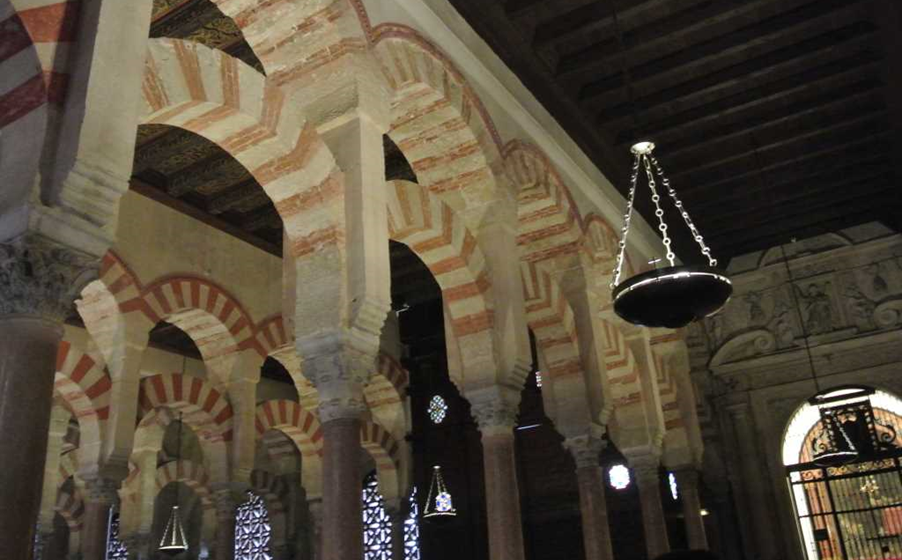
Photo by author, 2013
In Córdoba, which was finally recaptured from the Arabs, Spain, a Christian country, did not destroy the Mezquita, which is a symbol of Arab architecture, but added and expanded on top of it, and as a result, I think it was a great success from the perspective of cultural heritage preservation.
All photos by author, Oct 2013