JAP | ENG
4 months Europe trip 1968
#9/9
8-day trip from Helsinki to Yokohama
Stayed in Helsinki from November 11 to 15, 1968
November 15 At dusk, I departed Helsinki Station by an international train bound for Moscow.
November 16 Early in the morning, I arrived at the Moscow station.
Check in to the hotel.
On November 18, I checked out of my hotel in Moscow.
Head to the airport.
November 19 Around noon, landed in Khabarovsk.
November 21, arrival in Nakhodka
Arrived in Yokohama port on November 23
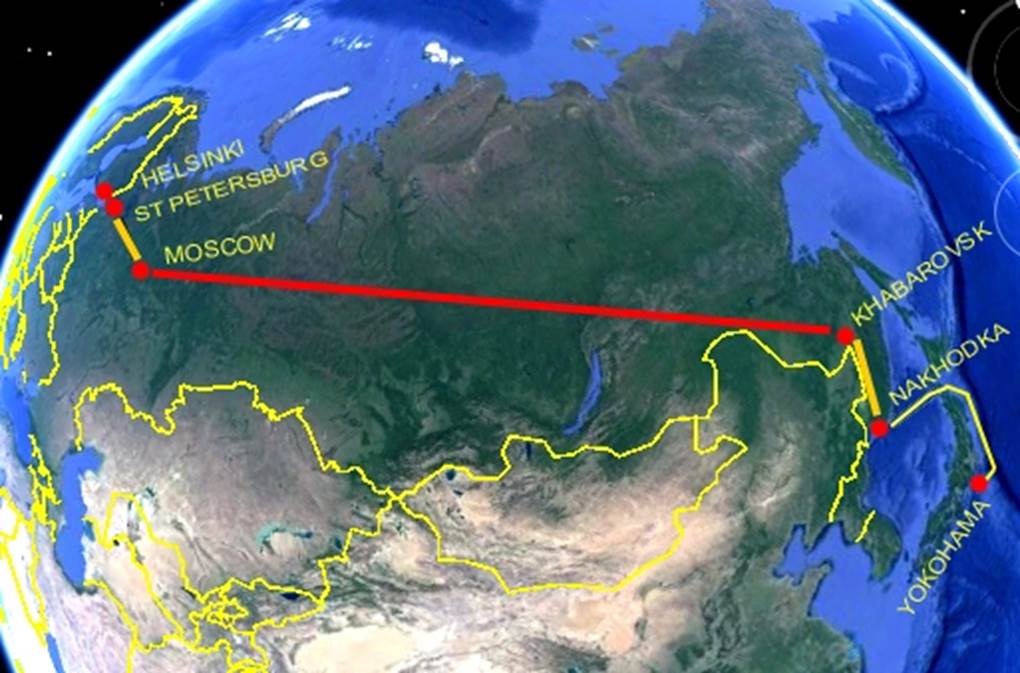
Travel from Helsinki to Moscow by overnight train
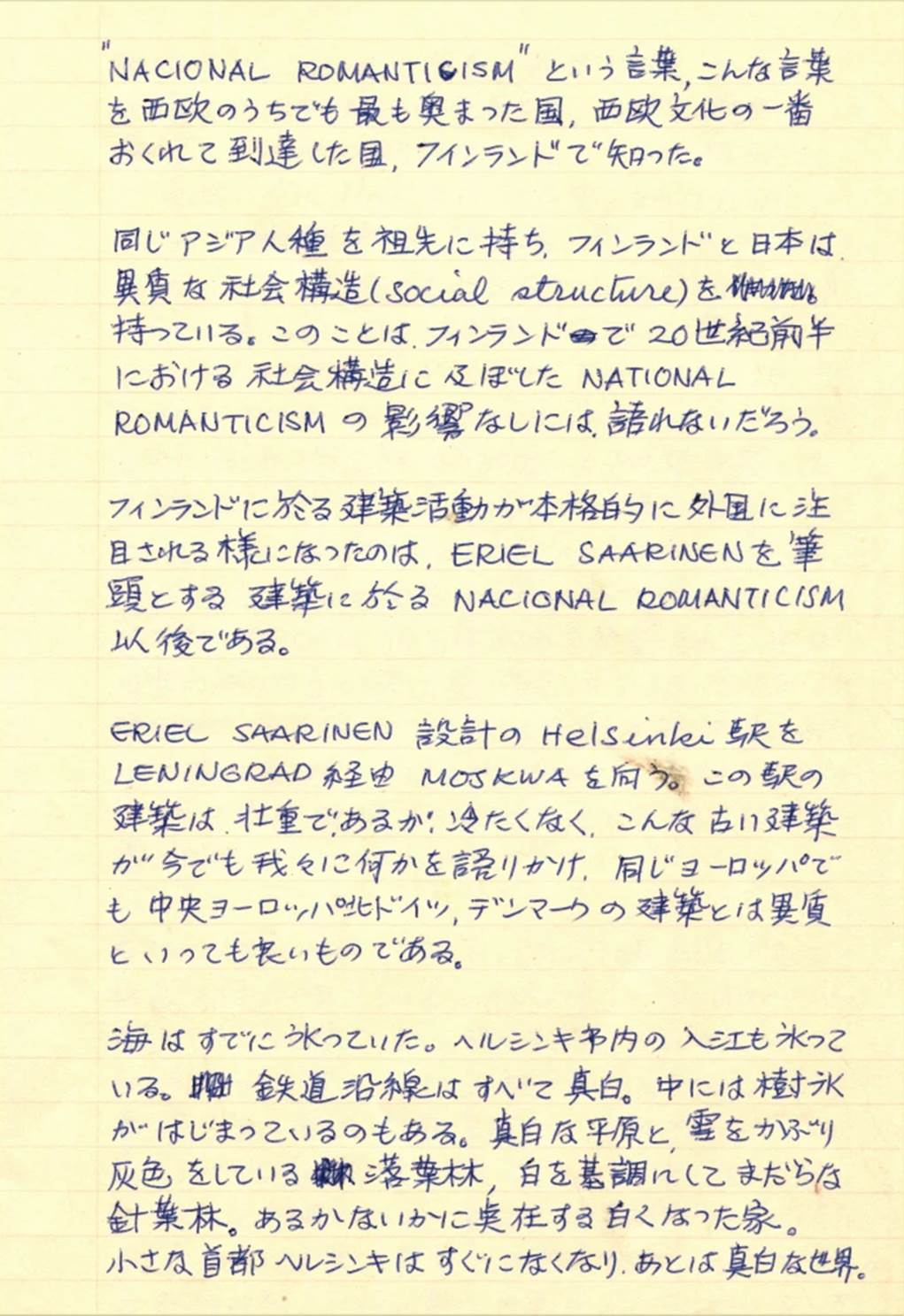
I depart from Helsinki Station, designed by the famous Finnish architect ERIEL SAARINEN in the early 20th century, and head to Moscow via Leningrad (now Petrovsburg). Helsinki Station, designed with Finnish nationalism at the forefront, known as National Romanticism architecture, is stately but not cold, and it can be said that what it speaks to its users is clearly different from that of Germany and other Scandinavian countries.
Looking out of the train window, I saw that the city’s seaside cove was already frozen. From the window of the train heading to the USSR, snow-white plains, snow-capped grey deciduous forests, snow-covered sparse coniferous forests. Looking at the snow-white houses scattered around, the small capital of Helsinki soon disappeared and became a pure white world.
Trouble at the border
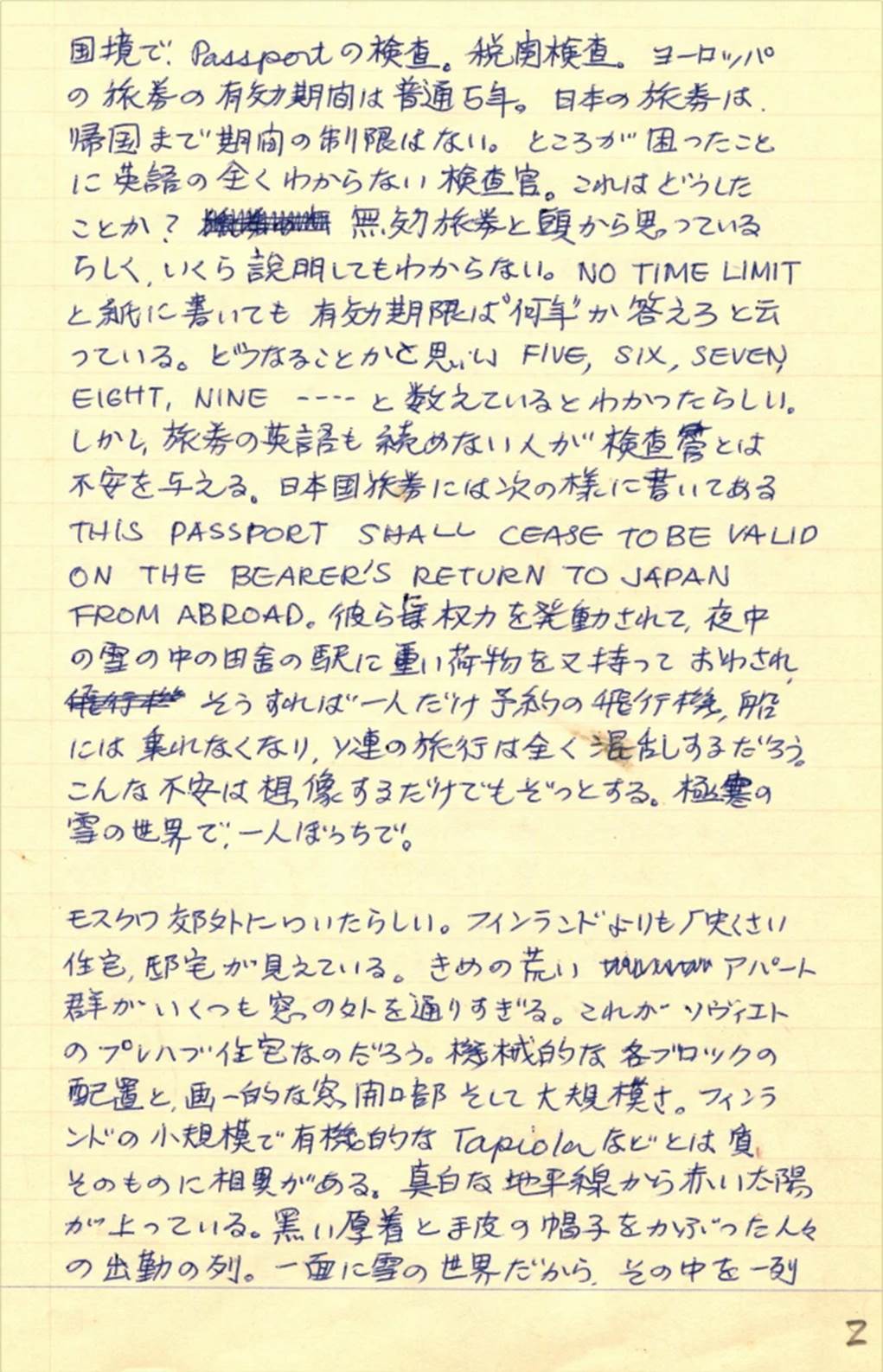
Shortly after nightfall, the train approached the Finnish-Soviet border, and passports were checked.
This is where an unexpected problem occurred.
The immigration officer looked at my passport for a while, then took it away and put it in the pocket of his uniform.
I tried to ask him in English to return my passport, but he didn’t answer.
After a while of back-and-forth, I found out that he couldn’t speak English, let alone read.
In the same sleeper express compartment was a Japanese university professor. He had been staying in Paris, and when he spoke to the immigration officer in French, he seemed to understand French.
At that time, international passports were usually valid for five years.
My passport was issued in 1962, and had no expiration date until my return to Japan, meaning it was valid indefinitely.
After he explained this to the officer in French, he left his post and disappeared into another carriage with my passport.
For a moment, I tried to imagine the worst-case scenario, such as being imprisoned in Siberia for possessing an illegal passport due to a misunderstanding, but after a while, the immigration officer returned and returned my passport with a stamp of immigration approval.
He probably went to consult with a superior officer who could speak English.
Thus, the worst was averted.
This case made me realize how suspicious foreigners are in this country.
At that time, around 1968, the main route connecting Japan and Europe was via Siberia.
Among the passengers were Japanese from all walks of life, including students, office workers, and university professors who were the aforementioned researchers.
Scenery from a train window outside Moscow
The red sun is rising from the pure white horizon. The train seems to be running around the outskirts of Moscow.
Coarse-grained apartment buildings and houses pass by outside the train window. The mechanical layout of the residential blocks, the uniform openings such as windows, and the large scale of the buildings surpassed the human scale.
They placed more importance on hard (quantity) than soft (quality).
I felt like I was seeing Soviet housing policy here.
From the train window, I could see a line of commuters in thick black clothes and fur hats. They looked ridiculous walking in a line in a world covered in snow.
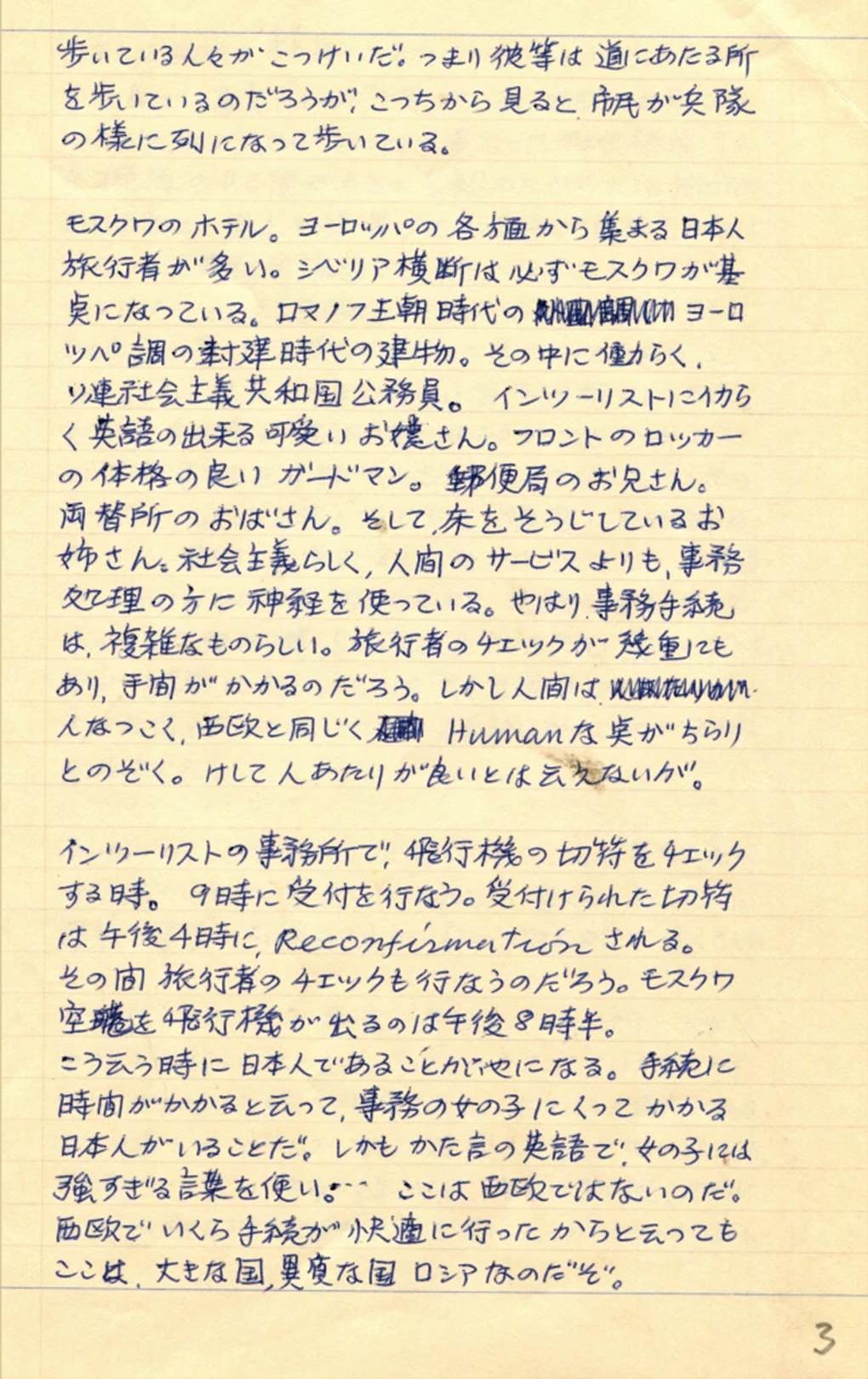
They were probably walking on the road, but from here, the line of citizens looked like soldiers. It was a scene from a totalitarian state.
Check-in to hotel in Moscow
A European-style building from the Romanov dynasty.
The hotel staff working in this state-owned building are all government servants of the Soviet Communist Party.
There’s the pretty young lady who speaks English and works for Intourist (a state-owned travel agency);
the well-built security man at the front desk and in charge of the lockers; the young man at the post office; the lady at the currency exchange; and the young lady who cleans the floors.
They all pay more attention to paperwork than to providing service to people.
There are many layers of checks for foreign travellers, so the paperwork seems complicated and time-consuming and difficult.
However, humans are friendly, and there are glimpses of a human feeling similar to that of Western Europe. Although I wouldn’t say the people are particularly friendly.
This happened at the airline ticket office
At the Intourist (state-owned travel agency) office, re-check for Aeroflot tickets already purchased in Helsinki was conducted from 9:00 a.m., and reconfirmation was conducted again at 4:00 p.m. This means that the police were conducting a third check from 9:00 a.m. to 4:00 p.m.
In the midst of this process, some Japanese people get angry at the office lady, saying that it’s taking too long. They are harsh to the young woman in broken English.
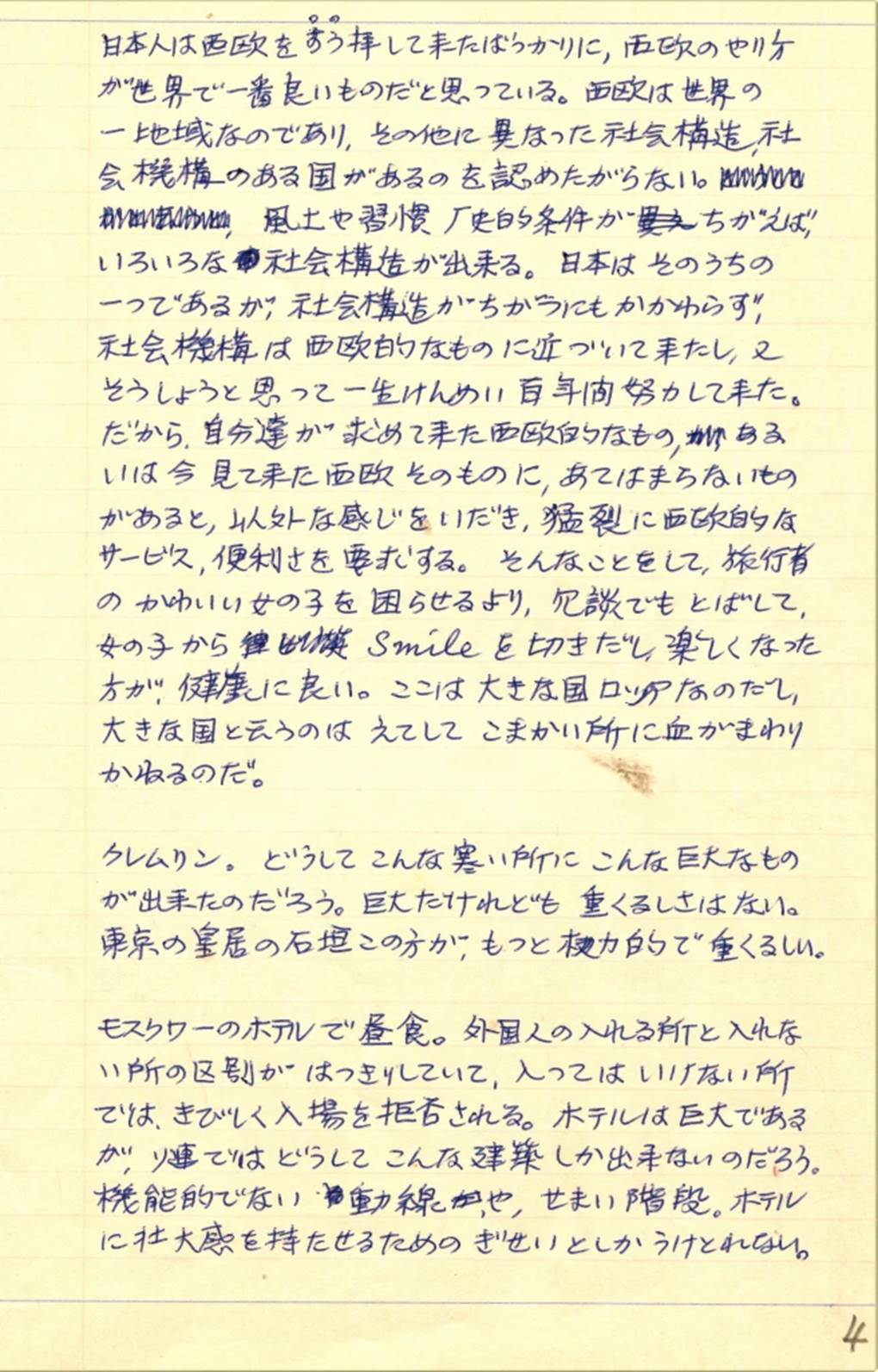
Here is no longer Western Europe, but a communist totalitarian state. Japanese have always worshipped the West, so they tend to think that the Western way is the best in the world. Western Europe is just a part of the world, and it is not the same as other regions with different climates, cultures and societies.
Japan is also a region of the world with a different climate, culture, and history from Western Europe, but since the Meiji era, it has worked hard to become closer to Western Europe.
Therefore, when there is something that does not fit into the Western way that they have been looking for, they feel surprised and fiercely demand Western conveniences and services. Rather than doing such things and causing trouble for the girl at the travel agency, it would more fun and healthy to make her smile by cracking a joke
Kremlin and Red Square
Passport are managed and kept at the hotel, so you can’t go too far.
If you are unfortunate enough to be stopped by a police officer on the street, you will be at a great disadvantage because you will not have your passport to prove your identity. It is a system designed to prevent foreign tourists from entering areas and places that the country does not want to show. In any case, it can be said that it is a country without freedom.
The Kremlin and Red Square were nearby, so I went there on foot.
The red walls and watchtowers surrounding the Kremlin Palace exceeded the scale of the building and were civil engineering structures that could be called fortresses.
It can be said that the heart of the country was a historical product of defense-first fortresses that protected it from attacks by hostile forces such as the people and local tribes.
Best hotels in Moscow
I decided to go to a hotel that is said to be the best in Moscow and have lunch. There was a clear distinction between places where foreigners could enter and places where they were not allowed to enter.
Places where you can’t enter are strictly denied entry.
I ordered a steak at a restaurant that allowed foreign currency.
The steak repelled the knife so much that it was like a rubber sandal, and I had a hard time chewing it.
The exterior of the hotel is huge and intimidating. I wonder why such architecture was the only thing that could be produced in the Soviet Union.
The functional traffic flow inside and the narrow staircases are the result of sacrifices made to give the hotel a sense of grandeur.
The time difference is 7 hours
The time difference from Moscow to Khabarovsk is as much as 7 hours.
The peculiarity of this flight was that the ground outside the window was snowy, and the line was all white.
The scenery on the ground of Siberia does not change, only the time difference changes from moment to moment, and it is a strange experience.
Today’s Russian planes are only Airbus and Boeing, but at that time, the aircraft of Soviet state-owned Aeroflot Airlines that I rode was made by Tupolev and Ilyushin.
When we reached cruising altitude, perhaps the cabin pressure was insufficient? Water vapor entered the cabin through the gaps in the window frame, was heated by the air inside the cabin, and turned into water droplets that accumulated on the window sill, which was a terrifying experience.
This flight is not an international flight, so it stops at major cities along the way. From these regional cities, porter ladies like those seen in Japan just after the end of the war board the plane, carrying vegetables and other items.
Because the luggage they carry is so large, the cabin becomes chaotic for a while. The Soviet Union is a large country with a poor distribution infrastructure, so I thought that these individual porter logistics existed.
Arrival at Khabarovsk: tension at the border
The plane trip ends in Khabarovsk, and from here I took a train to Vladivostok on the Sea of Japan. The flight from Moscow I used was a domestic flight, so I entered the arrival lobby easily without passport inspection.
An astonishing sight awaited me.
The arrival lobby had iron bars dividing the vast lobby in two.
Behind the bars were Soviet soldiers crowded together in combat fatigues and carrying guns.
It was my first time to see such a large number of military personnel on a war footing indoors, especially in an airport lobby.
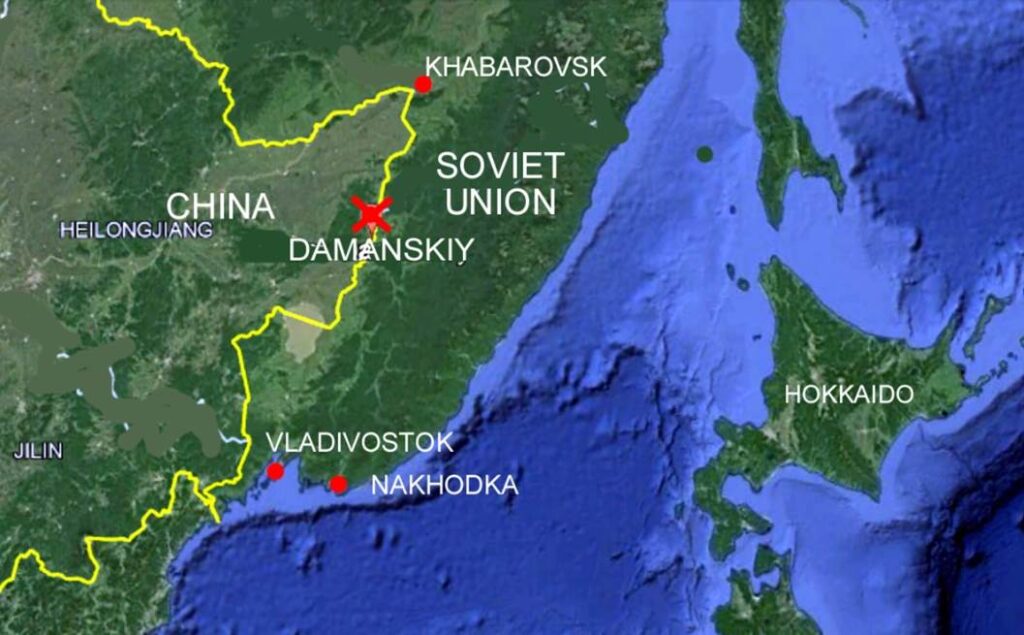
Sino-Soviet Border Dispute (Zhenbao Island Incident) Damansky Island
Later, I found out that in March 1969, a major military clash broke out over the border on Damansky Island in the Heilongjiang (Ussuri River).
When I visited the area, it was on the brink of war.!
670,000 Soviet troops and 710,000 Chinese troops were in the middle of a confrontation over Damansky Island.
Accommodation in Khabarovsk
The train from Khabarovsk to Vladivostok was scheduled to depart the next day, so we were assigned to a simple lodging facility on the airport grounds.
It was a one-story barracks-like building, and the room was furnished poorly with a simple bed on a bare cement floor.
We had plenty of time to visit Khabarovsk city, but when we got out onto the road, all we could see in the snowy fields were a colonnade of telegraph poles, and it was so desolate that we gave up on the idea.
At night, it was so cold that we got into the sleeping bags we had prepared to keep warm.
Khabarovsk→ Vladivostok→ Nakhodka
There was night train schedule between Khabarovsk and Vladivostok.
In general, you can estimate the level of the people of a country by looking at the houses and buildings of the people of the countryside.
The consistent policy of not exposing the scenery of the Siberian region of the Soviet Union to the eyes of foreign tourists was evident in the reason for setting up the itinerary of this night train.
Arrived in Vladivostok.
I was not allowed to walk around the city, and I was immediately put on a bus to Nakhodka, which was waiting for me.
Vladivostok is supposed to be a big city in the Far East, but they don’t want to show it to foreigners. It is supposed to be a splendid ice-free port, but it has a strong military presence and they are probably wary of foreigners.
Arrive in Nakhodka, where the ferry to Japan departs.
This is where departure and customs inspections take place. The procedure is complicated, inefficient, and slow. They treat people badly. A group of Japanese lost patience and began to make noise. There, I hear the word “Rosuke” being used frequently, which is an obsolete word. Originally, “Rosuke” is a word derived from the root word “Russkij” which means Russian, but in Japanese it is used as a insulting terms for Russians. Everyone was probably tired from the long journey.
Thus, we became passengers on the ship. After two days and one night on the ship, we arrived in Yokohama. On board was a group of young Japanese women who had returned from Europe.
Soviet orchestra at sea
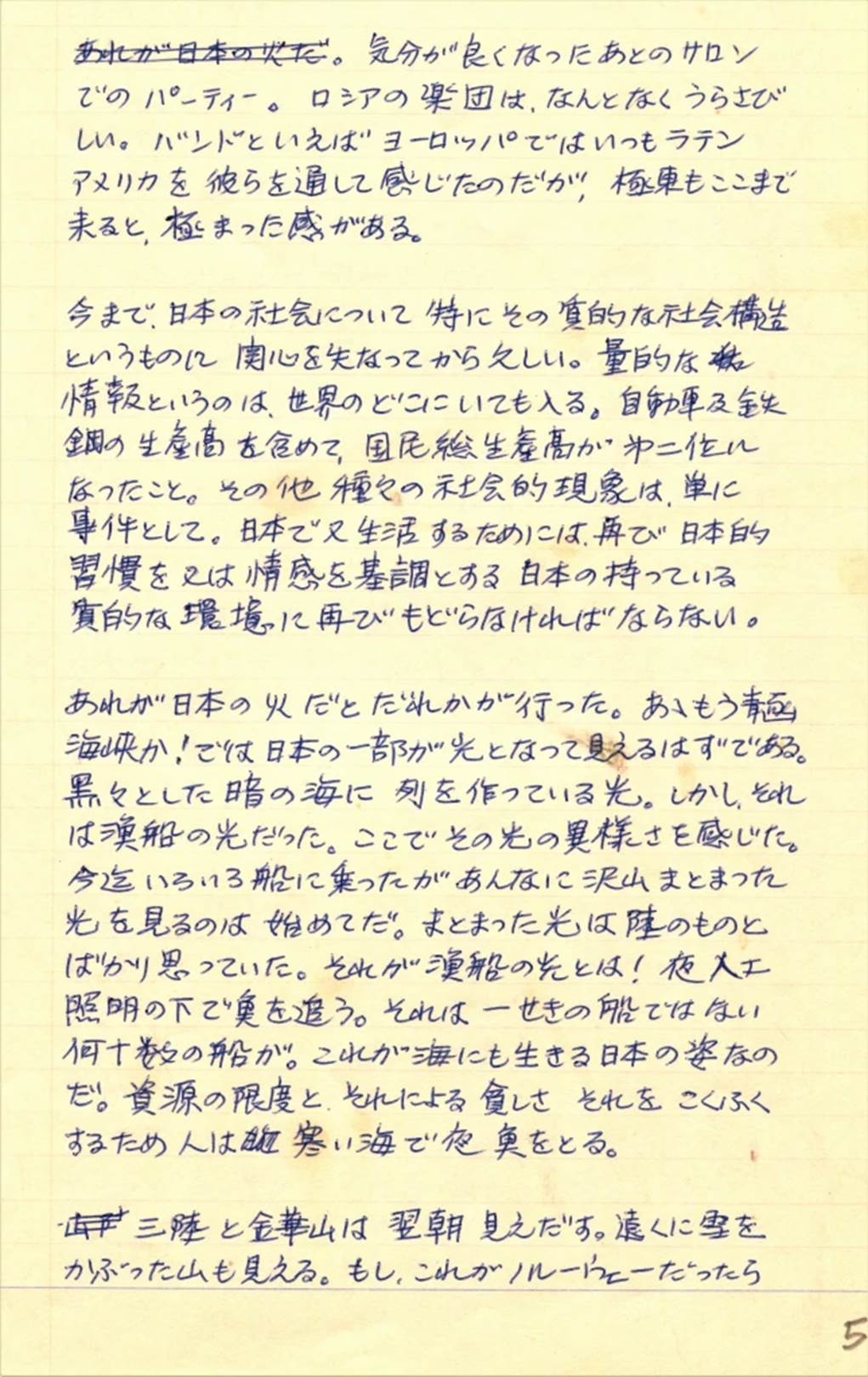
The ship departed from Nakhodka and headed out into the Sea of Japan.
A short time later, a party was held in the ship’s salon.
A Russian band was providing musical accompaniment, but the band’s atmosphere was somehow lonely and down-at-heel.
Is this the end of the Eurasian continent?
The lights of Japan came into view
When I went up on deck, someone said, “That’s the light of Japan.
” Oh, it’s already the Seikan Strait!
Then we can see some of the light on the land.
I could see the light lining up in the dark darkness. It was the light of a series of fishing fleets (probably squid fishing).
It was a strange light that I had never seen before.
I’ve been on many ships around the world, but this was the first time I’d seen so many groups of light. I had always thought that the light was from the land. That’s what a fishing boat does! Chase squid in the middle of the night under artificial lighting. That too a fleet of dozens of ships. This was the image of Japan living on the sea.
When I went out onto the deck in the morning, land that looked like the Sanriku coast came into view.
It had been six years since I last saw Japanese land. I could see snow-capped mountains in the distance. Both the Sanriku coast and the Norwegian coast are ria coasts, with similar topography.
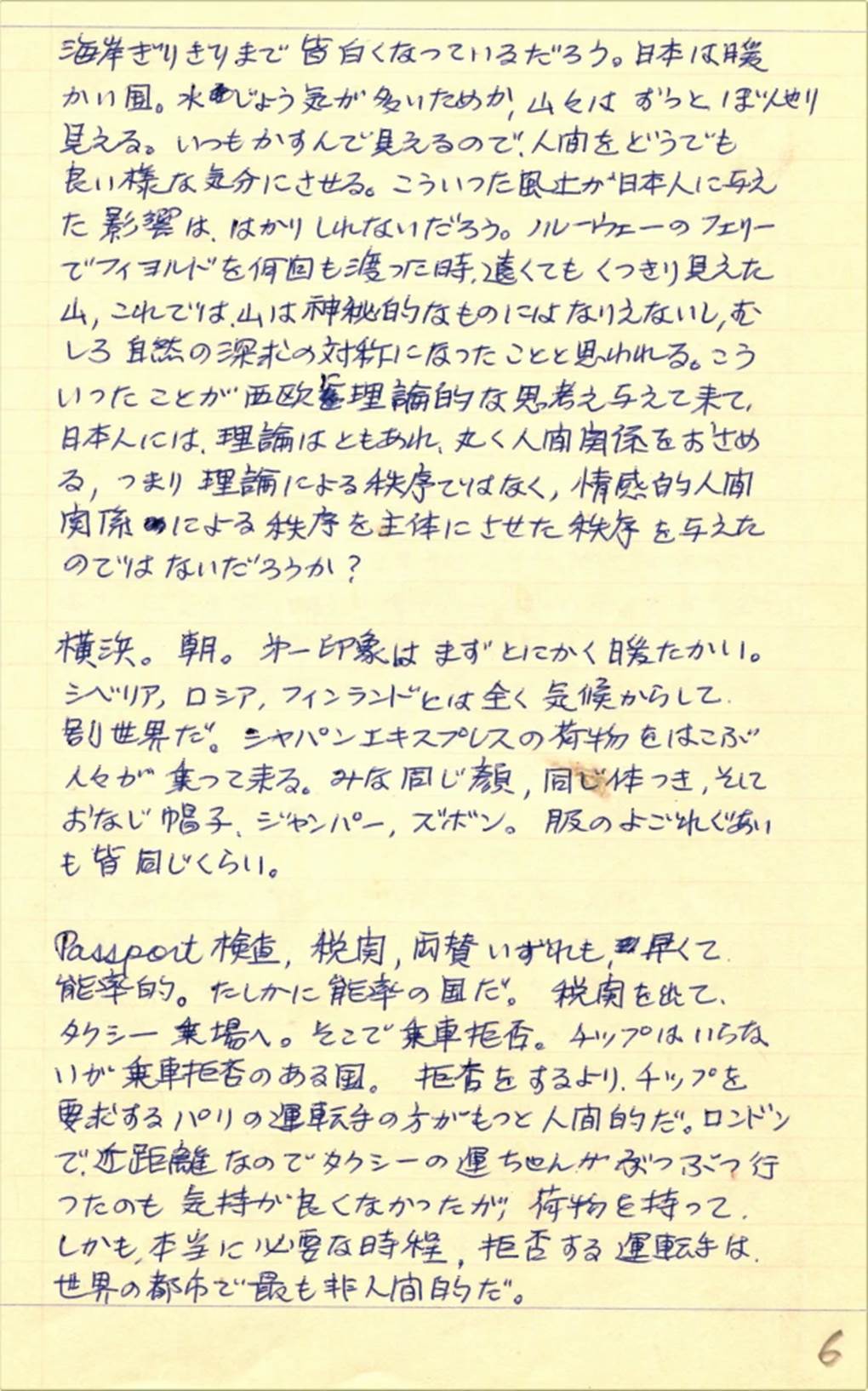
If this were Norway, the coast would probably be covered in white.
I crossed the Norwegian fjords many times by ferry.
The mountains that rose to the sea were clearly visible.
In comparison, the Sanriku mountains looked hazy and blurry due to the warm sea and high water vapor.
Due to the symmetrical climatic conditions, the Norwegian mountains could not be mystical objects, but rather objects of nature exploration and the development of logical thinking.
In comparison, Japan prefer an order that emphasizes emotional human relationships, regardless of logical order.
While looking at the hazy mountains of Sanriku, I thought about the influence of nature on humans.
Arrival in Yokohama
Six years and four months ago, I left this port and came back to this same port.
It’s morning and it’s warm. Until the day before, I had been through the climates of Finland, Russia, and Siberia, so it was a completely different world from the climate in Japan.
The people carrying the luggage of the Japan Express board the ship.
They all have the same faces, the same bodies, the same uniforms, jumpers, and pants. The degree of dirt on the clothes was about the same.
Over the past six years, I have travelled to countries of other ethnic groups, and I have reaffirmed my belief in “Japan as a single ethnic group.”
Passport inspection, customs, and currency exchange are all quick and efficient compared to other countries.
The passport inspector saw my departure stamp and said, “Thank you for your hard work,” before stamping my entry stamp. It must be extremely rare to be told “thank you for your hard work” by a national government official.
Refusal by a taxi driver
I left the wharf and went to the taxi stand. I was refused a ride there.
Japan is a country where tipping is not allowed, but refusal is allowed.
A driver in Paris doesn’t refuse a ride, but he asks for a tip.
This is more humane. A taxi driver I took for a short distance in London was grumbling to himself, but he didn’t refuse a ride.
A driver who refuses a ride when he sees a situation where someone who really needs a ride with heavy luggage is a rare case even in cities around the world.
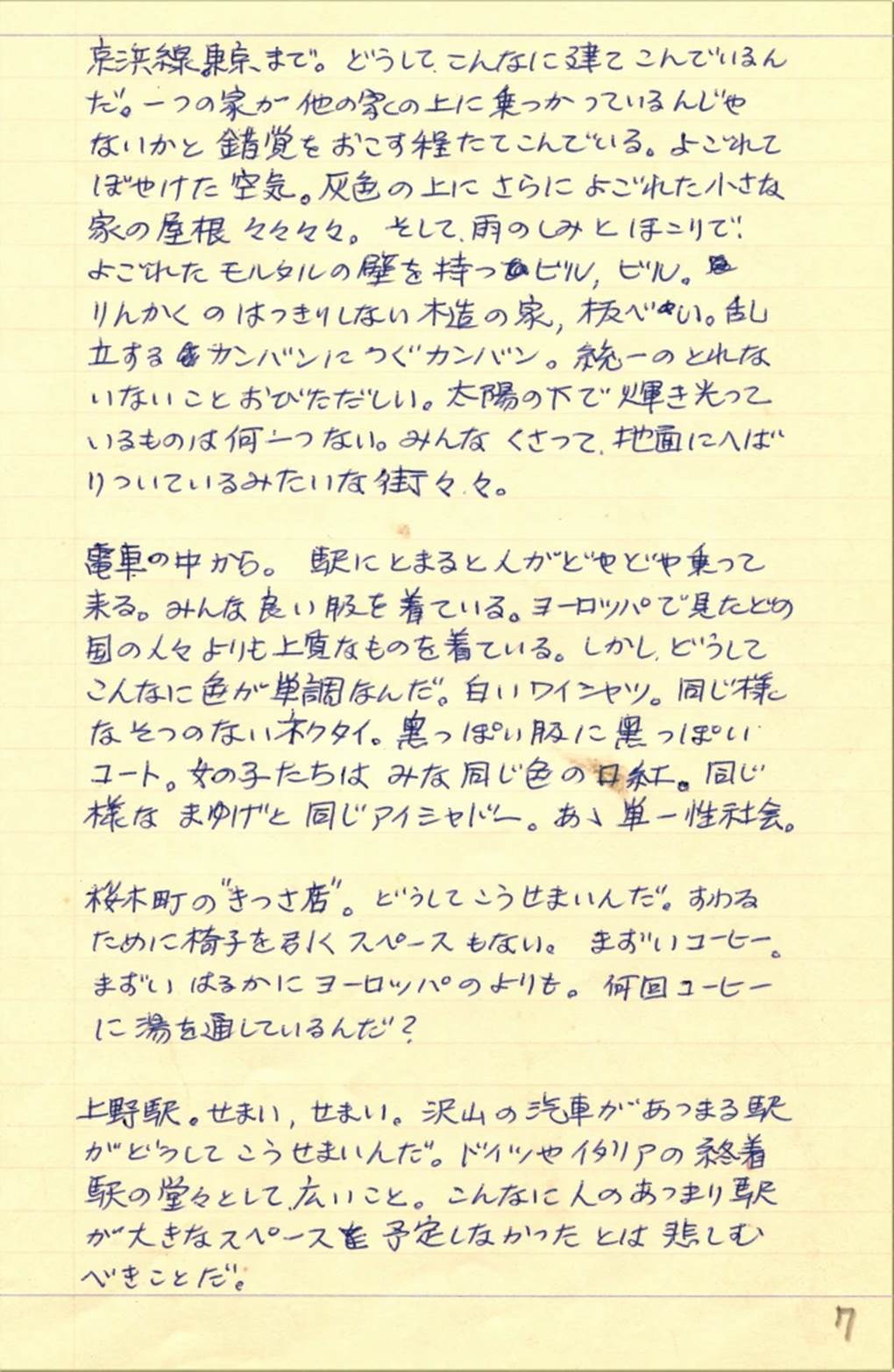
Coffee shop in Yokohama Sakuragicho
Why is it so narrow? Narrow. Narrow. There is no space to pull a chair to sit on. Bad coffee, bad taste. Tasteless. I wonder how many times they pours hot water into their coffee.
From the train window from Yokohama to Tokyo
Why is it so built up? It is so crowded to the point that it creates the illusion that one house is on top of another. Blurry outside air that looks dirty. Plus dirty roofs, roofs and roofs. And buildings, buildings after buildings with mortar walls stained with dust and rain. Wooden houses with unclear outlines and board walls. Billboard after billboard jumbled together. There is an enormous lack of uniformity. Not a single structure sparkles in the sun. Everything is rotten and stuck to the ground.
From inside the train
When I stopped at the station, people got on the train in droves.
Everyone is dressed in good clothes.
It’s a better outfit than I’ve seen in any European city.
But why are the colors so monotonous? Dark clothes and dark coats. A white shirt and a loose tie. Young woman lipstick of the same color, similar eyeshadow, eyebrows. Ah, a homogeneous ethnic group!!
Ueno Station
Narrow. Narrow. Narrow. Why is the terminal station, where so many trains gather, so small? Not to mention Paris, but also the wide and imposing comb-shaped terminus of Germany and Italy.
It’s sad that they couldn’t plan for enough space for such a major station where so many people gather.
This marks the end of my 4 months Europe trip and end of my 6 years 4 months stay from Japan.
Below are the original hand-written record of this trip (#9/9)